Winter offers a wonderful opportunity to spark children’s curiosity—especially when seasonal science is combined with the excitement of superheroes. Through imaginative challenges and hands-on investigations, children can test how ice melts, explore what makes objects slide or stick, build superhero hideouts, experiment with “freeze powers,” and move like their favorite heroes. These playful experiences connect #winter science, physical activity, storytelling, and dramatic play while strengthening observation, problem-solving, vocabulary, prediction, and early investigation skills. This article gives child care providers practical, low-preparation strategies for creating safe, inclusive, and curriculum-aligned activities that keep learning joyful and manageable in the #preschool classroom.
To strengthen the science-learning component of these activities, explore ChildCareEd’s self-paced online course Building Early Science Foundations  Buy Now $16.00, which helps educators foster curiosity and cognitive development through early scientific exploration. Providers can also take Role of Play in Learning Buy Now $16.00 to better understand how imaginative play supports children’s development and learning. Together, these trainings can help educators turn superhero-themed winter activities into meaningful opportunities for scientific inquiry, movement, creativity, and collaborative play.
Why it matters:
1) Winter themes naturally surface observable phenomena (freezing, melting, insulation) that make abstract concepts concrete.
2) Superhero narratives motivate participation and support social-emotional goals like body awareness, consent, and safety during active play — see practical lesson framing in ChildCareEd's superhero safety & body awareness. Embedding #science in familiar play increases retention and turns short indoor days into meaningful learning.
How do superhero themes help children engage with winter science?
1. They provide meaning-making metaphors: children compare their "superpowers" (warmth, insulation, breath) to real-world features like animal fur or blubber.
- 🦸♀️ Motivation: Superheroes invite role-play, which raises willingness to experiment (e.g., "Can my super suit keep me warm?"). Link to superhero lesson framing at ChildCareEd.
- 🧪 Context for inquiry: Use superhero problems ("How can Super Sam melt the frozen key?") to drive scientific questions and predictions — a technique highlighted in seasonal science planning like Winter Wonders.
- 🔤 Language & sequencing: Superhero storylines support vocabulary (melt, freeze, insulate, observe) and the habit of making and testing simple hypotheses.
Why this matters for providers: framing experiments as missions keeps routines smooth, reduces resistance, and helps children transfer observation skills across activities. Pair quick superhero intros with targeted questions, and you support both #sensory and cognitive learning in one short session.
What low-prep superhero winter science activities can you run tomorrow?
Below are five classroom-ready missions that use common materials. Each includes learning goals and a quick extension. For more winter activity ideas and printable resources, see ChildCareEd's winter classroom collection at Frosty Fun in the Classroom. You can adapt the same mission-card approach and inquiry routines to other seasonal themes; for spooky, curriculum-aligned experiments and Halloween-ready lesson plans, see Science exploration during Halloween.
- 🧊 Superhero Rescue: Frozen Toy Rescue
- Goal: Observe melting & test tools that speed melting.
- How: Freeze small figurines in water-filled containers. Give children droppers, warm water, salt, and spoons to rescue them.
- Extension: Chart which tool worked fastest; relate to real-world thawing.
- 🧤 Captain Coat: Insulation Challenge
- Goal: Compare which materials keep a container warm the longest (insulation).
- How: Wrap identical bottles in fabric, foil, or bubble wrap. Put a warm water bottle inside and measure the temperature over time.
- Extension: Connect to animal blubber demo; see blubber science ideas in winter science lists such as LivingLifeAndLearning.
- ❄️ Wonder Woman’s Snowstorm in a Jar
- Goal: Model precipitation and suspension.
- How: Use water, shaving cream, and colored water drops. Observe when "cloud" becomes saturated and rain falls.
- Extension: Relate to local weather charts (see outdoor learning guidance in ChildCareEd).
- 🧪 Iron Man’s Magic Milk (Surface Tension Mission)
- Goal: Observe chemical interaction and color movement.
- How: Add drops of food coloring to milk and touch with liquid soap on a cotton swab — colors explode outward.
- Extension: Ask children to predict what happens if they use oil instead of soap (see classic classroom demos in Science in Classroom).
- 🌨️ Flash Freeze Bubbles (Outdoor Mission)
Tip: Most of these are easily adapted indoors. If you lack snow, use shaved ice or frozen water trays. For many more step-by-step winter science activities, browse curated lists like Little Bins for Little Hands and Living Life & Learning.
How do you adapt superhero science for mixed ages and children with diverse needs?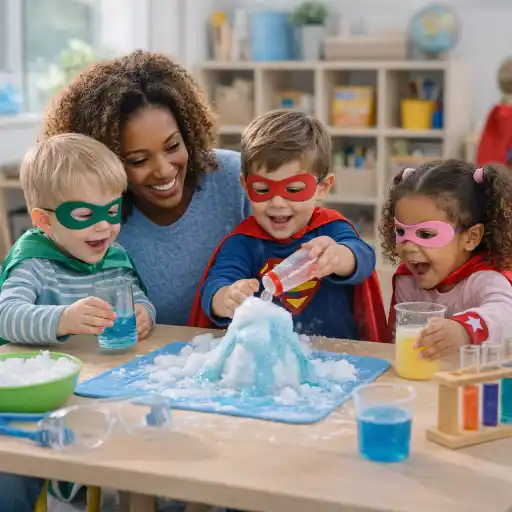
Inclusive design keeps activities accessible and meaningful. Follow these numbered strategies to scaffold, adapt, and differentiate without extra prep stress.
- 🧩 Offer three engagement levels per activity:
- Level 1 (Exploration): Sensory play and observation — e.g., touching ice, noticing temperature differences.
- Level 2 (Guided): Simple measurement or sorting — e.g., timing melts, graphing results.
- Level 3 (Extension): Predict-test-reflect cycle — design a new insulation wrap and compare.
- 🔎 Use visual supports and mission cards: Picture steps, simple icons, and a short safety reminder make procedures predictable for all learners.
- ♿ Adapt materials: Larger scoops, easy-grip droppers, pre-cut visuals, and tongs reduce fine motor barriers (see fine motor supports in ChildCareEd fine motor guide).
- 🤝 Peer pairing: Pair a child who enjoys exploratory talk with one who likes hands-on manipulation to build social and communication skills.
- 🗣️ Language supports: Pre-teach key words (melt, freeze, insulate, observe) and use them during reflection — tie vocabulary to storybook intros or superhero character traits in your circle time (see literacy cross-links in Frosty Fun).
State guidance: state requirements vary - check your state licensing agency for ratio and material-safety regulations before offering small-piece activities.
What practical setup, scheduling, and safety steps keep superhero science smooth?
Plan so experiments feel like simple missions, not big productions. Use this 1–6 checklist to prepare quickly and keep transitions calm.
- 🧰 Prep kit: Put materials for one mission in a clear tub with a laminated mission card and 3-step photos.
- ⏱️ Time-box: 12–20 minute rotations work well for preschool attention spans — start with a quick 2–3 minute story intro (superhero mission call) and end with a 2-minute reflection.
- 🧯 Safety check: Remove choking hazards for children under 3, supervise hot liquids, and use child-safe tools; consult licensing guidance as needed.
- 🔬 Student roles: Rotate short jobs (timer, recorder, tool-keeper) so children practice responsibility and language skills.
- ⚠️ Common mistakes & how to avoid them:
- Too many choices — keep one focused question per mission.
- Overly-complex materials — choose 3–5 items max per tub.
- No follow-up — always include a short reflection or display of findings.
- 📅 Integration: Embed missions into weekly themes — e.g., Monday: intro & vocabulary, Tuesday: hands-on mission, Wednesday: extension art or literacy connection (see weekly planning ideas in ChildCareEd).
How will you capture learning, extend investigations, and answer common staff questions?
Assessment can be informal and practical. Use simple enumerated tools so documentation is quick and meaningful.
- Observation checklist (3 items): Child predicts, child tests, child describes result. Mark "independent"/"with help".
- Photo evidence: Take 1–2 photos per mission and attach a one-sentence child quote to show reasoning.
- Portfolios: Keep mission cards in each child's folder to show growth across winter units.
- Extension ideas:
- Invite families to try a simple superhero mission at home and share photos.
- Co-create a superhero-winter-science book: each child contributes a drawing and a sentence.
FAQ (quick answers for busy staff)
- Q: How long should a mission last? A: 12–20 minutes with a 2–5 minute intro and wrap-up.
- Q: What if children want to repeat? A: Repeat — repetition builds observation and vocabulary.
- Q: Are messy activities appropriate inside? A: Yes, with simple containment (tray, towels) and clear cleanup roles.
- Q: Where can I find printable winter resources? A: Check ChildCareEd activity PDFs like the Winter Animal Sorting Buy Now $0.00 and minibooks for literacy ties.
Final encouragement: You don’t need snow, elaborate props, or long prep to make winter science memorable. Framing short experiments as superhero missions makes learning motivating, social, and repeatable. Use the mission-card method, prioritize safety, and let children lead simple hypotheses — you’ll see curiosity take off. For more winter lesson inspiration and printable PDFs, explore ChildCareEd’s seasonal science resources like Winter Wonders and the classroom activity library at Basic Science in Early Childhood.
- CDA Home Visitor Subject Area 3 Part 3 Birth to 5
- From Tantrums to Triumphs: Equipping Preschoolers with Self-Regulation Skills
- Tomorrow's Einsteins: Infant and Toddler Science
- Pediatric RSV First Aid & CPR/AED
- Emergent Learning & Development
- Creating Environments that Nurture Growth and Community
- Texas Director Credential
- Building Early Science Foundations
- Montessori Cultural Activities: Exploring the World Through Play and Learning
- Environments That Inspire Independence and Exploration
- 💛🧩 ¿Cómo puedo hacer que mi enseñanza sea inclusiva para los niños con autismo?
- Recursos en Español sobre el Sueño Seguro del Bebé
- ¿Cuáles son las mejores actividades del Día de la Tierra para niños en casa o en el aula?
- Actividades de Motricidad Gruesa que Desarrollan el Equilibrio, la Coordinación y la Fuerza
- 10 Ejemplos de Cómo la Cultura Influye en el Desarrollo Infantil
- Actividades de Fiesta para Niños de Preescolar y Primaria
- Proporciones de Cuidado Infantil y Tamaños de Grupo por Edad en Maryland (Guía Rápida para Centros y Hogares)
- Proporciones de Cuidado Infantil y Tamaños de Grupo por Edad en Nueva Jersey (Guía Rápida para Centros y Hogares)
- Proporciones de Cuidado Infantil y Tamaños de Grupo por Edad en Virginia (Guía Rápida para Centros y Hogares)
- Cómo Trabajar en el Cuidado Infantil en Carolina del Norte: Requisitos y Pasos
- Calabazas, hojas y manzanas: actividades de otoño para preescolares
- Celebrando la amistad en el cuidado infantil durante el Día de los Mejores Amigos
- Canciones, juegos y preguntas de círculo para niños
- Superhero Activities for Preschoolers: Play, Create, and Learn
- Superhero Examples for Kids: Learning About Helpers, Safety, and Kindness
- Cómo simplificar la capacitación para sus empleados de daycare
- How can superhero-themed play help build confidence in young children?
- What Do Superheroes Teach Kids About Kindness and Courage?
- Can Superhero Day Capes and Pretend Play Teach Children to Help Others?
- How can superhero-themed winter science activities energize your classroom?
