A thoughtfully designed sensory bin can turn scooping, searching, and sorting into meaningful conversation. Pairing sensory exploration with intentional language modeling helps children build vocabulary, communication confidence, and early literacy foundations; Language Development in Early Childhood  Buy Now $16.00 offers practical strategies that can strengthen classroom practice and contribute to professional training hours. For providers serving infants and toddlers, Playful Spaces for Infants & Toddlers Buy Now $24.00 provides additional guidance on selecting materials and creating engaging environments.
Why do sensory bins support early language development?
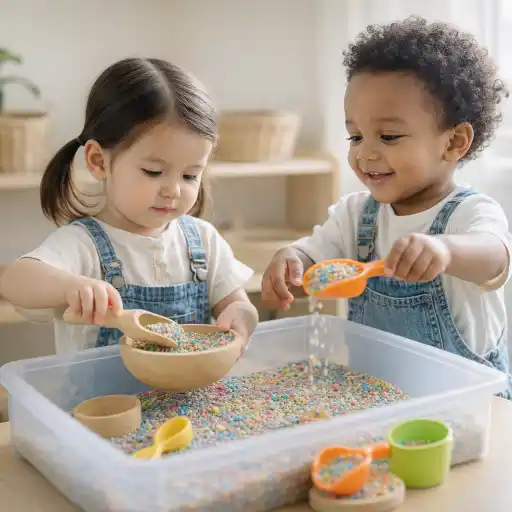
Sensory bins give children a concrete reason to communicate. When a child discovers a hidden animal, pours rice through a funnel, or presses kinetic sand into a mold, the experience creates natural opportunities to name objects, describe actions, request help, and share discoveries. The combination of movement, touch, sight, and adult interaction can make new words more memorable than words presented in isolation.
ChildCareEd’s sensory play in early childhood education resource emphasizes that open-ended sensory experiences invite experimentation and vocabulary growth. Providers do not need to turn play into a lesson with constant questioning. Instead, they can observe, narrate, pause, and respond to children’s interests.
- Use concrete experiences to introduce descriptive vocabulary.
- Model short phrases that children can imitate or adapt.
- Accept gestures, pointing, sounds, signs, home-language words, and speech as communication.
- Repeat favorite experiences so children encounter important words in meaningful contexts.
For children who are hesitant to touch, participation may begin with watching, using a tool, or pointing. Respecting these choices supports trust and keeps communication joyful rather than pressured.
How can providers plan a language-rich sensory bin?
Effective planning begins with one communication goal. A bin intended to build texture vocabulary will look different from one designed to encourage requesting or storytelling. Start with a shallow container, one base material, two or three tools, and a small collection of props. Too many materials can overwhelm children and make it harder for adults to notice meaningful communication.
Choose props that invite action and interaction. Cups and funnels encourage words such as in, out, full, and empty. Animals invite naming, sounds, movement words, and simple narratives. Picture cards can support children who benefit from visual communication, while familiar objects help toddlers connect language with everyday routines.
A practical planning template includes:
- Goal: Select one target, such as requesting, describing, or taking turns.
- Materials: Match the filler, props, and tools to that goal.
- Adult language: Prepare a few words and phrases to model naturally.
- Access: Offer tools, visuals, signs, AAC, or home-language support as appropriate.
- Observation: Record one example of communication and a possible next step.
Keep the setup flexible. ChildCareEd’s guide on creating a sensory bin for exploration recommends allowing children the #freedom to explore at their own pace while adults use open-ended prompts. The goal is purposeful invitation, not adult control.
Which sensory bin ideas build vocabulary and descriptive language?
Texture-based bins are especially useful for building descriptive language because children can connect words directly to what they feel. Offer large, safe fabric squares, smooth stones, pinecones, cotton balls, or washable textured objects. Model pairs such as soft and rough, smooth and bumpy, or light and heavy. Children may communicate through words, gestures, facial expressions, or comparisons.
Try these practical ideas:
- Nature discovery: Add large leaves, pinecones, and smooth stones. Invite children to notice what is “rough,” “crunchy,” “long,” or “small.”
- Color hunt: Use large pom-poms or colored pasta with bowls. Model color names and phrases such as “I found blue.”
- Ocean exploration: Add a safe filler, chunky sea animals, cups, and scoops. Use words such as “swim,” “hide,” “under,” and “deep.”
- Bakery pretend play: Use oats or another appropriate filler with measuring cups, cupcake liners, and large utensils. Model “mix,” “more,” “two,” and “serve.”
- Animal rescue: Hide large animal figures in shredded paper or pom-poms. Children can name, find, sort, and make animal sounds.
Describe rather than quiz. Instead of repeatedly asking, “What color is this?” try, “You found a yellow piece. It is bright.” Then pause. Wait time gives children an opportunity to respond without feeling tested.
Everyday household materials can be effective, as described in ChildCareEd’s resource on sensory bin themes with household items. Low-cost materials also make it easier to repeat experiences and extend learning over time.
How can sensory bins encourage interaction, requests, and storytelling?
Language grows through responsive relationships, not merely through exposure to vocabulary. Sit close enough to share the child’s focus, follow the child’s lead, and respond to their actions. If a child hands you a cup, you might say, “You want the cup. Here is the cup.” If a child points toward a hidden toy, acknowledge the message: “You found the truck!” These responses teach children that communication has power.
Sensory bins also create natural opportunities for turn-taking. One child can scoop while another holds the bowl; peers can take turns finding animals; an adult can alternate dropping feathers or pouring water. Use simple social phrases such as “my turn,” “your turn,” “help,” “more,” and “all done.” Children who do not yet speak can participate by reaching, pointing, signing, using pictures, or activating an AAC device.
To encourage storytelling, add a few related props rather than an entire scene. A farm bin might include animals, a fence, and a cup for feed. Model a simple sequence: “The cow is hungry. We give it food. Now the cow is happy.” Preschoolers can extend the story by deciding what happens next, explaining a problem, or retelling the experience to a peer.
- Pause with a desired tool and wait for a request or gesture.
- Expand children’s words by adding one or two meaningful words.
- Use action words such as dig, pour, hide, find, and build.
- Invite children to sequence actions: first, next, and finally.
- Celebrate communication attempts without demanding repetition.
These practices align with broader play-based language guidance: adults can model richer language while preserving children’s agency and imagination.
How should sensory bins be adapted for infants, toddlers, and diverse communicators?
Adaptation begins with development, communication style, and sensory preferences. Infants need simple experiences, brief sessions, and close supervision. Offer large, washable objects such as soft fabrics, damp and dry washcloths, or shatter-resistant mirrors. Narrate what the infant is noticing: “You touched the soft cloth,” or “The mirror shows your face.” Watch for cues and stop when the infant turns away, stiffens, cries, or appears overwhelmed.
Toddlers can explore larger scoops, cups, funnels, and props. Use short phrases, repetition, gestures, and generous wait time. Preschoolers may be ready for sorting, comparison, pretend scenarios, and longer narratives. The same bin can serve multiple ages when the adult adjusts the language and level of challenge.
Inclusive practice means children do not have to touch materials directly. Provide tongs, scoops, gloves, sealed sensory bags, or a viewing option. Reduce strong scents, visual clutter, and noise when needed. For dual language learners, include familiar objects, family-provided words, bilingual labels, songs, and books. Supporting the home language strengthens belonging and helps children connect new vocabulary to established concepts.
Children with communication differences may use gestures, signs, pictures, or AAC. Respond to all purposeful communication and collaborate with families and specialists when a child has an individualized plan. ChildCareEd’s Building Bridges for Dual Language Learners Buy Now $16.00 course can deepen providers’ understanding of culturally responsive language support, while Effective Approaches for Autism and Inclusion Buy Now $55.00 addresses communication, sensory differences, and adapted environments.
What safety and assessment practices make sensory bins successful?
Language-rich play must also be safe, hygienic, and manageable. Inspect materials before every use and choose items according to children’s ages and developmental abilities. Avoid choking hazards, sharp objects, unsecured batteries, toxic substances, cracked toys, and materials that cannot be cleaned. Children who mouth objects require especially careful material selection and active supervision.
Food-based fillers may be appropriate in some settings, but providers should review allergies, family communication, sanitation procedures, and program policy first. Water activities require close supervision, and water beads present serious risks if swallowed. State requirements vary - check your state licensing agency.
- 👀 Position yourself so every child remains visible and within appropriate reach.
- Use a tray or washable mat to contain spills.
- Wash hands before and after the activity.
- Clean tools and discard contaminated or difficult-to-sanitize materials.
- Store reusable fillers in sealed, labeled containers.
- Teach simple rules such as “tools stay in the bin” and “materials stay out of mouths.”
Assessment should be observational and brief. Record the context, the child’s communication, and a next step. For example: “During the ocean bin, Maya pointed to the fish, vocalized, and accepted the phrase ‘blue fish.’ Next, offer a choice between fish and shell.” Avoid turning the activity into a test or comparing children. ChildCareEd’s Assessment of Language and Literacy Skills Buy Now $24.00 course can help providers connect objective observations to meaningful learning goals.
Conclusion: How can sensory bins promote early language skills?
Sensory bins promote early language skills when they combine safe, interesting materials with responsive adult interaction. The strongest experiences are simple: one clear goal, a few purposeful props, descriptive modeling, wait time, and space for children to lead. A rice bin can become a vocabulary activity, a water tray can support turn-taking, and an animal rescue bin can inspire an entire story.
Remember the central principles:
- Connect words to real sensory experiences.
- Model language without overwhelming children with questions.
- Honor all forms of communication and participation.
- Adapt materials for age, ability, culture, and sensory preference.
- Observe progress and use documentation to plan the next step.
When providers approach sensory play with curiosity and respect, children gain more than new words. They practice attention, shared enjoyment, problem-solving, turn-taking, and the confidence to communicate their ideas. Start with one bin this week, listen closely to what children communicate, and let their discoveries guide the next conversation.
Five additional ChildCareEd courses to explore
- Building Vocabulary Buy Now $16.00 — strategies for intentional vocabulary growth.
- Classroom Tools for Emergent Literacy Buy Now $25.00 — practical materials and approaches for language-rich classrooms.
- Play Safe, Think Big: Literacy Through Play Buy Now $10.00 — connects supervision with early literacy through play.
- The Best Promotion is Play Buy Now $35.00 — examines how play supports communication and development.
- Supporting Families and Caregivers in Language and Literacy Buy Now $16.00 — strengthens partnerships that extend language learning beyond the classroom.
- Language Development in Early Childhood
- Language Development in School Age
- Reading Aloud and Storytelling
- Language and Literacy Foundations in Pre-K
- The ABCs of Behavior: Turning Challenges into Learning Opportunities
- Play with Purpose: Supporting Children with Autism
- Texas Director Credential
- Building Vocabulary
- Growing the Whole Child: Health, Emotions & Early Learning
- Supporting Families and Caregivers in Language and Literacy
- Terrible Two's Can Be Terribly Fun!
- Pumpkin Spice and Sensory Delight: Easy Autumn Sensory Bins for Early Learners
- CDA Certification en Español: Recursos y Consejos para Educadores Bilingües
- Cuáles Son las Señales de Alerta en el Desarrollo Infantil que Todo Educador Debe Conocer?
- Actividades de Otoño Fáciles para Preescolares esta Temporada
- Retraso del Habla en la Guardería: Cómo Pueden Ayudar los Proveedores
- How can I use beach and ocean-themed summer activities in my California early childhood classroom?
- What age-appropriate learning activities should we use for infants, toddlers & preschoolers in New York?
- Celebrando la amistad en el cuidado infantil durante el Día de los Mejores Amigos
- Canciones, juegos y preguntas de círculo para niños
- Cómo simplificar la capacitación para sus empleados de daycare
- How can childcare providers support fine motor development with simple activities?
- What are safe, engaging non-candy Halloween ideas for daycares?
- What sensory play ideas best support babies in child care?
- How can inexpensive sensory bins boost language, fine motor, social-emotional, and cognitive development?
- How can child care providers build early literacy skills through play?
- How Can I Use Everyday Materials for Meaningful STEM Exploration in My Preschool Classroom?
- Rosh Hashanah Sensory Bin Ideas: Apples, Honey, Shofars, and Sweet New Year Play
- How Can Child Care Providers Use Sensory Play to Support Young Children’s Development?
- How Can Sensory Bin Ideas Promote Early Language Skills?
