Low-cost sensory bins are one of the highest-return, lowest-cost strategies you can add to your classroom or program today. With everyday fillers, a few durable tools, and intentional prompts you can create short, repeatable learning moments that support #sensory #language #finemotor #socialemotional #cognitive development across age groups. Below are practical ideas, evidence-based explanations, safety steps, planning tips, common pitfalls, and a short FAQ designed for providers and directors who want usable, licensing-friendly approaches. For quick themes and how-to steps, see What easy sensory bin themes can I make with household items? and How to Create a Sensory Bin for Exploration.
1) What inexpensive sensory bin ideas can I set up today?
- 🍚 Beach Bin — Base: dry rice; Props: plastic shells, cups, scoops; Prompt: "Fill three cups and tell me which cup is full." See related themes at ChildCareEd: easy sensory bin themes.
- 🌱 Garden Bin — Base: potting soil (or brown rice indoors); Props: seed packets, tongs, toy worms; Prompt: "Plant two seeds and describe how they feel." (Idea inspired by Gardening Sensory Bins.)
- ❄️ Snow/Arctic Bin — Base: cotton balls or white rice; Props: small animals, measuring cups; Prompt: "Make a snowman with three pieces."
- 🍪 Bakery Bin — Base: flour or oats (taste-safe if allowed); Props: wooden spoons, cupcake liners, cookie cutters; Prompt: "Can you make two cookies?"
- 🔵 Color Hunt — Base: dyed pasta or colored beans; Props: bowls, tongs, color cards; Prompt: "Find something blue and sort it."
- 💧 Ocean Tray (water-safe) — Base: shallow water or dyed water beads; Props: plastic animals, strainers; Prompt: "Which animals float? Which sink?" See water play guidance at ChildCareEd: ocean sensory & safety. For themed activities and simple ocean crafts you can pair with an ocean tray, see our World Oceans Day craft ideas for young children.
- 🔬 Sink-or-Float Investigation — Base: water tub; Props: wooden blocks, plastic spoons, shells; Prompt: "Predict, test, and tell me why."
- ✨ Calm Bottle Station — Make sealed bottles with water, glitter, and oil for self-regulation; directions at Make Your Own Sensory Bottles Buy Now $0.00.
- 🥣 Taste-Safe Bin (for mouth explorers) — Base: dry cereal, cooked pasta, or oats; Props: scoops, cups; Prompt: "Tell me which feels crunchiest." (See therapy-friendly lists at Speech Room News.)
- 🧂 Cloud Dough — Base: flour + oil recipe; Props: scoops, cookie cutters; Prompt: "Make a shape and say its name."
- 🎨 Paint Tray (edible finger paint for young groups) — Base: yogurt + food coloring on wax paper; Props: brushes; Prompt: "Tell me how it feels — is it sticky or smooth?"
- 🛒 Dollar-Store Rotations — Assemble multiple small tubs using dollar-store finds (gems, scoops, pom-poms). See budget examples at Fab Everyday.
2) Why does sensory-bin play matter for young children?
Enumerated benefits:
- Neural scaffolding — repeated sensory exploration strengthens connections that support attention, memory, and executive function.
- Cross-domain growth — tactile play links to vocabulary growth, fine motor control, and early math concepts (counting, sorting).
- Self-regulation — rhythmic, repetitive actions (pouring, sifting) calm many children and create windows for language input.
Adult role: intentionally pair a 1–2 word target or an open prompt with each bin. For example, ask: "W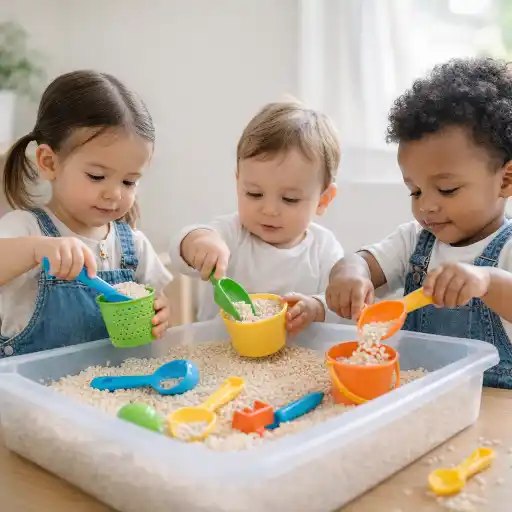 hat does it feel like?" or "Show me the small one." For background and classroom strategies, see Sensory Play in Early Childhood Education and the practical planning loop in How to Create a Sensory Bin for Exploration.
3) How do sensory bins promote language development?
Use this 3-step language routine every time:
- 🔊 Label — Name textures, tools, and actions: "soft, scoop, sink."
- ❓Prompt — Ask an open question: "What does it feel like? Tell me more."
- 🔁 Expand — Repeat the child’s words and add a model: Child: "Wet." Adult: "Yes — wet and cold."
Practical language targets (enumerated):
- Vocabulary: sensory adjectives (smooth, bumpy), action words (pour, sift).
- Spatial/math terms: more/less, big/small, full/empty.
- Narrative and social talk: explain a plan or describe a result ("We added three shells — look!").
Tip: If you’re tracking objectives, link one clear language goal to a bin (e.g., "use two new adjectives") and record a single observation per child. For therapy-informed filler lists and strategies, see Speech Room News.
4) How do sensory bins build fine motor, cognitive, and social-emotional skills?
These domains develop together during sensory play. Use targeted materials and prompts to emphasize the skill you want.
Fine motor (enumerated):
- 👐 Strength & precision — scooping, pinching, and using tongs strengthen hand muscles needed for writing. See practical activities in fine motor resources at OT Mom and Sensory-Processing-Disorder.
- ⚙️ Grading & bilateral coordination — pouring between containers and manipulating lids support coordinated two-hand tasks.
Cognitive learning (enumerated):
- 🔬 Scientific thinking — make predictions (sink/float), test, and record outcomes.
- 🔢 Early math — sorting by color/size, counting scoops, comparing quantities.
Social-emotional gains (enumerated):
- 🤝 Cooperative play — role-play at the water table (captain/scientist) promotes turn-taking and negotiation. Research shows teachers scaffold social engagement for children with additional needs (ECRP study).
- 🧘 Regulation — calm tubs or sealed sensory bottles can help children self-soothe and return to group activities.
Plan: choose 1 primary skill (e.g., pincer grasp) and 1 secondary outcome (e.g., new vocabulary) per bin to keep adult facilitation focused and document one observation per child.
5) How do I keep sensory bins safe, clean, and licensing-friendly?
Safety and sanitation are non-negotiable. Follow these practical, enumerated steps and link them to policy so staff practice matches expectations. Remember: state requirements vary - check your state licensing agency.
- ✅ Material choices
- Use taste-safe fillers for mouth-exploring groups (oats, cooked pasta). See therapy-safe lists at Speech Room News.
- Avoid small choking hazards for infants & young toddlers; use the toilet-paper-roll test and replace cracked toys.
- 🧼 Cleaning & turnover
- Wash hard tools daily with soap and water; sanitize according to center policy.
- Store reusable filler in sealed bags; discard edible fillers after single-group use when required by policy.
- 👀 Supervision & ratios
- Use active supervision—position staff to see and reach children quickly, especially during water play. See water-play guidance in ChildCareEd: ocean & water play.
- Train staff in Pediatric First Aid & CPR and create a clear quick-empty policy for tubs.
- ⚠️ Allergy & cultural considerations
- Check family permissions before using edible or scented fillers; keep substitution options for allergic children.
Common mistakes and how to avoid them (brief):
- ❌ Too many tiny parts — Fix: limit to one filler + two prop types; reserve complex sets for small-group tasks.
- ❌ No clear learning goal — Fix: pick one measurable objective (counting 1–5, use two adjectives) and guide staff prompts.
- ❌ Weak cleanup plan — Fix: label kits, provide a cleaning checklist, and schedule wash cycles.
FAQ
- How often should sensory bins be offered? Aim for short, frequent sessions (2–4 times per week) rather than one long messy day; rotate themes weekly to sustain interest.
- Can I use food in bins? Only with family permission and allergy checks; many centers avoid food fillers for group bins. See ChildCareEd safety guidance at Explain safety guidelines.
- What if a child has sensory aversion? Start with less-intense textures, model exploration, and offer a choice; observe cues and stop if the child shows stress signs.
- How do I document learning? Record one brief observation per child aligned to the bin goal: skill observed, evidence, and next step. Share a snapshot with families.
- Are sensory bottles useful? Yes—sealed sensory bottles are low-mess regulation tools. See ideas at Make Your Own Sensory Bottles Buy Now $0.00.
Conclusion
Inexpensive sensory bins are a practical, evidence-aligned way to promote language, #finemotor, #cognitive, and #socialemotional skills in early childhood programs. Use everyday fillers, set one clear learning target per activity, scaffold language with labels and expansions, and keep safety and cleaning standards written into routine. Start small: pick a single theme this week, add a simple prompt, and note one observation per child. For rapid staff training and deeper guidance, explore ChildCareEd's resources like How to Create a Sensory Bin and related trainings. State requirements vary - check your state licensing agency. With intentional planning, low cost materials become powerful learning engines that fit into daily routines and family conversations.
Why it matters: Sensory experiences activate multiple neural pathways at once—touch, vision, proprioception—and these multisensory inputs support early brain plasticity and learning. International reviews emphasize that early experiences and caregiver interactions shape foundational skills that predict later outcomes (OECD).Sensory bins are powerful language-rich contexts because they pair sensory input with adult modeling, gestures, and conversation. Research and professional resources show that when adults narrate, question, and expand children’s utterances during hands-on experiences, vocabulary and expressive language increase (see the neuroscience and language links at The Speech Practice).Short answer: use pantry staples, dollar-store tools, and a clear goal. Below are 12 ready-to-use, budget-friendly bins. Each item lists 1) base filler, 2) 2–3 props, and 3) one adult prompt to scaffold language and learning.- Growing the Whole Child: Health, Emotions & Early Learning
- Pediatric RSV First Aid & CPR/AED
- CDA Bridge Bundle: Family Child Care without Portfolio Review
- CDA Bridge Bundle: Infant/Toddler without Portfolio Review
- CDA Bridge Bundle: Preschool without Portfolio Review
- Effective Approaches for Autism and Inclusion
- Play with Purpose: Supporting Children with Autism
- Language Development in Early Childhood
- Texas Director Credential
- Terrible Two's Can Be Terribly Fun!
- Indoor and Outdoor Activities
- Developing Skills Through Fall Crafts in Childcare
- Exploring the Cognitive Benefits of Movement in Early Childhood Classrooms
- Pumpkin Spice and Sensory Delight: Easy Autumn Sensory Bins for Early Learners
- How to boost fine motor skills: Holiday Edition
- How motor skills shape child development and creative ways educators can foster them.
- Cuáles Son las Señales de Alerta en el Desarrollo Infantil que Todo Educador Debe Conocer?
- Actividades de Otoño Fáciles para Preescolares esta Temporada
- How can I use beach and ocean-themed summer activities in my California early childhood classroom?
- How Do Art Activities Support Cognitive Growth in North Dakota Preschoolers?
- How Do Art Activities Support Cognitive Growth in North Dakota Preschoolers?
- Canciones, juegos y preguntas de círculo para niños
- Superhero Examples for Kids: Learning About Helpers, Safety, and Kindness
- Easy Pool Noodle Sea Creatures for Ocean Theme Activities
- How can childcare providers support fine motor development with simple activities?
- How can ocean-themed sensory bins and water play boost learning while staying safe in preschool programs?
- Do Toys Come Alive: How Can Pretend Play Spark Creativity in Your Daycare?
- How can we explore sand, space, and science with young children in preschool settings?
- How can inexpensive sensory bins boost language, fine motor, social-emotional, and cognitive development?
