What if the bin behind your classroom could become the richest source of learning? Using everyday recyclables in intentional, open-ended ways gives teachers low-cost tools to boost children’s problem solving, fine motor skills, and expressive language while earning professional development that supports better classroom practice. For practical, classroom-ready strategies and a certificate you can use for staff PD, start with Beautiful Junk: Using Recycled Materials in the Classroom  Buy Now $16.00 and deepen your open-ended art approaches with Open Heart, Open Art Buy Now $16.00—both provide hands-on ideas you can implement tomorrow and help you grow program quality.
What benefits do recycled materials bring to young learners?
Recycled items are powerful because they are ambiguous: a cardboard tube can become a telescope, a drum, or part of a bridge. That ambiguity invites children to plan, test, and explain—core behaviors of creative thinking and early #STEM learning. Open-ended use of loose parts supports fine motor development, patterning and counting, symbolic play, and emotional expression through process art. Teachers also gain practical benefits: lower material costs, easy storage, and repeated opportunities for observation and assessment. For more ideas on turning found objects into creative projects, explore junk art. That’s why many early learning resources recommend integrating everyday items into invitations and centers (see How Can I Use Everyday Materials for Meaningful STEM Exploration).
Why it matters: building a culture of creative reuse leads to stronger problem-solving habits, more classroom talk about ideas, and equitable access to rich materials for all children. Use simple documentation (photo + child quote) to show learning, and you’ll quickly see how #recycled play becomes purposeful teaching.
How can I collect, prepare, and store recycled materials safely and efficiently?
Collection and preparation are the backbone of a sustainable upcycled-materials system. Start with a donation list for families (clean yogurt cups, sturdy cardboard, fabric scraps, bottle caps—avoid broken glass or oily containers). Pre-sort into labeled bins by size and hazard level so staff can set up an invitation in minutes. Sanitize non-porous items; launder fabrics and inspect for sharp edges. Always remove choking hazards for infants and toddlers.
- Storage tips: low, open shelving with picture labels supports independence and quick access.
- Prep routines: a weekly “sort & safety” time keeps bins classroom-ready.
- Legal/safety note: state requirements vary - check your state licensing agency for storage and material rules.
Link to a practical course that covers setup details and program design: Creating Environments that Nurture Growth and Community Buy Now $55.00.
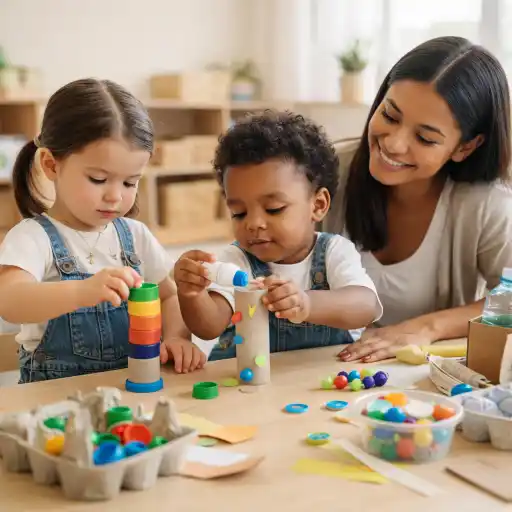
How do I design invitations and teacher moves that build #creativity and #STEM thinking?
Design invitations to be low-prep, open-ended, and limited (3–6 materials). Use a simple formula: short question prompt + curated materials on a tray + one documentation step. Examples:
- 🧰 Invitation: “Which of these will float?” (clear cup, bottle cap, sponge, small rock)
- Invitation: “Build something that can move a toy car.” (cardboard, dowels, bottle caps)
- Art invitation: paper, glue, collage bits, and frames for loose-parts displays.
Teacher moves that deepen learning: observe first, ask one open-ended question (“What do you notice?”), encourage one prediction or trial, then document with a photo and a short child quote. Resist over-directing; scaffolding is about extending vocabulary and ideas, not producing a uniform product. For concrete open-ended art methods and prompts, see Art from the Heart for Preschoolers Buy Now $35.00.
How can I adapt activities for diverse learners and involve families?
Adaptations make upcycled invitations accessible to all learners. For infants and toddlers, increase item size and focus on sensory tubs; for children with fine-motor needs, offer tweezers, larger beads, or two-handed tools. Use visual step sequences, photo models, and sentence frames for children who benefit from predictability. For Dual Language Learners, label bins in the home language and English, accept explanations in either language, and send home one-photo extensions that families can try. Research-backed family engagement is simple: ask families for safe donations, send a weekly photo plus one question to try at home, and explain the learning goals behind the activity.
Professional development supports inclusion and materials choices—consider Using Toys to Support Learning Buy Now $16.00 to align materials to developmental goals and to ensure play supports growth for diverse children.
What common mistakes should I avoid and what questions do providers ask most often?
Common mistakes are practical and fixable:
- ❌ Overfilling shelves — rotate to 1–2 invitations to avoid overwhelm.
- ❌ Over-directing projects — offer prompts, not templates.
- ❌ Avoiding messy investigations — plan trays, smocks, and quick cleanup routines.
- ❌ Poor documentation — use the photo + quote routine so learning is visible.
Quick FAQ:
- Q: How long should invitations last? A: 10–20 minutes for focused invitations; multi-day investigations for deeper science or construction work.
- Q: Are recycled materials hygienic? A: Non-porous items clean easily; launder or discard porous items when needed.
- Q: How do I show this counts as professional development? A: Pair in-class implementation with a targeted course (e.g., Beautiful Junk Buy Now $16.00) and use course certificates for staff PD logs.
- Q: Are these activities safe for licensing? A: Generally yes when you follow safety checks, but state requirements vary - check your state licensing agency.
Summary
Recycled materials are an equitable, high-value route to building children's #creativity, #art, and #STEM dispositions inside your #classroom. With a simple collection system, predictable prep routines, curated invitations, and purposeful adult moves, teachers can transform everyday items into consistent learning invitations. Avoid common pitfalls by limiting choices, resisting over-direction, and documenting with a photo and child quote. For practical implementation and PD credit, explore courses like Beautiful Junk Buy Now $16.00, Open Heart, Open Art Buy Now $16.00, Art from the Heart Buy Now $35.00, Using Toys to Support Learning Buy Now $16.00, and Creating Environments that Nurture Growth and Community Buy Now $55.00 to strengthen staff practice and sustain a culture of creative reuse. Start small this week: set one open-ended tray with 3–4 recycled items, ask one question, and document what children say and do—the rest will follow.
- Beautiful Junk: Using Recycled Materials in the Classroom
- CDA Home Visitor Subject Area 3 Part 3 Birth to 5
- CDA Home Visitor Subject Area 2 Part 3 Birth to 5
- CDA Bridge Bundle: Family Child Care without Portfolio Review
- Art from the Heart for Preschoolers: Open Ended Art Projects that Build Self-Esteem
- CDA Bridge Bundle: Infant/Toddler without Portfolio Review
- CDA Bridge Bundle: Preschool without Portfolio Review
- Emergent Learning & Development
- Creating Environments that Nurture Growth and Community
- "Junk" Art
- CDA Certification en Español: Recursos y Consejos para Educadores Bilingües
- 😤💬 ¿Qué Le Digo a un Niño que Acaba de Morder a Otro?
- 👶 ¿Cuáles son las proporciones y grupos requeridos en Dakota del Norte? 🏫
- Recursos en Español sobre el Sueño Seguro del Bebé
- 10 Ejemplos de Cómo la Cultura Influye en el Desarrollo Infantil
- Cómo Trabajar en el Cuidado Infantil en Carolina del Norte: Requisitos y Pasos
- Cómo Ser Maestra de Preescolar en Illinois
- Cómo Ser Maestra de Preescolar en Maryland
- Cómo Ser Maestra de Preescolar en Carolina del Norte
- Can recycled materials build real creativity in early childhood classrooms?
- STEM for Preschoolers: Fun Activities That Encourage Curiosity
- Made by Me! Labor Day Crafts for Preschoolers That Celebrate Hard Work
- Open-Ended Art Activities for Preschoolers: 15 “What Can You Make?” Invitations
- How Can Recycled Materials Create Engaging Learning Centers?
- How Can Child Care Providers Create Low-Cost STEM Activities With Items They Already Have?
- How Can Loose Parts Play Turn Everyday Objects Into Powerful Learning Opportunities?
- How Can Teachers Build Learning Centers on a Tight Budget?
- How Can Open-Ended Summer Art Encourage Planning and Creativity?
