Can a thoughtfully designed learning center really begin with a cardboard box, a few containers, and a clear plan? Absolutely. With intentional selection, safe preparation, and purposeful organization, providers can create rich experiences while protecting limited program funds; Spicing Up the Classroom: Learning Centers  Buy Now $16.00 offers focused professional learning that can strengthen center planning and support applicable training-hour goals.
Why Do Low-Cost Learning Centers Matter?
A tight budget does not mean children must receive narrow or less meaningful learning experiences. In fact, open-ended materials often offer more possibilities than single-purpose commercial toys. A box may become a house, ramp, boat, store, or stage depending on children’s ideas. This flexibility supports #creativity, communication, problem-solving, and collaboration.
Centers also help teachers observe development in authentic contexts. While children sort bottle caps, build with tubes, or create signs for dramatic play, educators can notice mathematical reasoning, fine-motor coordination, vocabulary, self-regulation, and social negotiation. NAEYC describes open-ended cross-area play as an opportunity for children to develop increasingly complex ideas through experimentation with materials; its center resources provide additional examples.
The environment itself functions as a teaching partner. Head Start emphasizes that preschool environments should respond to children’s abilities, interests, developmental levels, cultural identities, and languages. A well-planned low-cost center can therefore advance equity, independence, and engagement without requiring expensive equipment.
How Can Teachers Inventory Before They Buy?
The most effective budget strategy is to pause before shopping. Walk through the room with a notebook and document what you already have, what is underused, and what each center genuinely needs. Avoid purchasing materials simply because they are attractive or discounted.
- List existing materials by center: blocks, literacy, art, dramatic play, math, science, and sensory play.
- Identify versatile gaps, such as baskets, clipboards, measuring tools, labels, or washable fabric.
- Remove broken, unsafe, duplicated, or developmentally inappropriate items.
- Choose materials that can serve several purposes across the curriculum.
- Create a short priority list before accepting donations or visiting a thrift store.
Useful no-cost or low-cost sources may include clean packaging, cardboard, paper tubes, fabric scraps, large lids, food containers, magazines, envelopes, natural loose parts, and donated books. Families, local businesses, reuse centers, libraries, and community groups may be willing to contribute when requests are specific and manageable.
However, “free” should never mean “automatically appropriate.” Inspect every item for sharp edges, splinters, cracks, mold, residue, staples, magnets, batteries, and small parts. Wash and dry materials according to program procedures. State requirements vary - check your state licensing agency, especially when introducing natural materials, furniture, tools, or items used with infants and toddlers.
Which Recycled Materials Work Best in Learning Centers?
Prioritize materials that are clean, durable, easy to manipulate, and open-ended. Recycled materials are most valuable when children can combine, transform, and revisit them rather than complete a predetermined craft.
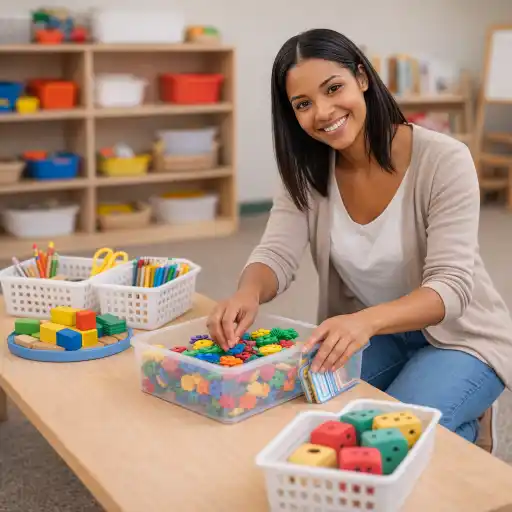
- Construction and STEM: boxes, tubes, paperboard, lids, craft sticks, cardboard strips, and masking tape support bridges, ramps, towers, and vehicles.
- Math and manipulatives: large caps, egg cartons, containers, muffin tins, stones, and clothespins invite counting, sorting, matching, measuring, and patterning.
- Dramatic play: clean food containers, menus, paper bags, fabric, clipboards, and boxes can become a market, clinic, restaurant, post office, or home.
- Art and design: packaging, magazines, paper scraps, fabric, cardboard, and natural objects provide surfaces and textures for process-focused art.
- Literacy: envelopes, signs, labels, index cards, notebooks, and recycled office paper encourage writing, mapping, storytelling, and message-making.
Use a limited selection rather than filling every shelf. A shallow tray with six intentional materials may sustain deeper exploration than an overflowing bin. The resource recycled materials in learning centers offers examples of connecting found objects to curriculum goals. For process-focused art ideas, explore junk art, which uses upcycled materials to encourage children’s creativity and fine-motor development.
Represent children’s families and communities through authentic, respectful materials. Everyday objects should expand children’s identities and experiences—not reduce cultures to decorations or stereotypes.
How Can Teachers Turn Inexpensive Materials Into Purposeful Centers?
Begin with a learning intention, then design an invitation that leaves room for children’s agency. A prompt should stimulate thinking without dictating a final product. For example, “How can you build a bridge for three animals?” is more productive than asking every child to copy one model.
- 🏗️ Paper engineering: Offer paper, tape, and blocks. Invite children to build the tallest structure that stands independently.
- Ramp investigation: Combine cardboard, books, toy vehicles, and different surface coverings. Ask what changes movement.
- Community market: Use boxes, paper bags, menus, play money, and clipboards. Children can negotiate roles, create signs, count items, and solve customer problems.
- Sorting studio: Provide large lids, containers, tongs, and trays for classification by size, color, texture, or function.
- Story-building basket: Add fabric, boxes, puppets, paper, and writing tools so children can invent settings and record ideas.
Make the learning visible with a photograph, child quote, sketch, or brief reflection. Ask questions such as “What are you noticing?” “What might you change?” and “How could you show someone else how it works?” Teachers can introduce vocabulary—balance, compare, flexible, heavier, connect, predict, and redesign—without taking control of the project.
The course CDA: Curriculum Alignment & Materials Buy Now $16.00 is another relevant option for strengthening decisions about age-appropriate materials, individual needs, and center design.
How Can Organization Stretch a Small Materials Budget?
Organization protects both money and instructional time. When materials have visible “homes,” children can access them independently, cleanup becomes teachable, and teachers are less likely to repurchase items that are already available.
- Use donated boxes, baskets, or clean containers for storage.
- Label shelves with photographs and words so nonreaders can participate.
- Store one activity per tray or basket to simplify setup and cleanup.
- Keep high-use materials at children’s level and restricted tools out of reach.
- Create a small “works in progress” area for multi-day projects.
- Rotate a portion of the materials weekly while keeping familiar center structures.
In a small room, define centers with rugs, low shelves, tables, or visual boundaries rather than purchasing new furniture. Group quieter areas—such as reading and writing—away from louder block or dramatic-play spaces when possible. Place messy activities near surfaces that are easy to clean, and maintain clear pathways and adult sight lines.
Directors can support sustainability by creating a shared inventory, scheduling brief safety inspections, and giving teachers planning time. The Classroom Setup for Child Care Buy Now $24.00 course explores intentional arrangement, accessible materials, and welcoming environments; it may help providers earn relevant professional development hours while improving daily classroom practice.
How Can Providers Avoid Common Budget Mistakes?
Budget-friendly design is not about accepting everything or doing more with less at any cost. It is about making deliberate decisions that protect safety, inclusion, learning quality, and staff capacity.
- Too many materials: Begin with a focused collection and add items in response to children’s questions.
- Product-focused crafts: Offer tools and materials instead of requiring identical outcomes.
- Unsafe donations: Inspect, clean, and discard anything that cannot be supervised or sanitized appropriately.
- Cluttered storage: Rotate materials and remove duplicates that overwhelm children.
- Decorative spending: Prioritize child-created displays, books, functional storage, and versatile tools.
- Inaccessible centers: Provide varied sizes, adapted grips, visual directions, quiet options, and clear pathways.
Inclusion should be planned from the start. Children may participate by building, sorting, drawing, speaking, gesturing, dictating, photographing, or demonstrating. For dual language learners, use pictures, home-language labels, gestures, and opportunities to communicate in the language that best supports their thinking.
Evaluate centers by observing engagement and growth rather than appearance. Are children using language, persisting, collaborating, making choices, and revising ideas? A short documentation note can guide the next adjustment: reduce choices, add a challenge, change the location, or introduce a new tool.
What Is the Best Way to Build a Low-Cost Center This Week?
Choose one center rather than attempting a complete classroom transformation. Start with an inventory, identify one learning goal, gather three to six safe materials, and prepare one open-ended prompt. Teach children how to use and return the materials, then observe before making changes.
- Choose a center that needs greater engagement or clearer organization.
- Collect and inspect materials already available.
- Remove clutter and label the storage area.
- Add one meaningful provocation connected to children’s interests.
- Teach expectations for access, cooperation, safety, and cleanup.
- Document one child’s strategy, question, or new skill.
- Revise the center based on evidence rather than assumptions.
Small improvements accumulate. A donated box, a recycled lid, a family photograph, or a carefully worded question can become the beginning of rich learning. Providers do not need catalog-perfect rooms; children need safe, responsive environments where their ideas matter.
Conclusion
So, how can teachers build learning centers on a tight budget? By beginning with observation and inventory, selecting safe open-ended materials, organizing them for independence, and connecting each center to meaningful developmental goals. Recycled and donated materials can support language, #math, science, creativity, social development, and self-regulation when teachers intentionally arrange and extend children’s play.
Prioritize function over decoration, quality over quantity, and children’s thinking over polished products. Review local rules before using unfamiliar materials, and remember that state requirements vary - check your state licensing agency. With one focused center, a few versatile materials, and a willingness to revise, your classroom can offer abundant learning without an abundant budget.
Five Courses to Explore
- Spicing Up the Classroom: Learning Centers Buy Now $16.00
- Beautiful Junk: Using Recycled Materials in the Classroom Buy Now $16.00
- CDA: Curriculum Alignment & Materials Buy Now $16.00
- Classroom Setup for Child Care Buy Now $24.00
- Creating Environments that Nurture Growth and Community Buy Now $55.00
- CDA Preschool Credential with Portfolio Review
- Money Matters in Medicine
- CDA Bridge Bundle: Preschool
- 45 Hour School Age Methods and Materials
- CDA Bridge Bundle: Family Child Care without Portfolio Review
- CDA Bridge Bundle: Infant/Toddler without Portfolio Review
- CDA Bridge Bundle: Preschool without Portfolio Review
- Creating Engaging and Meaningful Learning Experiences
- Texas Director Credential
- CDA: Curriculum Alignment & Materials
- Preschool Curriculum for Educators to Choose
- CDA Certification en Español: Recursos y Consejos para Educadores Bilingües
- 👶 ¿Cuáles son las proporciones y grupos requeridos en Dakota del Norte? 🏫
- Requisitos de Cuidado Infantil en Nueva Jersey para Centros y Proveedores de Cuidado Infantil Familiar
- Proporciones de Cuidado Infantil y Tamaños de Grupo por Edad en Maryland (Guía Rápida para Centros y Hogares)
- Proporciones de Cuidado Infantil y Tamaños de Grupo por Edad en Nueva Jersey (Guía Rápida para Centros y Hogares)
- Proporciones de Cuidado Infantil y Tamaños de Grupo por Edad en Virginia (Guía Rápida para Centros y Hogares)
- How Can DC Child Care Programs Keep Staff During Workforce Shortages?
- What new child care news in Florida should providers know and how can ChildCareEd help?
- What new child care news in DC should providers know and how can training help?
- Celebrando la amistad en el cuidado infantil durante el Día de los Mejores Amigos
- Canciones, juegos y preguntas de círculo para niños
- Why Does Child Care Cost So Much in New York — And How Can Providers Talk to Families About Value?
- Cómo simplificar la capacitación para sus empleados de daycare
- How Can Childcare Directors Lead Strong Teams and Safe Programs?
- How can directors lead stronger child care programs today?
- How Can You Refresh a Back-to-School Classroom for Under $100?
- How Can Teachers Build Learning Centers on a Tight Budget?
- Why Are Reusable Printables a Smart Investment for Child Care Providers?
- How Can Child Care Programs Budget for Supplies Shared Across Classrooms?
