When a child hesitates over a comparison, the quickest fix—telling them which symbol to use—can also hide what they understand. With thoughtful scaffolding, you can adjust the challenge while keeping the reasoning in the child’s hands; Tailoring Instruction to Children’s Needs  Buy Now $24.00 offers practical guidance on differentiation and scaffolding for varied learners. Use the strategies below to make comparison activities accessible, meaningful, and focused on children’s thinking.
Why does adapting comparison activities matter?
Comparing two numbers may look like a small task, but it brings together several skills: recognizing numerals, connecting numbers to quantities, understanding words such as “greater” and “less,” and interpreting the symbols >, <, and =. A child may understand which of two piles has more yet need support connecting that idea to written notation. Another child may recognize the symbols but struggle to explain the relationship. These differences are useful information about where teaching can help—not evidence that a child is “bad at math.”
Children benefit when we adjust the route into a learning goal without removing the thinking. The National Centre for Excellence in the Teaching of Mathematics describes a progression from comparing collections, to discussing which group has more, to comparing the numbers that represent them. One-to-one matching and examples with equal quantities also help children attend to the number of objects rather than their size or arrangement.
For providers, this approach makes activity cards more than a set of answers to check. A child’s explanation, gesture, or model can reveal understanding even when the written response is still developing. Protecting that productive thinking supports confidence, mathematical language, and the child’s growing #reasoning.
What should you observe before changing the task?
Start with a brief, low-pressure observation. Present two number cards or small collections and notice what the child does before offering a hint. Can they identify each numeral? Do they count accurately, match objects one by one, or compare by looking? Can they say which group has more, fewer, or the same? Do they understand what the task is asking, and can they communicate a choice through speech, pointing, gesture, or arranging objects?
Different responses suggest different supports. If the child compares objects accurately but misreads a numeral, focus on matching that numeral to a familiar quantity. If they identify numbers but reverse the symbols, return to comparison language and ask them to read the whole statement. If they seem unsure about equal, use two collections that look different but contain the same number.
Try prompts that uncover thinking without supplying the answer:
- “What do you notice about these two numbers?”
- “How could you check your idea?”
- “Can you show that number with counters?”
- “What does this comparison say when we read it aloud?”
Make brief notes about observable actions rather than labels. For example: “Counted both groups accurately, then chose the symbol after using the number line.” Reviewing observations across more than one activity helps you choose a sensible next step and avoid interpreting a single mistake as a fixed difficulty.
How can you scaffold the activity without giving away the answer?
Scaffolding means offering enough support for a child to participate and make progress, then reducing that support as the child becomes more independent. It does not mean doing the thinking for them. Begin with the least intrusive prompt and wait long enough for the child to respond. A calm pause can be more helpful than a rapid sequence of hints.
Move through a progression from concrete to symbolic when needed: build two groups with counters, count or match them, connect each group to a numeral, describe the relationship, and then choose a symbol. If a child is already comfortable with quantities, you can work directly with numerals while keeping optional materials nearby. NCETM’s early comparison guidance supports progressive experiences that move from collections to number comparisons and include examples of equal groups.
- Offer a number line or ten-frame as a tool the child can choose, not a route you insist on.
- Give a sentence frame—“___ is greater than ___”—while leaving the numbers and comparison open.
- Reduce the number of cards at once, or let the child select a card to begin.
- Model the process on a different example, then invite the child to try the target problem.
Keep the learning goal steady while adapting the materials, pace, language, or response method. A child might point to a symbol, place a symbol card, explain verbally, or demonstrate with objects. Each can provide evidence of mathematical thinking.
How can you adapt Task Cards - Greater/Less Than for different learners?
ChildCareEd’s Task Cards - Greater/Less Than Buy Now $2.49 resource includes 24 cards, a recording sheet, and an answer key. Children compare two numbers and record whether the relationship is greater than, less than, or equal to. The cards can be used at a center, in a small group, or as a “write the room” activity. Their compact format makes it straightforward to adjust how many cards children see and what supports are available.
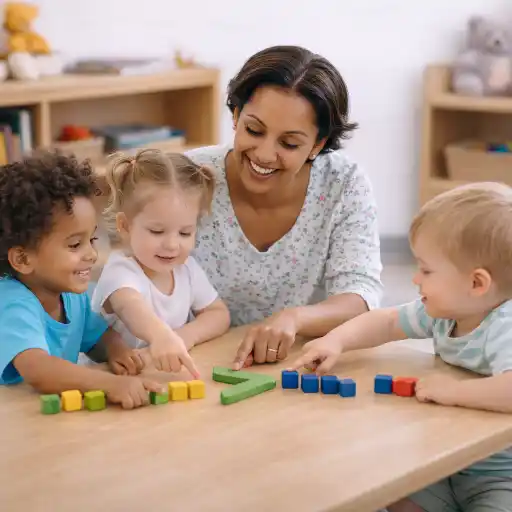
Make the cards serve the learner, rather than expecting every learner to complete them in the same way:
- For an emerging comparer, use a few cards with counters or numeral cards paired with dot patterns.
- For a child who understands quantity but is learning notation, ask them to explain the comparison first and then choose a symbol.
- For a child ready for more, include equal comparisons, close number pairs, or an invitation to create a comparison for a peer.
- For children who benefit from movement, place a small selection around the room and invite them to bring a card to a partner or compare numbers on a floor number line.
- 🤝 Invite partners to take turns choosing a card and explaining a strategy, rather than racing to finish.
Offer the answer key for checking after children have had a chance to reason, not as a cue to copy. The resource is a useful practice tool, but the educator’s questions and observations help turn each card into an opportunity to think aloud, test an idea, and build #numberSense.
Which common pitfalls can adaptations help you avoid?
One common pitfall is treating a symbol as a visual trick to memorize. A mnemonic such as an “alligator mouth” may help some children remember symbol direction, but it should not replace understanding which number is greater. Ask the child to read the comparison and explain what it means. If the sign points toward the larger number but the child cannot describe the relationship, return to quantities and comparison language.
Another pitfall is supplying hints so quickly that the child has little time to think. Instead of saying “the answer is greater than,” ask how the child might find out. A number line, counters, or matching can support investigation without deciding for them. Also avoid assuming that an incorrect answer reflects carelessness; the child may be working through numeral recognition, vocabulary, counting, or symbol direction.
- Do not make speed the goal; prioritize explanation and a thoughtful check.
- Do not remove all challenge when a child needs support; adjust the entry point instead.
- Do not group children by a fixed ability label; use flexible groupings based on the current activity.
- Do not overlook language access; model key terms and welcome gestures, home-language explanations, and visual responses.
Open-ended questions such as “How did you figure that out?” can invite children to share their thinking without narrowing them to a teacher’s preferred method. As NAEYC’s guidance on open-ended questions notes, prompts that invite children to explain and explore can encourage curiosity, language, and mathematical thinking. Your role is to listen, notice, and offer a next step that preserves the child’s agency.
How can you use observations to plan the next step?
After the activity, use what you observed to decide whether the child needs another concrete experience, a different representation, more practice with vocabulary, or a greater challenge. Keep documentation focused and manageable: record the task, the child’s strategy, the support offered, and one possible next step. For example: “Compared 6 and 3 with counters, identified 6 as greater, but needed a prompt to select >. Next: connect spoken comparison statements to symbol cards.”
Share patterns with colleagues and, when appropriate, families. A child’s approach may change depending on fatigue, familiarity with materials, language, or group size, so avoid making a broad conclusion from one card. The DREME Network’s guided small-group activities illustrate the value of revisiting activities at different levels and adjusting the challenge as children’s skills grow.
For deeper professional learning, explore these English-language ChildCareEd courses:
- Tailoring Instruction to Children’s Needs Buy Now $24.00 — differentiation and scaffolding for individual needs.
- Early Mathematics Through Play Buy Now $24.00 — play-based approaches to number sense, comparison, and mathematical reasoning.
- Math Foundations in Early Childhood Buy Now $16.00 — hands-on ways to make math accessible and engaging.
- Letter & Number Planning in Child Care Buy Now $24.00 — planning math and literacy activities with individual needs in mind.
- Preschool Assessments & Observations Buy Now $24.00 — observing children and using information to plan individualized experiences.
Course details and training-hour applicability depend on your circumstances; state requirements vary - check your state licensing agency.
Conclusion: How can providers adapt without giving the answer?
To adapt greater-than and less-than activities without giving children the answer, first observe how they compare, then offer a support that helps them continue doing the mathematical thinking. Use objects, number lines, language frames, smaller card selections, or varied response methods as needed. Reduce help as children gain confidence, and treat an incorrect response as a chance to learn about the strategy—not a reason to take over.
Task cards can provide focused practice when they are paired with conversation, flexible supports, and time to reason. Keep the goal clear: children should do more than choose a symbol; they should build a meaningful understanding of the relationship between quantities and communicate how they know. With responsive adaptations, every child can participate in a way that honors their strengths and supports growth.
- From Play to Planning: Building Culturally Competent, Child-Centered Curriculum
- Children at the Wheel: Emergent Curriculum
- Pediatric RSV First Aid & CPR/AED
- CDA Bridge Bundle: Family Child Care
- CDA Bridge Bundle: Family Child Care without Portfolio Review
- CDA Bridge Bundle: Infant/Toddler without Portfolio Review
- CDA Bridge Bundle: Preschool without Portfolio Review
- Texas Director Credential
- Effective Coaching & Mentoring in ECE
- CDA Certification en Español: Recursos y Consejos para Educadores Bilingües
- 🔍 ¿Qué ves cuando observas a un niño aprender?
- 💛🧩 ¿Cómo puedo hacer que mi enseñanza sea inclusiva para los niños con autismo?
- ⏰ Cómo puedo facilitar las transiciones y las rutinas diarias en mi aula?
- ¿Cuáles son las mejores actividades del Día de la Tierra para niños en casa o en el aula?
- Actividades de Motricidad Gruesa que Desarrollan el Equilibrio, la Coordinación y la Fuerza
- Actividades de Fiesta para Niños de Preescolar y Primaria
- Proporciones de Cuidado Infantil y Tamaños de Grupo por Edad en Nueva Jersey (Guía Rápida para Centros y Hogares)
- Proporciones de Cuidado Infantil y Tamaños de Grupo por Edad en Virginia (Guía Rápida para Centros y Hogares)
- ¿Cuál es la Diferencia Entre la Crianza Respetuosa y la Crianza Permisiva?
- Lista para Guardería en Casa en Illinois: Cómo Iniciar una Guardería en el Hogar
- Celebrando la amistad en el cuidado infantil durante el Día de los Mejores Amigos
- Canciones, juegos y preguntas de círculo para niños
- Cómo simplificar la capacitación para sus empleados de daycare
- How Can Printable Activities Save Teachers Hours of Prep Time?
- How Can the Power of the Pause Give Young Children Enough Time to Respond?
- Why Are Reusable Printables a Smart Investment for Child Care Providers?
- How Can You Use a Hundreds Chart Beyond Rote Counting?
- Why Can a Child Compare Two Piles but Struggle with Greater-Than Symbols?
- How Can You Adapt Greater-Than and Less-Than Activities Without Giving Children the Answer?
