Leaves scattered across a table can become a lively math investigation when children count, match, and compare them. Use the ideas below to build preschoolers’ number sense and math language, and explore No Such Thing as Boring Math  Buy Now $24.00 for a deeper look at planning playful, developmentally informed math experiences.
Why are “more,” “fewer,” and “equal” worth teaching through play?
Quantity comparison is more than a vocabulary lesson. When children decide which collection contains more leaves, they coordinate counting, attention, visual observation, and reasoning. They begin to understand that numbers describe quantities and that groups can be compared even when their objects differ in color, shape, or arrangement. These foundations support later work with addition, subtraction, and data.
Hands-on materials make the relationship visible. A child can move one leaf from each group, line leaves up in pairs, or count each collection to check an initial guess. The physical action helps connect the words more, fewer, and the same to quantities children can see and touch. Fall materials add genuine interest: leaves come in different colors and sizes, and children may have collected them outdoors themselves.
These activities also create useful opportunities for social learning. Partners can share materials, compare strategies, and listen to one another’s explanations. The goal is not to produce a fast answer; it is to help each child build a confident, curious #math identity and feel that their ideas matter.
How can you prepare a safe, inviting fall comparison activity?
Start with a small collection of leaves or use paper, fabric, or plastic leaf counters. Provide two trays or spaces, a comparison mat, and a small set of picture or numeral cards. Keep the materials simple enough that children can focus on comparing rather than managing a complicated setup.
ChildCareEd’s Colorful Fall Leaves: More, Fewer, or the Same Buy Now $1.49 is a six-page printable resource for preschoolers ages 3–5. It includes eight autumn-themed comparison scenes, vocabulary cards, a reusable comparison mat, and educator guidance. Use it as a ready-to-go invitation, or adapt the same structure with real leaves and classroom objects.
- Inspect natural materials and remove items that are damaged, moldy, or unsuitable for the children in your group.
- Use larger substitutes and close supervision when small pieces could pose a mouthing or choking risk.
- Set out modest quantities at first, such as one to five objects per group, and add more as children are ready.
- 🍂 Invite children to notice leaf colors and shapes before counting; this builds curiosity and gives everyone a way into the activity.
Follow your program’s sanitation and supervision procedures. State requirements vary - check your state licensing agency.
How do you introduce the comparison words clearly?
Model the words with two visible groups. Place three leaves in one space and five in another. Say, “This group has more leaves. This group has fewer leaves.” Then arrange two groups of four and explain, “These groups have the same number.” Pair each word with a gesture—such as pointing to the larger group or aligning items—to make meaning accessible to children who are still developing language.
Next, let children investigate. Ask one question at a time and leave space for a response. “Which group has more?” can invite a visual estimate. “How could we check?” encourages children to count or match objects one-to-one. If a child gives an unexpected answer, resist correcting immediately. Ask them to show how they decided; their strategy tells you what kind of support will be useful.
- “What do you notice about these two groups?”
- “Can you make the groups the same?”
- “What happens if we add one leaf here?”
- “How can we check without guessing?”
Use the words naturally across the day: compare the number of children at two centers, notice whether there are enough cups for everyone, or describe which block tower has more blocks. Frequent, relaxed use strengthens #vocabulary without turning conversation into a quiz.
Which hands-on fall games help children compare quantities?
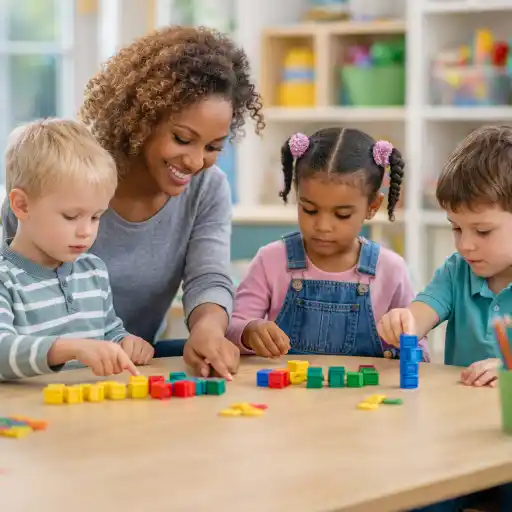
One effective routine is a “collect, count, compare” game. Give each child a tray and invite them to collect a small number of leaves or counters. Children count their collections, then compare with a partner’s. They can make two rows and match each object to one in the other group. Any unpaired leaves make the difference concrete: one collection has more, and the other has fewer.
Try a fall comparison mat as a small-group center. Children choose a picture scene or draw two number cards, build each group with counters, and place the groups side by side. Encourage them to say a complete comparison, such as “The yellow group has two more leaves than the red group,” if that level of language is comfortable. For early learners, a point, gesture, or single comparison word is a valid starting response.
- Leaf match: Make two groups and pair each leaf across the groups. Decide whether one group has extras or whether they match exactly.
- Roll and compare: Roll a die twice, build each quantity with fall counters, and describe which is greater or whether the amounts are equal.
- Leaf color graph: Sort leaves by color, build columns, and discuss which color has the most or fewest.
- Make it equal: Start with unequal groups and invite children to add or remove leaves until the groups match.
Keep games collaborative rather than speed-based. Children learn from hearing different strategies, and educators can make the challenge easier or harder by changing the number of objects, adding visual supports, or asking children to explain their thinking.
How can you adapt the activity and notice children’s learning?
Children may be developing different parts of the comparison process. One child may recite number words but need practice touching one object for each count. Another may count both groups accurately but be learning the meaning of “fewer.” A third may be ready to say how many more are needed to make groups equal. These differences are expected; adjust the entry point while keeping the shared purpose of exploring quantity.
Support emerging learners with small collections, clearly spaced objects, dot cards, gestures, and a modeled example. Offer choices in how children respond: they may speak, point, place a picture card, or demonstrate by rearranging objects. Children who are ready for more can compare larger collections, estimate before counting, or explain how many items need to be added or removed.
Assess during play rather than interrupting the activity. Notice whether a child counts each item once, understands that the final count names the total, matches objects one-to-one, and uses comparison language or another clear representation. Write a concise observation and possible next step, such as: “Counted both groups correctly; next, invite the child to adjust one group to make them equal.”
Avoid relying on worksheets, introducing too many new terms at once, or giving the answer before children can test a strategy. For broader professional learning about play-based math and child development, providers can also explore Early Mathematics Through Play Buy Now $24.00, Math Foundations in Early Childhood Buy Now $16.00, and Letter & Number Planning in Child Care Buy Now $24.00.
Conclusion: What makes fall quantity comparison meaningful?
Hands-on fall math works when children can explore real quantities, use meaningful language, and explain their own strategies. With leaves, a comparison mat, and a few thoughtful prompts, providers can make “more,” “fewer,” and “the same” visible, tactile, and connected to children’s experiences.
- Begin with modest, safe collections and concrete objects children can move.
- Model comparison language, then invite children to check by counting or matching.
- Differentiate the quantity, materials, and response options to support varied learners.
- Observe strategies and use what you notice to plan the next small step.
The guiding question is simple: which group has more, fewer, or the same—and how can we find out? When educators approach that question with curiosity and patience, fall materials become an inviting pathway to early #numbers, reasoning, and mathematical confidence.
- 45 Hour Child Growth and Development
- Early Mathematics Through Play
- CDA Home Visitor Subject Area 3 Part 3 Birth to 5
- CDA Home Visitor Subject Area 2 Part 3 Birth to 5
- Math Foundations in Early Childhood
- No Such Thing as Boring Math
- Texas Director Credential
- Building Vocabulary
- Letter & Number Planning in Child Care
- Enhancing STEM Education for Infants and Toddlers
- CDA Certification en Español: Recursos y Consejos para Educadores Bilingües
- 💛🧩 ¿Cómo puedo hacer que mi enseñanza sea inclusiva para los niños con autismo?
- Proporciones de Cuidado Infantil y Tamaños de Grupo por Edad en Maryland (Guía Rápida para Centros y Hogares)
- Proporciones de Cuidado Infantil y Tamaños de Grupo por Edad en Nueva Jersey (Guía Rápida para Centros y Hogares)
- Proporciones de Cuidado Infantil y Tamaños de Grupo por Edad en Virginia (Guía Rápida para Centros y Hogares)
- Cómo Trabajar en el Cuidado Infantil en Carolina del Norte: Requisitos y Pasos
- Canciones, juegos y preguntas de círculo para niños
- Count It, Sort It, Find It! Fall Math Games for Preschoolers
- Can You Build a Leaf Bridge? Fall STEM Challenges for Pre-K
- Fall Challenge Accepted! Hands-On Learning Games for Pre-K
- How Can Preschool Math Become Meaningful, Playful, and Part of Every Day?
- How Can You Create Easy Preschool Math Centers with Print, Prep, and Start Learning?
- How Does Counting Shapes Build Early Number Sense Through Play?
- How Can Visual Feedback Support Multiplication Fluency?
- Why Can a Child Compare Two Piles but Struggle with Greater-Than Symbols?
- How Can Hands-On Fall Math Teach Children More, Fewer, and Equal?
- How Can Hands-On Fall Math Teach More, Fewer, and Equal?
- How Can Preschoolers Learn More, Fewer, and Equal Without Rushing Into Numbers?
- How Can Fair Sharing Build Early Math Skills Beyond “Take Turns”?
