A child may recite numbers in order and still be unsure which group has more—because saying number words is not the same as understanding quantity. Help children build that connection through visible, movable groups, and explore Early Mathematics Through Play Buy Now $24.00 for practical ways to weave meaningful math into play and routines. For focused classroom ideas, Math Foundations in Early Childhood  Buy Now $16.00 offers additional hands-on strategies to strengthen your teaching practice.
Why does comparing groups matter beyond counting?
Counting is a valuable tool, but a number sequence alone does not show that a child understands how many objects a number represents or how two quantities relate. Comparing two visible groups gives children a concrete reason to notice amount: Which plate has more crackers? Do both towers have the same number of blocks? Is there enough for everyone?
When children see and handle objects, they can test their ideas by matching, moving, arranging, or counting. These actions help connect number words with real quantities and support developing #numberSense, mathematical reasoning, and language. The What Works Clearinghouse recommends teaching number and operations through a developmental progression, monitoring learning, and helping children describe their world mathematically (Teaching Math to Young Children).
Comparison also lets educators notice children’s thinking. A child may judge by sight, count each item, or pair objects one-to-one. These different approaches are useful information for deciding what to model next—not reasons to rush a child toward symbols or worksheets. Early experiences with groups help make later number ideas more meaningful.
How can you make more, less, and equal visible?
Begin with two small collections of similar objects, such as large counters, blocks, toy animals, or paper shapes. Place them in separate, clearly defined spaces. Similar size and spacing help children focus on how many there are rather than being distracted by a larger-looking object or a longer row. Start with a few items and increase the amount as children show readiness.
Invite children to look, make a prediction, and then check. They can count each collection, moving or touching one item for each number word, or match items from one group to the other. Matching makes the relationship especially visible: an unmatched object indicates that one group has more; if every object has a partner, the groups have the same amount. This connects to comparing groups before introducing numerals.
- Use a few comparison words at a time: more, fewer, and the same.
- Ask, “What do you notice?” before asking for a specific answer.
- Invite children to rearrange a group and consider whether the amount changed.
- 🍂 Use seasonal or classroom objects children already find interesting, after checking that materials are safe and suitable.
A classroom-ready option is Which Group Has Less? Buy Now $1.50, while the Share the Acorns activity Buy Now $1.50 invites children to move pieces and explore equal groups and leftovers.
How can educators model comparison without turning it into a quiz?
Think aloud as you compare. Place two groups in rows and say, “Let’s see whether these groups have the same number.” Count each group carefully, then pair the objects. Narrate what the action shows: “Each bear has a block. They have the same number,” or “This block has no partner, so this group has one more.” The Eastern Connecticut State University resource on cardinality explains why the final number word can help children understand the total in a counted set.
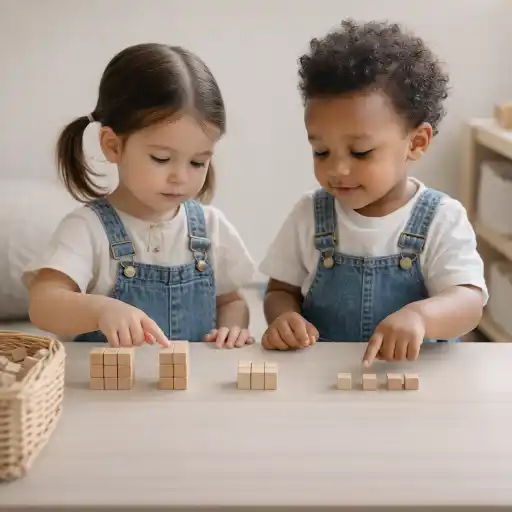
Use open prompts that invite children to demonstrate their reasoning rather than guess what an adult expects:
- “How could we check which group has fewer?”
- “Can you move one piece so the groups have the same number?”
- “What might happen if we add one more here?”
- “How do you know these groups match?”
Accept pointing, gestures, arranging objects, and explanations in a child’s home language as meaningful participation. Some children may understand a comparison before they can comfortably say the vocabulary. Your clear narration builds the bridge between what they do and the words used to describe it.
Keep the pace calm and playful. If a child’s answer differs from yours, ask them to show how they decided. Listening first reveals whether the child is estimating, tracking objects, counting, or matching—each strategy offers a useful place to begin instruction.
How can you adapt the activity to children’s different readiness levels?
Children develop comparison skills at different rates, and the same child may use different strategies on different days. Keep the learning goal—understanding relative quantity—while adjusting the number of objects, the arrangement, the materials, or the way a child responds.
- For beginning comparers: Offer one to three large items in each group. Demonstrate pairing objects and connect the action to “same” or “one more.”
- For developing counters: Increase the collection gradually. Invite children to count each set and then explain which has more or fewer.
- For children ready for a challenge: Ask them to make the groups equal by adding or removing an item, or to show one more and one fewer.
- For access and participation: Use high-contrast materials, larger pieces, defined spaces, picture cues, and options to point, build, gesture, or speak.
- For multilingual learners: Pair vocabulary with gestures and visuals, welcome home-language reasoning, and model the classroom terms without requiring children to abandon familiar language.
Offer feedback that names the strategy: “You matched each counter to check,” or “You added one so both groups are equal.” This values reasoning and persistence instead of labeling a child as naturally good or poor at math. For more activity ideas focused on comparing quantities, consider the group-with-more dots activity Buy Now $2.00 or the acorn comparison mats Buy Now $1.50.
How can you extend learning and avoid common pitfalls?
Once children have explored two groups with objects, carry the same comparison idea into familiar routines. Compare block towers, check whether there are enough cups for snack, sort classroom items by color and compare the resulting groups, or look at columns on a simple class graph. These repeated, meaningful encounters help children recognize that comparison is useful beyond a single math center.
Observe how children approach the task. Do they count each object once? Pair items? Notice an unmatched piece? Do they understand that rearranging the objects does not change the group’s amount? A concise note can help you plan: “Ari matched four counters in each row to show equality; next, offer a group with one extra.” The Institute of Education Sciences guidance supports using progress monitoring to build instruction on what each child already knows (WWC math practice guide).
Common pitfalls are manageable when you keep the focus on understanding:
- Do not assume fluent counting proves a child understands quantity; let the child show and explain.
- Avoid speed contests and correcting before hearing the child’s strategy.
- Do not rely on worksheets alone; combine printed activities with objects, talk, and play.
- Vary arrangements so children attend to quantity rather than memorizing one picture or layout.
Use safe, age-appropriate materials, supervise closely, and avoid small loose parts for children who may mouth objects. State requirements vary - check your state licensing agency. For broader professional learning, explore No Such Thing as Boring Math Buy Now $24.00, which focuses on intentional play and mathematical learning.
Conclusion: What helps preschoolers understand more, less, and equal?
Counting is one part of early mathematics, but children also need chances to see, handle, and compare quantities. Offer two manageable groups, invite children to predict, and check their ideas by counting or matching one item to one item. Use everyday language to name what the comparison shows, and give children time to explain their approach.
Adapt the quantity and materials to each child, accept multiple ways of communicating, and observe strategies to plan the next step. When comparison becomes part of play, snack, block building, and classroom routines, children can connect number words with quantities and relationships—not merely recite a sequence. The practical answer is simple: make groups visible, make reasoning welcome, and build from what each child already understands.
- 45 Hour Child Growth and Development
- 45 Hour Preschool Methods and Materials
- 45 Hour Infant and Toddler Methods and Materials
- 45 Hour School Age Methods and Materials
- CDA Infants/Toddlers: Brain Development and Gene Expression
- Art from the Heart for Preschoolers: Open Ended Art Projects that Build Self-Esteem
- Lesson Planning for Preschoolers
- Connections That Count: Building Relationships in Child Care
- Texas Director Credential
- Cómo Obtener la Credencial de Visitante de Hogar CDA
- CDA Certification en Español: Recursos y Consejos para Educadores Bilingües
- 💛🧩 ¿Cómo puedo hacer que mi enseñanza sea inclusiva para los niños con autismo?
- ¿Cómo empiezo mi certificación CDA en Florida en línea?
- Actividades de Motricidad Gruesa que Desarrollan el Equilibrio, la Coordinación y la Fuerza
- Cómo Crear Tu Portafolio CDA Paso a Paso
- Actividades de Otoño Fáciles para Preescolares esta Temporada
- Celebrando la amistad en el cuidado infantil durante el Día de los Mejores Amigos
- Canciones, juegos y preguntas de círculo para niños
- Cómo simplificar la capacitación para sus empleados de daycare
- Why Can a Child Compare Two Piles but Struggle with Greater-Than Symbols?
- Why Can a Child Skip Count from Two but Not from Six?
- Why Can a Child Skip Count by Twos but Not by Sixes?
- How Can Hands-On Fall Math Teach Children More, Fewer, and Equal?
- How Can Hands-On Fall Math Teach More, Fewer, and Equal?
- How Can Preschoolers Learn More, Fewer, and Equal Without Rushing Into Numbers?
- How Can an Apple Stand Become Meaningful Preschool Math?
- Why Isn’t Counting Enough to Help Preschoolers Understand More, Less, and Equal?
