When two preschool towers reach the same height but use different numbers of blocks, children meet a surprisingly rich math puzzle: the number of units and the amount of space they cover are not always the same thing. Try the challenge below, and explore Early Mathematics Through Play Buy Now $24.00 for practical ways to weave counting, measurement, and reasoning into classroom play. The course offers a broader toolkit for making everyday math experiences intentional and engaging.
Why is a same-height, different-count puzzle worth exploring?
A tower comparison can prompt children to investigate a distinction that adults often take for granted: height describes how far a structure reaches vertically, while block count describes how many pieces it contains. If the blocks differ in size or thickness, two towers may look equally tall even though one contains more pieces. That mismatch is not a problem to correct quickly; it is an invitation to observe, compare, and explain.
These investigations build early ideas about measurement, quantity, and spatial relationships. Children may estimate which tower is taller, count pieces, line up blocks, or reconsider a first guess. In a hands-on building activity, concrete materials make abstract relationships visible, while conversation helps children connect what they see with mathematical language. Robertson Program’s tower-building lesson frames construction as an opportunity to investigate counting, quantity, and number relationships.
For providers, the puzzle also supports purposeful observation. Notice whether a child compares from the same starting point, counts each block once, or explains a conclusion with evidence. These observations can guide a next prompt without turning play into a test. The aim is not for every child to reach the same answer in the same way; it is to nurture curiosity and strengthen #reasoning through a problem children can touch and revisit.
How can you set up the Tower Comparison Challenge?
Invite two or more children to build towers that reach the same marked height, but offer blocks in at least two sizes or thicknesses. Use a stable surface and place a vertical reference—such as a strip of painter’s tape or a classroom ruler—behind the building area. The reference helps children compare tower heights without requiring precise standard measurement.
Introduce the puzzle with a question rather than a model answer: “Can you make two towers that reach the same line but use different numbers of blocks?” Allow children to choose how they will build. They might place one block at a time, test different combinations, or adjust a tower after comparing it with the reference.
- Offer a manageable collection of large, safe blocks in contrasting sizes.
- Mark a shared target height on a wall, easel, or sturdy vertical board.
- Provide space for towers to stand side by side and remain undisturbed.
- Keep a clipboard or whiteboard nearby for children’s drawings, estimates, or counts.
- 🔎 Ask children to predict first, then test their idea by building and comparing.
For younger preschoolers, begin with just two block types and a low target. For children ready for more complexity, include several sizes or ask them to build multiple solutions. First 8 Studios’ block tower activity offers a useful comparison approach: build structures close together, examine whether they match, and discuss how to adjust them. Keep the experience collaborative; each child’s strategy can become a useful contribution.
What mathematical ideas can children discover?
The challenge brings several mathematical ideas together without requiring a formal lesson. Children can count the blocks in each tower, compare the two totals, estimate how many pieces might be needed, and test whether a change affects height. They can also notice that the properties of the materials matter: when blocks have different thicknesses, equal height does not necessarily mean equal count.
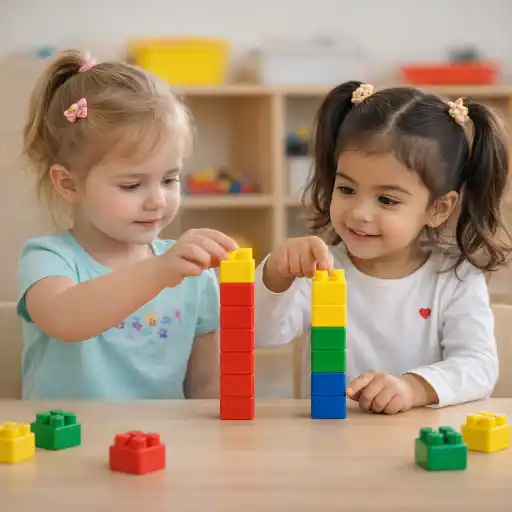
Use a consistent comparison method. Ask children to start both towers from the same surface and check each against the same height marker. If they line the towers up side by side, remind them to align the bases. This makes the comparison fair and gives children a repeatable way to check their observations.
- Counting: “How many blocks did you use in this tower?”
- Measurement: “Do the tops reach the same line?”
- Comparison: “Which tower has more pieces? Which has fewer?”
- Prediction: “What might happen if we replace one thick block with two thin ones?”
- Explanation: “How can we show that the towers are the same height?”
Invite children to describe their evidence rather than simply announce a winner. A child might point to the shared line, count aloud, or place a block beside another to compare. The recognition-of-quantity resource describes how children develop from relying on number words toward recognizing and reasoning about sets. Here, counting the pieces and visually judging height offer complementary ways to think about quantity and measurement.
How can teachers scaffold without taking over the building?
Children benefit when educators make the mathematical question clear but leave room for child-led strategies. Begin by observing. If a tower falls or the heights do not match, resist the impulse to rebuild it for the child. Instead, acknowledge the effort and ask a prompt that helps the child decide what to try next: “What do you notice about the tops?” or “How could we check the number of blocks?”
Use vocabulary naturally and repeat it during play: same height, taller, shorter, more, fewer, thick, thin, compare. Children may show understanding through gestures, construction, or talk; accept these different forms of expression. For dual language learners, pair words with gestures, visual cues, and familiar terms in the child’s home language when possible. If a child has motor or visual access needs, offer larger pieces, a clearly marked target, or a partner-building option.
- Model a comparison strategy only when children need a starting point, then invite them to try it.
- Offer choices: “Would you like to count the blocks or compare the tops first?”
- Extend a successful attempt: “Can you find another combination that reaches the line?”
- Keep frustration low by treating unstable builds as information, not failure.
For ideas that connect classroom practice with broader math concepts, the ChildCareEd course Math Foundations in Early Childhood  Buy Now $16.00 focuses on hands-on, play-centered approaches to early math. Use professional learning to refine your prompts while honoring children’s agency: the educator’s role is to make thinking visible, not to control the solution.
How can you document learning and avoid common pitfalls?
Keep documentation short and useful for planning. Record the child’s strategy, language, and next possible step rather than writing only “got it” or “needs help.” A photo of two towers beside their shared height marker can be paired with a brief note: “Jordan counted six thin blocks and three thick blocks; noticed both towers reached the tape line.” Such evidence helps staff discuss how the child is connecting #counting and measurement.
- Observe: Does the child align both towers at the base and compare their tops?
- Listen: Does the child use words such as “same,” “more,” “taller,” or “thicker”?
- Plan: Choose one next invitation, such as comparing block trains or measuring with identical cubes.
- Share: Describe the child’s strategy to families and invite a simple building comparison at home.
Common pitfalls are easy to avoid. Don’t assume that the tower with more pieces must be taller; inspect block dimensions and use a shared starting point. Don’t rush to correct a child’s estimate; ask how they can check it. Avoid making speed or competition the goal, since thoughtful testing and collaboration matter more. Use blocks that are appropriate for the children’s ages and follow supervision and safety practices.
When aligning activities, observation, or training with local expectations, remember that state requirements vary - check your state licensing agency. This keeps classroom planning grounded in local guidance while allowing play to remain responsive and joyful.
Conclusion: What should providers take away from the tower puzzle?
How can preschoolers build towers that are the same height with different block counts? Give them varied blocks, a shared height reference, time to experiment, and questions that encourage them to explain what they notice. The key insight is that height and number of pieces are related, but not identical: block size changes how many pieces may be needed to reach a target.
Use the puzzle to bring counting, measurement, comparison, prediction, and mathematical language into meaningful play. Scaffold with open questions rather than taking over, adapt materials so every child can participate, and document one specific strategy to inform the next invitation. If you would like a fuller foundation for planning this kind of play-based math, explore Early Mathematics Through Play Buy Now $24.00 and other relevant ChildCareEd learning options:
- Math Foundations in Early Childhood Buy Now $16.00
- No Such Thing as Boring Math Buy Now $24.00
- Lesson Planning for Preschoolers Buy Now $24.00
- Enhancing STEM Education for Infants and Toddlers Buy Now $16.00
A small building challenge can reveal a great deal about how children think. Protect the time, stay curious alongside them, and let their discoveries shape the next question.
- Lesson Planning for Preschoolers
- CDA Preschool Credential with Portfolio Review
- 45 Hour Preschool Methods and Materials
- CDA Bridge Bundle: Preschool without Portfolio Review
- 45-Hour Preschool Curriculum
- Emergent Learning & Development
- Creating Environments that Nurture Growth and Community
- Texas Director Credential
- Letter & Number Planning in Child Care
- CDA Certification en Español: Recursos y Consejos para Educadores Bilingües
- 👶 ¿Cuáles son las proporciones y grupos requeridos en Dakota del Norte? 🏫
- Cómo Abrir Una Quardería En Casa Sin Dinero?
- Recursos en Español sobre el Sueño Seguro del Bebé
- Curso de Comunicación de 9 Horas de Maryland
- Apoyo en Español para Capacitaciones Grupales Presenciales y por Zoom en Cursos Selectos
- Proporciones de Cuidado Infantil y Tamaños de Grupo por Edad en Maryland (Guía Rápida para Centros y Hogares)
- Proporciones de Cuidado Infantil y Tamaños de Grupo por Edad en Nueva Jersey (Guía Rápida para Centros y Hogares)
- Proporciones de Cuidado Infantil y Tamaños de Grupo por Edad en Virginia (Guía Rápida para Centros y Hogares)
- Lista para Guardería en Casa en Illinois: Cómo Iniciar una Guardería en el Hogar
- Ejemplos de Crianza Respetuosa vs. Crianza Permisiva
- Cómo Ser Maestra de Preescolar en Virginia
- Celebrando la amistad en el cuidado infantil durante el Día de los Mejores Amigos
- STEM for Preschoolers: Fun Activities That Encourage Curiosity
- Teaching Math to Young Children: Why Counting to 20 Doesn’t Mean They Understand 20
- How Can STEM Activities Turn Everyday Preschool Play Into Powerful Learning?
- How Can Early Math Activities Build Young Children’s Mathematical Thinking?
- How Can You Make a Math Activity Work for Children at Different Skill Levels?
- How Can Preschoolers Build Towers of the Same Height with Different Numbers of Blocks?
