A wobbly block tower, a spilled cup of water, or a coat that will not stay on a hook can become the beginning of an invention. With everyday materials and supportive questions, preschool teachers can help children imagine, build, test, and improve ideas; the Beautiful Junk: Using Recycled Materials in the Classroom  Buy Now $16.00 course offers practical ways to turn recyclables into engaging learning tools. For a deeper foundation in inquiry and experimentation, explore Basic Science in Early Childhood Buy Now $25.00 to strengthen your classroom practices and professional knowledge.
Why does inventive thinking matter in preschool?
Invention at this age is not about producing a polished gadget. It is the process of noticing a need, imagining possibilities, trying an idea, and learning from what happens. When children figure out how to keep a paper bridge from bending or move water from one container to another, they are practicing early engineering, reasoning, language, and flexible thinking. They also experience themselves as capable contributors whose ideas can change their environment.
Everyday challenges make meaningful starting points because children understand the context. A classroom problem—how to keep a pretend animal dry, make a ramp for toy cars, or carry blocks across the room—gives design work a clear purpose. NAEYC’s description of the preschool engineering design process shows how educators can help children identify a problem, imagine and plan, create a model, and improve it.
Low-cost materials also support equitable, repeatable exploration. A collection of cardboard, paper, fabric, large lids, and tubes can be rearranged in many ways, encouraging children to revisit ideas rather than follow a one-time demonstration. As they work, children use #curiosity, #creativity, #problemSolving, #persistence, and #collaboration—dispositions that matter well beyond a STEM center.
How can ordinary classroom problems become invention challenges?
Begin by observing daily routines and play. Notice where children pause, improvise, or ask for help. These moments often reveal a problem they genuinely want to solve. Instead of presenting a finished model, state the challenge in simple language and let children define what might count as a useful solution.
- “The toy animals need a way to cross the pretend river. What could we make?”
- “Our paper tower keeps tipping. How could we help it stand?”
- “How can we move water to the sandbox without carrying one cup at a time?”
- “Can you make a small shelter that keeps this toy dry?”
Keep the challenge open-ended, but clarify real constraints: available materials, safe use, size, or what the design needs to do. Ask whose needs the solution should meet. A ramp may need to work for different toy vehicles; a pretend shelter may need enough space for several children’s ideas. This invites empathy and purposeful choices without imposing a single correct answer.
Give children time to notice and discuss the problem before gathering supplies. A quick sketch, dictated plan, or conversation can make their thinking visible. When the challenge comes from children’s experiences, their motivation is more likely to last through the inevitable redesigns. The teacher’s role is to frame the problem and make room for children to take ownership—not to turn play into a test.
Which inexpensive materials invite the most creative design?
Choose safe, clean, open-ended items that can be combined and repurposed. Materials do not need to be high-tech; the useful feature is that they leave room for many possible uses. A tube might become a tunnel, water channel, telescope, or structural support depending on the problem children are exploring.
- Cardboard boxes, tubes, paperboard, and scrap paper
- Clean containers, large lids, and sturdy cups
- Fabric scraps, yarn, string, and wide tape
- Craft sticks, large blocks, and child-safe connectors
- Natural loose parts such as leaves, smooth stones, and sturdy sticks
- Basic tools such as rulers, crayons, child-safe scissors, and measuring cups
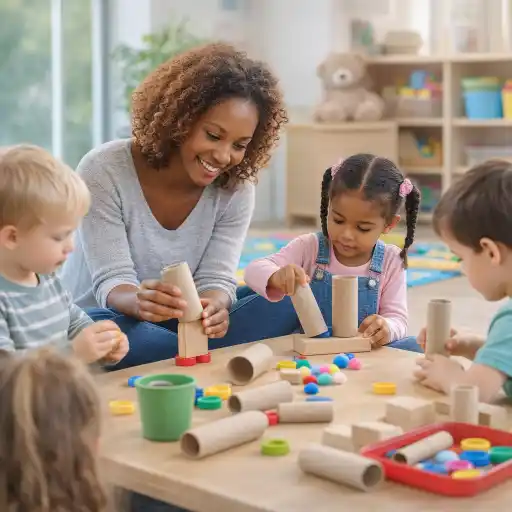
Offer a manageable selection rather than an overflowing collection. Three to six materials can help children focus while still leaving meaningful choices. Store materials in visible, labeled trays or baskets, and provide a designated place for works in progress so designs can remain available for further testing.
Inspect and prepare every item before use. Remove sharp edges, staples, broken pieces, residue, and choking hazards; clean materials according to program procedures. Consider children’s ages, abilities, and sensory preferences when selecting supplies. For guidance on making recycled items into classroom learning invitations, see using everyday materials for meaningful preschool STEM exploration. State requirements vary - check your state licensing agency.
How can teachers guide children through imagining, building, and testing?
A simple design cycle gives children a rhythm without prescribing the outcome: identify a problem, imagine possibilities, plan, create, test, and improve. Preschoolers may move back and forth between these steps. That is expected; a test often changes the plan, and a new material can spark a different idea.
- Imagine: Invite children to share more than one idea through talk, gesture, drawing, or pretend play.
- Plan: Ask what materials they might need and, when helpful, sketch a quick plan.
- Create: Let children build a model or prototype while adults support safe tool use.
- Test: Agree on a simple way to see whether the design meets the challenge.
- Improve: Invite children to change one feature and test again.
For a bridge challenge, children might place a toy across a cardboard span and notice that it bends. They can add a support, fold the cardboard, or change the distance between the ends, then compare results. Ask open questions such as “What do you notice?”, “What could you try next?” and “How will we find out if it works?” The STEMIE guide to open-ended questions reinforces the value of responsive interactions that invite children’s thinking.
Document a photo, a child’s words, or a quick drawing. This record helps children revisit an idea and helps teachers plan a next step. Celebrate the observations and revisions—not only a design that works on the first try.
How can educators support every child without taking over?
Inventive work is most meaningful when children have agency and a way to participate. Some children may build actively; others may select materials, explain a plan, test a prototype, take a photograph, or observe before joining. Offer multiple roles and communication options so participation does not depend on speaking quickly or using one particular tool.
- Use picture cues or a visual sequence for the design cycle.
- Offer larger materials, adapted grips, pre-cut pieces, or stable work surfaces when useful.
- Welcome home-language explanations, gestures, drawings, and demonstrations.
- Provide a quieter, less cluttered workspace for children who benefit from it.
- Allow partners or small groups to share roles and materials.
Observe before intervening. If a child’s structure collapses, resist the urge to fix it immediately. Acknowledge the experience—“The roof slid when you added the block”—and give the child time to decide what to try. Offer a hint only when needed, then return control to the child. This balance of attention and restraint protects both safety and ownership.
Be attentive to the emotional side of testing. A child may feel disappointed when an idea does not work as expected. You can validate the feeling while treating the result as useful information: “You hoped it would stand. We found out this base moves. What would you like to change?” Avoid labeling a child’s attempt a failure or comparing designs. The goal is a welcoming space where children feel safe to explore and revise.
How can programs make inventive thinking a consistent practice?
Invention does not need to be a special event or a separate STEM unit. Directors and teachers can build it into block play, outdoor exploration, art, dramatic play, and everyday routines. Start with one brief challenge, then revisit it over several days. Repetition gives children time to compare versions, collaborate, and deepen their understanding of materials.
After an activity, reflect as a team: Which children’s ideas shaped the work? What did they test or change? Were the materials accessible and safe? What question or resource might extend the investigation? A short photo-and-quote record can help staff notice learning and plan a meaningful continuation rather than simply replacing the activity.
Common pitfalls are usually manageable:
- Over-directing: offer a problem and open prompt, not a model to copy.
- Too many supplies: begin with a small selection and add materials in response to children’s thinking.
- Expecting a perfect product: value the design process, ideas, and revisions over appearance.
- Ending after the first test: leave time and space to return to the prototype.
- Skipping safety checks: inspect materials, supervise tools, and follow program procedures.
For further professional learning, educators can explore Building Early Science Foundations Buy Now $16.00, Enhancing STEM Education for Infants and Toddlers Buy Now $16.00, and Children at the Wheel: Emergent Curriculum Buy Now $25.00. These courses address related approaches to science inquiry, early STEM, and child-centered planning; review course details to choose what best fits your role and learning goals.
Conclusion: How can preschool teachers encourage invention without costly materials?
Preschool teachers can encourage inventive thinking by treating real classroom needs as design opportunities and offering safe, reusable materials children can transform. Invite children to imagine, plan, build, test, discuss, and improve; use open-ended questions, accessible participation options, and documentation to make their thinking visible.
The essential resource is not an expensive kit but a responsive educator who notices children’s questions, protects time for exploration, and sees unexpected results as a reason to keep thinking. Start with one everyday problem and a few simple supplies. Children’s ideas can turn that modest beginning into a rich cycle of discovery.
- 45 Hour Child Growth and Development
- 45 Hour Preschool Methods and Materials
- 45 Hour School Age Methods and Materials
- CDA Bridge Bundle: Family Child Care without Portfolio Review
- Art from the Heart for Preschoolers: Open Ended Art Projects that Build Self-Esteem
- CDA Bridge Bundle: Infant/Toddler without Portfolio Review
- CDA Bridge Bundle: Preschool without Portfolio Review
- Texas Director Credential
- Tiny Tinkerers: How Messy Play Today Could Lead to Tomorrow’s Top Inventors
- CDA Certification en Español: Recursos y Consejos para Educadores Bilingües
- Cuáles Son las Señales de Alerta en el Desarrollo Infantil que Todo Educador Debe Conocer?
- Celebra El Cumpleaños de Dr. Seuss En Tu Guardería Con Actividades Fáciles y Divertidas!
- ¿Qué es la Certificación de 90 Horas para Cuidado Infantil en Maryland?
- 10 Ejemplos de Cómo la Cultura Influye en el Desarrollo Infantil
- Proporciones de Cuidado Infantil y Tamaños de Grupo por Edad en Virginia (Guía Rápida para Centros y Hogares)
- ¿Cuál es la Diferencia Entre la Crianza Respetuosa y la Crianza Permisiva?
- Cómo Celebrar el Día Nacional del Kindergarten
- Cómo Ser Maestra de Preescolar en Maryland
- Calabazas, hojas y manzanas: actividades de otoño para preescolares
- Celebrando la amistad en el cuidado infantil durante el Día de los Mejores Amigos
- Diversión fresca de verano: actividades del Día Nacional del Helado para niños
- Canciones, juegos y preguntas de círculo para niños
- Cómo simplificar la capacitación para sus empleados de daycare
- How can I use simple STEM activities to spark curiosity in preschoolers?
- STEM for Preschoolers: Fun Activities That Encourage Curiosity
- How Can Child Care Providers Create Low-Cost STEM Activities With Items They Already Have?
- Which Low-Cost Printables Make the Biggest Classroom Impact?
- How Can Preschool Teachers Encourage Inventive Thinking Without Expensive STEM Materials?
