When children see only one “right” way to use a block, paintbrush, or cardboard box, valuable opportunities for exploration can disappear. With intentional materials and responsive teaching, you can help children imagine possibilities, test ideas, and build confidence; The Best Promotion is Play  Buy Now $24.00 offers a deeper look at how play supports development and classroom practice. For creative art strategies that move beyond copy-the-model crafts, explore Open Heart, Open Art Buy Now $16.00 as a practical next step.
Why does using materials in more than one way matter?
Children learn about an object by handling it, noticing its qualities, and exploring what it can do. A block may first be mouthed, tapped, or stacked; later, it may become a phone, a bridge, or part of an imagined city. This progression—from sensory exploration to purposeful use and symbolic representation—offers children opportunities to develop ideas at their own pace. NAEYC describes how ordinary materials such as blocks, paint, sand, water, playdough, and natural objects can support sensory, creative, and dramatic play.
When a material has one prescribed outcome, the adult often does most of the planning. Open-ended materials shift some of that decision-making to children. They can choose, combine, revise, and explain their actions. These experiences can invite problem-solving, language, collaboration, early math, and fine-motor practice within the same play episode. The benefits depend on thoughtful selection, sufficient time, and responsive support—not simply on placing a collection of objects on a shelf.
Creative use also communicates that children’s ideas are worth taking seriously. Rather than evaluating whether a creation looks like an adult’s model, educators can notice children’s strategies and invite them to share their thinking. This strengthens children’s agency while helping teachers see learning that may not be obvious in a finished product. A playful shift in the adult’s role—from instructor of a single use to attentive partner—can make a familiar classroom feel full of possibilities.
Which materials invite children to imagine and experiment?
Look for materials that can be moved, combined, changed, and interpreted in multiple ways. They do not need to be expensive or novel. Everyday objects, natural items, construction materials, and art supplies can all become creative resources when they are safe and presented as invitations rather than as instructions.
- Building and construction: blocks, cardboard boxes, tubes, fabric, and large interlocking pieces.
- Natural materials: leaves, pinecones, smooth stones, and twigs, gathered and used responsibly.
- Art and making: paper, clay or playdough, paint, collage pieces, and varied drawing tools.
- Dramatic-play props: scarves, baskets, containers, utensils, and familiar objects that can stand in for something else.
- Sensory and inquiry tools: scoops, funnels, measuring cups, magnifiers, and water or sand where appropriate.
Try combining a few contrasting materials rather than presenting a crowded assortment. For example, offer blocks, fabric, and small figures in a defined area; children might build a shelter, invent a story, or use the fabric in an unexpected way. ChildCareEd’s guide to loose-parts play offers further ideas for classroom use.
Before setting materials out, inspect them for breakage, sharp edges, splinters, toxicity, and age-related choking risks. Consider children’s sensory preferences, abilities, cultures, and interests as well. State requirements vary - check your state licensing agency.
How can the classroom setup encourage independent exploration?
Children are more likely to explore when materials are visible, reachable, and arranged in a way that makes possibilities easy to notice. Low shelves, open baskets, clear work surfaces, and picture-and-word labels can support children in choosing and returning items. A shallow tray or small-group table can make an invitation feel manageable; a few carefully chosen objects often invite deeper play than a shelf overflowing with choices.
Set materials near familiar play areas so children can connect new ideas with experiences they already understand. Fabric next to blocks may suggest a roof or a river, but it need not prescribe either. Leave room for children to move materials between centers when that is safe and workable. If a project needs more than one session, create a designated place for works in progress so children can return to their thinking.
Use rotation thoughtfully, guided by observation rather than an arbitrary schedule. A familiar material may still offer new possibilities when paired with a different tool or displayed in a new way. Conversely, if children are not engaging, first ask whether the display is confusing, inaccessible, crowded, or disconnected from their interests before deciding the material has failed.
- Keep a small, purposeful selection available and store extras for later rotation.
- Offer enough pieces for children to work together without unnecessary competition.
- Make cleanup predictable with clear labels and simple, consistent routines.
- Adapt tools or access as needed—for example, provide larger pieces, stable surfaces, or alternate ways to handle materials.
Thoughtful setup is not about making the room look perfect. It is about making children’s choices possible and showing that the classroom is a place where ideas can grow.
What can teachers say and do without taking over?
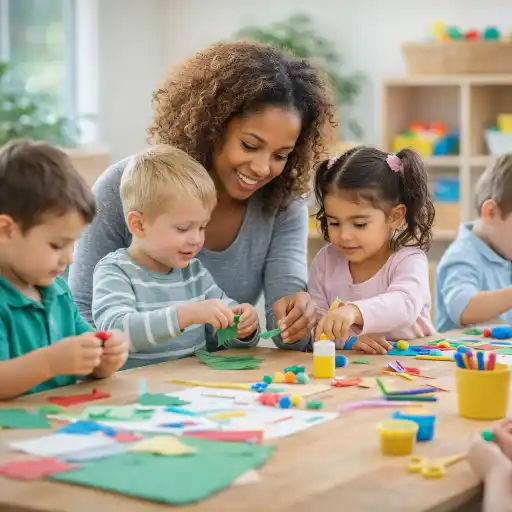
Begin by observing. Notice how a child approaches a material, what they repeat, what they combine, and where they pause. Give the play time to develop before stepping in. When you do join, follow the child’s lead and offer language that recognizes their actions: “You balanced the long block across two short ones,” or “You’re pressing the clay and watching what changes.” Descriptive comments make children’s thinking visible without declaring what their creation should be.
Open-ended questions can extend exploration, especially when they come from genuine curiosity. Try “What else could this be?”, “What might happen if you turn it?”, or “What are you noticing?” Ask one question, then allow time for the child to think or respond in words, gestures, or action. Avoid turning play into a quiz or asking children to explain every choice.
A brief demonstration can help when a child is unfamiliar with a tool or asks for an idea. Show a technique—such as rolling playdough or joining two cardboard pieces—without creating a finished model for children to copy. If a child becomes frustrated, help break the challenge into manageable parts while keeping the child’s goal at the center.
- Follow interests and join play as a partner, not a director.
- Describe effort, decisions, and problem-solving rather than judging the final product.
- Offer help when invited, or when a safety or access need calls for it.
- 🎨 Invite possibility: “I wonder what the sponge might do. Would you like to try it, watch, or choose another tool?”
NAEYC recommends focusing on children’s process and interests, narrating their actions, and supporting their efforts. A pause can be an important teaching move: it gives children room to stay with their own ideas.
How can teachers support different interests, abilities, and ages?
Creative exploration does not look the same for every child. One child may jump into messy play, while another prefers to watch or use a tool instead of touching the material directly. A child may communicate an idea through movement, construction, home-language words, drawing, or pretend play. These are meaningful forms of participation, not signs that a child is doing the activity incorrectly.
Offer flexible ways to engage. Provide brushes, tongs, scoops, or gloves when they are useful; arrange materials at accessible heights; and use visual cues or familiar objects to make a new invitation easier to understand. For children who benefit from predictability, introduce one new element at a time and keep familiar materials available. For infants and toddlers, choose appropriately sized items, supervise closely, and allow exploration to unfold in short, responsive exchanges.
Children’s backgrounds and family experiences can also shape the meanings they bring to materials. Invite family knowledge and, where appropriate, include familiar household objects, textiles, stories, or words in children’s home languages. Avoid assuming that every family uses or values materials in the same way. Ask respectfully and make participation in donations or activities optional.
Watch for individual cues. A child who observes from the edge may be gathering information before joining. A child who turns away may be communicating a preference or discomfort. Offer alternatives and revisit the invitation later rather than insisting that every child participate in the same way. Inclusive support means widening access while preserving children’s choice and dignity.
How can providers avoid common pitfalls and notice learning?
It is easy to narrow children’s possibilities without meaning to. A sample craft can imply that everyone should produce the same result; repeated directions can turn exploration into a step-by-step task. Instead, clarify the purpose—such as exploring texture, practicing a tool, or investigating balance—while leaving room for varied outcomes. Some teacher-guided instruction is useful, but it can sit alongside open-ended experiences rather than replace them.
Another common pitfall is offering too many materials at once. A large, disorganized collection may make it harder for children to choose, begin, or clean up. Start with a focused selection, observe what happens, and adjust. Do not equate a tidy finished product with meaningful learning: a child’s repeated attempts, conversation, experimentation, and collaboration may matter more than what remains at the end.
Documentation can help staff plan meaningful next steps. Record specific observations, child quotes, photographs (following program policies), and changes in strategy. For instance: “After the tower fell twice, Maya placed two wide blocks at the base and tested it again” tells more than “Maya played with blocks.” Directors can support consistency by discussing observations during team meetings and helping staff connect materials to children’s interests and developmental goals.
- Instead of displaying a model to copy, present a small set of materials with an open invitation.
- Instead of asking “What is it?”, try “Tell me about what you’re doing.”
- Instead of adding more items when interest dips, reconsider the arrangement, timing, and children’s current interests.
- Instead of recording only products, document children’s ideas, persistence, collaboration, and revisions.
Conclusion: How can teachers make room for creative uses of materials?
Teachers encourage creative use of materials by choosing flexible objects, arranging them accessibly, protecting time for exploration, and responding to children’s ideas with observation and genuine curiosity. Blocks, fabric, natural objects, recycled pieces, and art supplies can support many kinds of play when adults avoid prescribing a single outcome. Safety checks and developmentally appropriate adaptations remain essential.
Start small: choose a few safe materials, set them out in an inviting way, and notice what children do before deciding what to add or change. Follow their interests, ask open questions sparingly, and value the thinking behind the process. When children are trusted to imagine and experiment, a familiar box or block can become the beginning of a new idea—and teachers gain a clearer view of how children learn.
To deepen your practice, consider these English-language ChildCareEd courses: The Best Promotion is Play Buy Now $24.00, Open Heart, Open Art Buy Now $16.00, Beautiful Junk: Using Recycled Materials in the Classroom Buy Now $16.00, CDA: Curriculum Alignment & Materials Buy Now $16.00, and Creating Environments that Nurture Growth and Community Buy Now $55.00. Check course details and your professional-development requirements before enrolling.
- 45 Hour Preschool Methods and Materials
- Easy Steps to Resume and Interview Success
- What Makes Me Special: An Overview of Autism and ADHD
- 45 Hour School Age Methods and Materials
- CDA Bridge Bundle: Family Child Care without Portfolio Review
- Art from the Heart for Preschoolers: Open Ended Art Projects that Build Self-Esteem
- Bridging Intent and Response: Communication
- CDA Bridge Bundle: Infant/Toddler without Portfolio Review
- Staff Supervision, Observation & Feedback
- Wellness in Action: Teaching Healthy Habits to Children
- Tiny Hands, Big Dreams: Fostering Creativity in Preschoolers
- National Grouch Day: Turning Grouches into Giggles, Teaching Kids about Handling Negative Emotions
- How motor skills shape child development and creative ways educators can foster them.
- CDA Certification en Español: Recursos y Consejos para Educadores Bilingües
- ¿Qué es la Certificación de 90 Horas para Cuidado Infantil en Maryland?
- 10 Ejemplos de Cómo la Cultura Influye en el Desarrollo Infantil
- Proporciones de Cuidado Infantil y Tamaños de Grupo por Edad en Nueva Jersey (Guía Rápida para Centros y Hogares)
- Proporciones de Cuidado Infantil y Tamaños de Grupo por Edad en Virginia (Guía Rápida para Centros y Hogares)
- Cómo Celebrar el Día Nacional del Kindergarten
- Consejos de Supervisión Activa para Salones de Preescolar y el Juego al Aire Libre
- 7 Estrategias de Supervisión Activa para un Cuidado Infantil Más Seguro
- Celebrando la amistad en el cuidado infantil durante el Día de los Mejores Amigos
- Cómo simplificar la capacitación para sus empleados de daycare
- How Can Preschool Math Become Meaningful, Playful, and Part of Every Day?
- Teacher-Directed or Child-Directed? Finding the Right Classroom Balance
- How Can One Material Spark Different Discoveries for Infants and Toddlers?
- How Can Learning Spaces Encourage Independent Problem-Solving?
- How Can Teachers Encourage Children to Use Materials Creatively Instead of Only One Way?
- No Snow? No Problem! How Can You Create Winter Sensory Activities for Every Childcare Classroom?
