When number practice feels like a chore, a colorful dot marker can turn it into an inviting, hands-on challenge. Pairing dotting with purposeful number recognition helps children connect numerals, spoken number names, and quantities while strengthening classroom-ready skills; explore No Such Thing as Boring Math  Buy Now $24.00 for practical ways to weave math into play, and Early Mathematics Through Play Buy Now $24.00 for strategies spanning counting, number sense, and exploration. These courses can deepen your planning beyond a single worksheet, while the ideas below help you get started tomorrow.
Why combine dot markers with number recognition practice?
Dot-marker activities give children an active way to look closely at numerals, make choices, and show what they notice. Rather than asking a child only to name a number, an educator can invite them to find the numeral among distractors, say its name, and mark it. This links visual attention, language, and movement in a short, satisfying task.
These pages are most useful when they are one part of a broader math experience. Children develop number understanding by connecting number names, written symbols, and quantities—not simply by coloring a page. A worksheet can prompt those connections when the adult adds talk and concrete materials: “You found the 4. Can you make a group of four counters, too?”
Dotting also gives young learners practice coordinating what they see with how they move their hands. The process can support fine-motor control, visual scanning, and attention to directions, though a child’s ability to dot neatly is not a measure of mathematical understanding. Keep the goal on exploration and meaning, not perfect circles.
- Choose one clear math goal, such as finding a numeral or matching it to a set.
- Use a brief activity as a playful invitation, not as a replacement for conversation, games, or manipulatives.
- Celebrate strategies and persistence: “You looked carefully and checked each number.”
For a helpful companion on making math lively and intentional, see ChildCareEd’s No Such Thing as Boring Math Buy Now $24.00 course.
How can educators prepare a dot-marker number activity?
Start with a worksheet or a simple page you create yourself. The ChildCareEd Spot and Dot letter A activity Buy Now $0.00 is a letter-focused example of the spot-and-dot format; for number practice, prepare a page featuring one target numeral repeated among a small selection of other numerals. The sellable Do-A-Dot Numbers Worksheet can serve as a ready-made starting point. Select a manageable range that reflects what children have encountered in play and daily routines.
Gather washable dot markers, a stable work surface, and optional counters or number cards. If dot markers are unavailable, children can use stickers, crayons, or a finger to point and then cover the numeral with a small, age-appropriate material under close supervision. Check that all supplies are suitable for the children’s ages, and supervise use according to program safety practices.
Before inviting children, decide what you will observe. Is the child recognizing the target symbol? Can they name it? Do they connect it with the matching quantity? These are related but distinct skills. Keep instructions short, model one example, and give children time to scan the page without rushing.
- Introduce the numeral and say its name together.
- Model finding and dotting one example, explaining your thinking aloud.
- Offer the page with only a few distractor numerals at first.
- Place counters nearby if you want to link the numeral to a quantity.
Preparation should make the task accessible and inviting—not turn it into a test. A calm setup gives you more time to notice each child’s approach.
How do you connect numerals, number names, and quantities?
Number recognition becomes richer when children experience a numeral in more than one way. A child may point to the written 5 when asked, say “five” when shown it, or count five objects. These abilities overlap, but they are not identical. Intentionally moving between them helps educators see what a child understands and what kind of support may help next.
Use the dot worksheet as a starting point for a short conversation. When a child finds a target, invite them to say the number, trace its shape in the air, and build a matching set with counters, blocks, or familiar classroom objects. For example: “You dotted the 3. Let’s count three bears together.” Count each object once and pause after the last item to name the total.
Represent quantities in different arrangements so children do not learn that a number only looks one way. Three counters can sit in a row, form a triangle, or be spread across a mat; the quantity remains three. The NSW Education resource on connecting number names, numerals, and quantities likewise emphasizes making links across verbal, visual, concrete, and symbolic representations.
- Say the number name as the child locates the numeral.
- Match a numeral card to a small collection of objects.
- Ask open prompts such as “How did you know?” or “What else shows three?”
- For children who are ready, compare two sets using more, fewer, or the same.
These exchanges turn each dot into a chance to reason, communicate, and build #numbersense.
How can you adapt the activity for different learners?
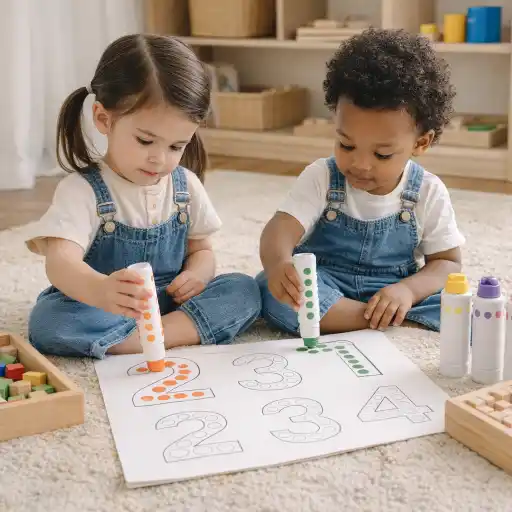
Children come to number activities with varied experience, language, motor control, attention, and confidence. Adjusting the task is not lowering expectations; it is making the learning goal reachable. Begin with what a child can do comfortably, then add challenge gradually as interest and understanding grow.
For a child who is new to numeral recognition, offer one target number and only a few choices. Pointing, placing a sticker, or choosing a card can show recognition without requiring the child to use a marker precisely. A child who already recognizes the numerals might search a busier page, find numerals out of sequence, or match each numeral to a set of objects.
Consider sensory and motor needs as well. Some children may prefer a thicker marker, a slanted surface, larger targets, or an alternative tool. Others may benefit from seeing a model, hearing a direction in their home language, or working alongside a peer. Shorten the activity or offer a movement break if attention wanes. Children should never have to finish every item to demonstrate learning.
- 🖍️ Offer a choice of marker, sticker, crayon, or pointing response.
- Reduce visual clutter and enlarge numerals when needed.
- Use a small number range and build gradually from familiar skills.
- Invite children to show understanding through objects, gestures, words, or matching.
Observe and adjust without labeling a child as “good” or “bad” at math. A supportive response—“Let’s look at the shape together”—keeps the activity welcoming and preserves a sense of agency.
How can you extend learning and avoid common pitfalls?
Once children understand the basic routine, extend the math without making the page longer or more demanding. Ask a child to count the dots they made, create a group of matching objects, or find the same numeral on a classroom label or calendar. You can also invite children to make a dot pattern, compare two numerals, or play a small-group “find the number” game with cards.
Use observations to plan the next experience. If a child identifies a numeral but does not yet connect it to quantity, bring in counters and model one-to-one counting. If the child counts a set accurately but is unsure of the written symbol, revisit numeral matching through games and environmental print. The Early Math Counts Number Memory activity offers another way to pair numerals with pictorial quantity representations.
A common pitfall is treating correct marks or a completed worksheet as proof of broad math mastery. A child may dot by guessing, copying a peer, or following color cues without recognizing numerals. Ask the child to explain, point, match, or count so you can understand their thinking. Another pitfall is pushing speed: timed tasks can shift attention from careful recognition to performance pressure. Keep practice brief, playful, and responsive.
Document a specific observation rather than a vague judgment: “Found 2 and 5 independently; matched 2 to two counters with a prompt.” Use that information to select the next step and share meaningful progress with families. State requirements vary - check your state licensing agency if you need to align math activities or documentation with local guidance.
Conclusion: What makes dot-marker number practice effective?
Combining dot markers with number recognition practice works best when the activity connects a numeral to its spoken name and a real quantity. Keep the page simple, model the task, provide appropriate tools, and let children explain or demonstrate their thinking. The markers make practice tangible and appealing, but the educator’s questions, observations, and follow-up experiences are what deepen learning.
Remember the main goal: help children notice numerals, connect them with number words and quantities, and feel capable as they explore math. Adapt the activity to each learner, keep it short enough to remain enjoyable, and extend it with counters, games, movement, and everyday classroom discoveries. For a broader foundation in play-based math planning, explore Early Mathematics Through Play Buy Now $24.00 or No Such Thing as Boring Math Buy Now $24.00 from ChildCareEd.
- 45 Hour Child Growth and Development
- Many Colors, One Canvas: MD ECE Conference
- CDA Home Visitor Subject Area 2 Part 3 Birth to 5
- 45 Hour Preschool Methods and Materials
- Power of Art: Bldg Self-Esteem & Positive Behavior for ALL Abilities
- The ABCs of Behavior: Turning Challenges into Learning Opportunities
- Children at the Wheel: Emergent Curriculum
- 45 Hour School Age Methods and Materials
- Texas Director Credential
- Cómo Obtener la Credencial de Visitante de Hogar CDA
- 💛🧩 ¿Cómo puedo hacer que mi enseñanza sea inclusiva para los niños con autismo?
- ¿Cómo empiezo mi certificación CDA en Florida en línea?
- Canciones, juegos y preguntas de círculo para niños
- Cómo simplificar la capacitación para sus empleados de daycare
- Count It, Sort It, Find It! Fall Math Games for Preschoolers
- Teaching Math to Young Children: Why Counting to 20 Doesn’t Mean They Understand 20
- How Can You Teach Numbers to Ten with Ten-Frames and Visual Models?
- How Can Early Childhood Programs Introduce Juneteenth in Developmentally Appropriate Ways?
- How Can Visual-Motor Practice Strengthen Alphabet Order?
- How Do Dot-to-Dot Activities Support Number Order and Pencil Control?
- How Can Child Care Providers Integrate Counting into Seasonal Art Activities?
- How Can Dot Markers Make Number Recognition Practice More Meaningful?
- How Can Hands-On Dot-Marker Activities Build Alphabet Knowledge?
- How Can Connect-the-Dots Activities Reinforce Number Sequence and Motor Planning?
- How Can Independent Practice Connect Numerals and Number Words?
- How Can You Adapt Number Activities for Children with Cerebral Palsy?
- Why Does a Child Think Odd Numbers Are Always Smaller—and How Can Providers Help?
- What Do Missing-Number Problems Reveal About a Child’s Math Strategy?
