Hello friend — this short guide is for child care providers and directors in Minnesota who care for children learning two languages. Many children in our care are #DLLs, and they bring big strengths. This article gives clear steps you can use right away. You do not have to be a language expert to help a child thrive.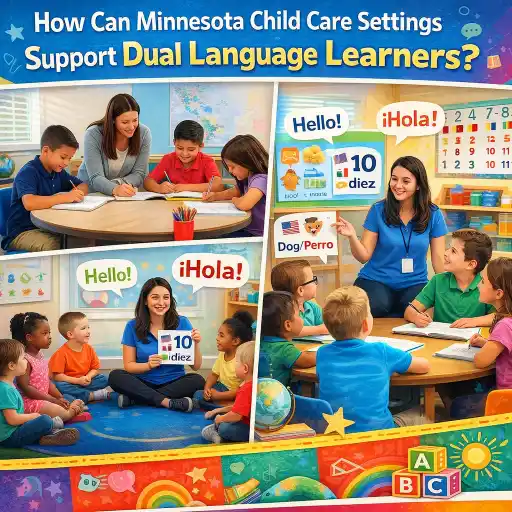
Quick facts: 1 in 5 young children in Minnesota grows up in a home where a language other than English is spoken — that means this touches a lot of programs (Reach Out and Read Minnesota). Start small: welcome the child’s home language, add visuals, and build family partnerships. For practical classroom ideas, see Supporting Dual Language Learners in Child Care Settings and How Can Child Care Programs Best Support Dual Language Learners?.
Why this helps your program now:
- Children learn better when they feel #safe and seen.
- Keeping the home language supports learning of English and later reading.
- Working with families builds trust and keeps children connected to culture.
Why does supporting Dual Language Learners matter in Minnesota child care?
Why it matters for Minnesota programs:
- Children feel safer and join class more quickly when they see their language and culture in the room.
- Families are more likely to trust and use your program when you honor their language.
- Programs that support languages often see better child outcomes and stronger family engagement.
Practical links: Minnesota programs can find local guidance and resources on the state site under "Multilingual Learners" (Minnesota Department of Education) and use community webinars like The Next Page: Bilingualism in Early Childhood for the local context.
Short takeaway: Support the child’s home language and English at the same time. That helps development and family trust. Remember: keeping two languages is a gift for a child’s brain and future learning. #Minnesota #bilingual
It matters because children who keep their home language do better later in school. When we support a child’s two languages, we help their thinking, memory, and identity. Research and practice say that bilingualism is a strength, not a problem. See the ideas in Many Languages, One Classroom for good reasons to celebrate language.How can I set up a welcoming, language-rich classroom?
- 😊 Labels in two languages: Put picture labels on shelves and bins in English and the child’s home language. See examples in ChildCareEd’s guide.
- 📚 Books and music: Add board books, picture books, and songs in home languages. Use translations and invite families to share favorites (Many Languages, One Classroom).
- 🖼️ Family photos and objects: Display photos and meaningful items from home. These calm children spark conversation.
- 📷 Visual routines: Use picture schedules, object cues, and simple signs for transitions. Visuals reduce confusion during busy times.
- 🎨 Cultural corners: Create a small area with toys, art, or music from the child’s culture. Rotate items so each child’s culture is highlighted over time.
- 🔤 Print supports: Add name cards, alphabet posters, and simple labels to build print knowledge across languages (see language & literacy strategies).
Use durable, clear labels and pictures. Ask families to help with words and photos. State requirements vary - check your state licensing agency when you add materials or post translated policies.
Setting up your room makes a big difference. A few low-cost changes help children understand routines and feel at home.What daily teaching moves help children learn and keep their home language?
- 😊 Model language: Speak slowly, use short sentences, and describe what you do aloud (self-talk and parallel talk). Repeat keywords often.
- 📷 Use gestures and pictures: Point to objects, act out words, and show photos when you name things. Visuals help make meaning.
- 🔁 Repeat and expand: When a child says a word, repeat it and add one new word. This grows vocabulary step by step.
- ✍️ Support print knowledge: Use name cards, letter posters, and reading times. Print skills in any language support later reading (see Promoting Language Development).
- 🤝 Peer buddies: Pair children to play and learn together. Peers can model language naturally during play.
- 🎵 Songs and routines: Use the same songs and signals for transitions. Routines give a chance to hear and practice words again and again.
For toddlers, the Language Modeling PDF Buy Now $0.00 has quick scripts you can copy. Small, repeated supports are better than big changes. Celebrate the child when they use either language — praise works wonders. #inclusion #bilingual
You don’t need to speak every language to support a child. Use these simple moves every day. They are backed by resources like Language Modeling Buy Now $0.00 and ChildCareEd trainings.How can I partner with families, connect to community supports, and follow rules?
Strong family partnerships are central. Families are experts about their child’s language. Use simple, respectful steps to build trust.
- 📩 Invite family voice: Ask parents to share favorite words, songs, and photos. Keep a small notebook with the phonetic pronunciations they write for you.
- 📲 Use visuals and voice notes: Send photos, short voice messages, or translated flyers. ChildCareEd has resources for family engagement and translations (Free Resources and Professional Development in Different Languages).
- 🎓 Staff training: Take courses like Building Bridges for Dual Language Learners
 Buy Now $16.00 (approved in Minnesota) to learn practical tools. You can also enroll in individualized learning online courses to strengthen skills in tailoring instruction and supports to each child's unique needs.
 - 🏘️ Community links: Connect families to local bilingual story times and cultural events. Reach Out and Read and local libraries often host bilingual programs (Reach Out and Read MN).
Common mistakes and how to avoid them:
- Don’t tell families to stop the home language — that harms learning. Encourage home language use.
- Don’t label normal steps (like a silent period or mixing words) as a disorder. These are typical in language learning.
- Don’t rely only on tests in English. Use observations and family reports across both languages (see ChildCareEd guidance).
Important note: state requirements vary - check your state licensing agency for rules on translated materials, record keeping, and staff qualifications. For immersion program ideas and research, see CARLA at the University of Minnesota (CARLA).
Summary and FAQ: What are the next steps and common questions?
Summary: Start with small, practical steps: label the room in both languages, use visuals and routines, invite families into the classroom, and use repeatable teaching moves. Train your staff with short courses like Building Bridges Buy Now $25.00 and use free resources on ChildCareEd’s website. Keep connection and respect at the center of your work.
Quick FAQ
- Q: Do I need to speak the child’s home language? A: No. Use visuals, key words, family notes, and gestures. Family help is priceless.
- Q: Will two languages confuse a child? A: No. Bilingualism supports thinking and later reading.
- Q: How do I measure progress? A: Watch the child in play, use checklists, and ask families to share language at home.
- Q: Where can I get training in other languages? A: ChildCareEd supports many languages for course slides (see PD languages).
- Q: Who can I contact in Minnesota for policy or program questions? A: Check the Minnesota Department of Education pages under "Multilingual Learners" (MDE A–Z) and local early learning partners.
Final encouragement: You are already doing important work. Small, consistent supports help children feel #safe, keep their home language strong, and learn English. Use the links in this article for classroom tools, family handouts, and training. Celebrate language every day — it makes your program stronger and children happier. #families #inclusion
- Building Bridges for Dual Language Learners
- Building Bridges for Dual Language Learners: For Workforce Solutions
- CDA Bridge Bundle: Family Child Care without Portfolio Review
- CDA Bridge Bundle: Infant/Toddler without Portfolio Review
- CDA Bridge Bundle: Preschool without Portfolio Review
- 45-Hour Infant and Toddler Curriculum
- Texas Director Credential Renewal
- Texas Director Credential
- Building Bridges for Dual Language Learners
- Language for Our Littlest Learners: Building Communication From the Start
- The Power of International Sign Language in Early Childhood Education
- CDA Certification en Español: Recursos y Consejos para Educadores Bilingües
- Apoyo en Español para Capacitaciones Grupales Presenciales y por Zoom en Cursos Selectos
- Apoyo en Preescolar para Retrasos del Habla: Estrategias Simples que Ayudan
- How can child care programs best support Dual Language Learners?
- How can Texas child care providers use simple language and visual supports with children?
- How Can North Dakota Caregivers Help Toddlers with Speech Delays?
- How can I support a child in New York childcare who refuses to speak to any adult?
- How can Minnesota child care settings support Dual Language Learners?
- Canciones, juegos y preguntas de círculo para niños
- How Can New York Providers Support Children Learning English?
- How can child care programs support immigrant and multilingual families?
- How can child care programs best support Dual Language Learners?
- How Can Child Care Programs Create Inclusive Programs for Rural Communities?
- What Cultural Differences Can Be Mistaken for Behavior Problems in Child Care?
- Why Do Bilingual Classroom Activities Matter for Dual Language Learners?
- How Can Spanish Printable Resources Support Dual Language Learners?
- How Can Teachers Support Children Starting Kindergarten This Fall?
