Children who refuse to talk to adults can feel scared, embarrassed, or overwhelmed. This article helps directors and providers in New York understand what might be happening and gives practical steps you can use right away. You will learn how to keep children safe, build #trust, and help a quiet child find their #voice without pressure. This guide applies to group care, family child care, and preschool settings in #NewYork. Remember: state requirements vary - check your state licensing agency.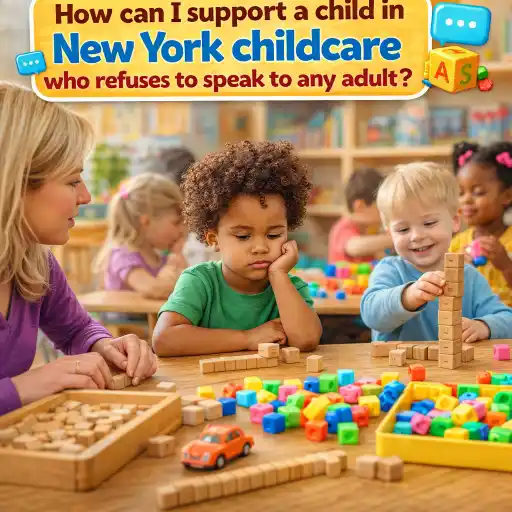
1) What could cause a child to stop talking to adults?
- Temperament and shyness — some children are naturally quieter and need more time to warm up. See Helping Shy or Quiet Children Find Their Voice in Group Settings for gentle ideas.
- Selective mutism — a childhood anxiety where a child speaks at home but not in other places. The review in the APA literature.
- Trauma or stress — children who feel unsafe may freeze or avoid adults. See trauma-informed steps at Trauma-Informed Care in Childcare Settings.
- Speech or language delay — some children understand a lot but haven’t learned words yet. Practical classroom supports are in Supporting Children with Speech Delays in Child Care.
- New routines, new adults, or language differences — a child learning two languages or new to your program may stay silent while they listen and learn; see tips at How can child care programs best support Dual Language Learners?.
Why this matters: children who don’t speak may miss chances to build friendships and skills. Small supports make a big difference. For more on recognizing worries and talking with families, look at the CDC training Watch Me! Module 4.
2) How do I make the classroom safe so the child will try to speak?
- 😊 Build trust slowly:
- Greet the child by name every day.
- Spend a short one-on-one play time (5–10 minutes) without asking them to talk.
- Use consistent, calm routines so the child knows what to expect. See How can we build respectful teacher–child relationships?.
- 📷 Add visual supports:
- Use picture choice boards, feeling charts, and a simple schedule so the child can point or show instead of speaking. Ideas are in Supporting Children with Speech Delays.
- 🌐 Supporting dual language learners: For staff working with children who may be silent due to language differences or bilingual development, ChildCareEd's Building Bridges for Dual Language Learners
 Buy Now $16.00 is a 2-hour online course covering how to use visuals, modeling, and language-supportive strategies to help children who are navigating two languages — directly supporting the visual choice boards, expand-and-extend methods, and small-group communication steps described throughout this article.
- 🧩 Create low-pressure ways to communicate:
- Offer puppets, whisper options, or a “talking helper” toy teachers hold while the child whispers into it.
- Allow hand signals or cards for “more,” “help,” and “all done.”
- 👥 Use small groups and buddies:
- Pair the child with one trusted peer for short activities to practice communication.
- 📣 Model and expand language:
- If the child points, model the words. Example: Child points to cup → Adult: “You want cup. Red cup.” This “expand and extend” method is explained in Language explosions.
Keep your tone calm and avoid pressuring the child to talk. Celebrate any small effort — even eye contact or a smile is progress.
3) What should I say to families and how do we team up?
- 🔎 Share observations with care:
- Start with strengths: “I see Maya playing with cars and listening at circle time.”
- Give facts: when, where, and what you notice (no labels). The CDC advises using milestone checklists when concerned; see Watch Me!.
- 🤝 Ask questions and listen:
- Ask what the child does at home and what helps them warm up.
- Repeat back what you hear so families feel heard.
- 🧾 Create a small team plan:
- List 2–3 classroom steps you will use (visuals, small group, one-on-one time).
- Ask families to try one matching step at home (same words or a visual card).
- Set a short follow-up (3–7 days) to check progress.
- 📚 Refer when needed:
- If you suspect selective mutism, anxiety, or a speech delay, suggest evaluation by a speech-language pathologist or mental health professional. ChildCareEd has guidance on speech concerns at Supporting Children with Speech Delays and trauma-informed care at Trauma-Sensitive Care.
- 📋 Mandated reporter training: To make sure all New York staff are confident in their reporting obligations when silence or withdrawal raises concerns, ChildCareEd's Mandated Reporters Buy Now $16.00 is a 2-hour online course covering how to recognize signs of abuse and neglect, document observations objectively, and follow New York's mandatory reporting procedures — directly supporting the CPS guidance and careful documentation steps outlined in this guide.
Remember to document observations. In New York, mandated reporting rules apply if you suspect abuse or neglect — review the guidance at New York Child Abuse Laws and the state CPS guide A Guide to New York's Child Protective Services System. If you are unsure about referral steps, ChildCareEd offers New York–approved trainings for providers: Professional Development Training for New York Childcare Providers. For information about state awareness campaigns and ACEs-focused trainings in other states, see Georgia Child Abuse & Neglect Awareness.
4) How do I avoid common mistakes and what is a simple daily checklist?
Common mistakes often slow progress. Here’s how to avoid them and a short checklist you can use now.
Common mistakes (and fixes):
- ❌ Mistake: Pressuring the child to speak in front of others. Fix: Use private, low-pressure invitations and one-on-one play. See Helping Shy or Quiet Children Find Their Voice.
- ❌ Mistake: Assuming silence is rudeness or defiance. Fix: Consider anxiety, language exposure, or a speech delay and observe across days.
- ❌ Mistake: Giving long lectures while a child is upset. Fix: Calm first, then coach with short phrases. See What Positive Behavior Guidance Techniques Work in Child Care?.
- ❌ Mistake: Not involving families early. Fix: Share facts, ask about home patterns, and propose one small joint step.
Daily checklist (5 quick actions):
- 😊 Greet the child by name each arrival.
- 📷 Post simple visuals (schedule, choice cards) at child height.
- 🧩 Give a 5–10 minute one-on-one play time without expecting speech.
- 📣 Model short phrases and expand what the child shows or points to.
- 🤝 Send a brief family note: strength + one observation + one small plan. (Example: “Maya listened to the story today. At home, can you try a 2-minute puppet game?”)
Why it matters: Calm, steady steps protect relationships and help the child learn at their own pace. Small wins build confidence and reduce anxiety.
Conclusion: What next and FAQ
Start with safety, trust, and small wins. Work with families, use visuals and small-group supports, and consult specialists when needed. Keep notes and follow New York rules on mandated reporting and referrals. For training and more tools, explore ChildCareEd courses like Trauma-Sensitive Care and Supporting Children with Speech Delays.
FAQ:
- Q: When should I worry and refer for evaluation? A: If the child speaks at home but not at your program for many weeks, is very anxious, or shows other delays, suggest a speech or mental health evaluation. Use objective notes and share them with the family. See Supporting Children with Speech Delays.
- Q: Is silence the same as selective mutism? A: Not always. Selective mutism is a specific anxiety pattern. Consult specialists and use resources such as the APA review (APA).
- Q: Do we have to report silence? A: Silence alone is not reportable. But if you suspect abuse or neglect, you must follow mandated reporter laws. See New York Child Abuse Laws and state CPS guidance.
- Q: How long before we expect change? A: Small steps can show in days; bigger changes may take weeks. Track progress and celebrate small wins.
Thank you for supporting children who are quiet or anxious. Your calm, consistent care matters. For more classroom scripts, check Positive Guidance and keep learning with New York training options at ChildCareEd NY trainings. Keep using your strengths—children notice kind, steady adults.
Safety and predictability are the first steps. Follow these numbered steps you can use today: There are many reasons a child might not speak to any adult. Some common causes are: Families are the experts about their child. Use these clear steps to partner with them:
- CDA Home Visitor Subject Area 3 Part 3 Birth to 5
- CDA Home Visitor Subject Area 2 Part 3 Birth to 5
- Mastering Supervision: Keeping Children Safe in All Settings
- Bienvenido! Welcoming All Families
- Birth to Five CDA Credential with Portfolio Review
- Pediatric RSV First Aid & CPR/AED
- CDA Bridge Bundle: Family Child Care without Portfolio Review
- CDA Bridge Bundle: Infant/Toddler without Portfolio Review
- CDA Bridge Bundle: Preschool without Portfolio Review
- Texas Director Credential
- Welcome to New York: Early Childhood Education
- CDA Certification en Español: Recursos y Consejos para Educadores Bilingües
- 🔍 ¿Qué ves cuando observas a un niño aprender?
- 💛🧩 ¿Cómo puedo hacer que mi enseñanza sea inclusiva para los niños con autismo?
- 👶 ¿Cuáles son las proporciones y grupos requeridos en Dakota del Norte? 🏫
- 10 Ejemplos de Cómo la Cultura Influye en el Desarrollo Infantil
- Proporciones de Cuidado Infantil y Tamaños de Grupo por Edad en Virginia (Guía Rápida para Centros y Hogares)
- Lista para Abrir una Guardería en Casa en Dakota del Norte: Cómo Empezar
- Lista para Guardería en Casa en Texas: Cómo Iniciar una Guardería en el Hogar
- Apoyo en Preescolar para Retrasos del Habla: Estrategias Simples que Ayudan
- How can New York childcare providers build self-confidence in toddlers?
- How can I support a child in New York childcare who refuses to speak to any adult?
- Cómo simplificar la capacitación para sus empleados de daycare
- How can I renew my New York child care license without a gap?
- How Can New York Providers Support Health, Family, and Learning Together?
- How can New York providers host effective parent-teacher conferences?
- How Can Child Care Providers Teach Children What to Say During Conflict Beyond “Use Your Words”?
- How Can Child Care Providers Build Positive Relationships With Difficult-to-Reach Children?
- How Can Child Care Providers Support Kindergarten Emotions on the First Day of School?
