As child care leaders in Minnesota, you care for little lungs and big feelings every day. This guide gives clear, simple steps you can use today to prepare for severe #weather, smoky air, heat waves, and sudden storms. Why it matters: when you plan, children stay safer, families trust you, and staff feel ready. Use local tools and trainings, and remember state requirements vary - check your state licensing agency.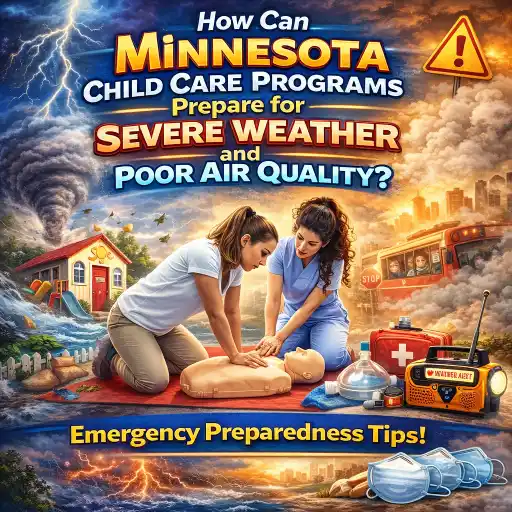
What should we do now to be ready before an alert happens?
Preparation starts with a few easy wins you can do this week. Follow these steps:
- Make a simple plan and write it down. Include evacuation routes, shelter-in-place spots, reunification steps, and who calls families. ChildCareEd has a free guide and sample plans to help you start quickly.
- 📋 Building your emergency plan: For programs that need to create or update a written emergency plan, ChildCareEd's Creating an Emergency and Disaster Preparedness Plan
 Buy Now $16.00 is a 2-hour online course walking providers through how to develop a clear, practical emergency plan covering evacuation routes, shelter-in-place procedures, reunification steps, and family communication — directly supporting the plan-writing and hazard-mapping steps described in this article.
 - Build or refresh a Go-Bag for each classroom or a central bag. Include attendance sheets, emergency contacts, meds (if allowed), first aid, water, snacks, a whistle, and a charged power bank. See the ChildCareEd checklist: Your Emergency Go-Bag.
- Map hazards and exits. Do a quick hazard walk at child height and use a hazard map tool like the one from ChildCareEd: Hazard Mapping Buy Now $0.00.
- Assign roles and practice them. List 1–2 people who will check alerts, one who grabs the Go-Bag, one who leads reunification, etc. Include substitutes in training.
- Train staff on local alerts and where to check them: MN Dept. of Health and AirNow are good sources. For air guidance, use the Minnesota Outdoor Air Quality Guidance for Schools and Child Care.
- 🚨 Emergency and disaster preparedness: To build staff confidence in responding to severe weather, smoke events, and evacuations, ChildCareEd's Emergency and Disaster Preparedness Buy Now
$55.00$45.00 is a 6-hour online course covering how to prepare for, respond to, and recover from a range of emergencies in early childhood settings — a direct match for the drill practice, role assignments, and post-event documentation steps outlined in this guide.
Small steps done now save time and stress when an alert comes. Keep a printed plan in the office and a quick checklist by every exit. #preparedness #safety #children
How do we decide when to keep kids indoors because of smoke or bad air?
Use the Air Quality Index (AQI) as your main decision tool and follow Minnesota guidance. The MDH guidance helps schools and child care decide when to change outdoor plans: Minnesota Outdoor Air Quality Guidance. Also watch MN wildfire updates: Wildfire Smoke - MN Dept. of Health.
- Check AQI regularly (morning and before afternoon play). Use AirNow or the MPCA maps. Helpful link: MN Air Quality, Climate and Health.
- Use clear cutoffs. Many programs use rules like:
- 0–50 (Good): outdoor play as usual.
- 51–100 (Moderate): watch sensitive kids; consider shorter outside time.
- 101–150 (Unhealthy for Sensitive Groups): move active play indoors; limit vigorous activity.
- 151+ (Unhealthy or worse): keep everyone indoors, reduce activity, use filtered air.
- When inside, make indoor air cleaner:
- 🔸 Run HVAC on recirculate and use the best filter available (MERV 13+ if possible).
- 🔹 Use portable HEPA air cleaners in rooms where children spend most time (“clean-air room”).
- 🔸 Avoid indoor activities that make smoke worse (frying, candles, vacuuming without HEPA).
- Mask guidance: follow public health advice. For young children, masks often don’t fit well—primary protection is staying indoors and using clean air. See CDC guidance on children and smoke: Wildfire Smoke and Children (CDC) and MN recommendations.
- Document your decision and tell families. A short message like: “AQI ___ today; we are using indoor plans and running filters. Please send asthma meds if your child needs them.” ChildCareEd offers sample smoke-day messages: When to Keep Kids Inside.
Keeping a simple AQI cutoff posted helps staff make fast choices. #airquality #preparedness
What should we do during heat, storms, power outages, or an evacuation?
On the day of the event, clear steps help staff act calmly. Use these numbered actions and link them to your written plan. For heat guidance, Minnesota offers strong tips: Extreme Heat - MN Dept. of Health. For weather watches and warnings, use NOAA/NWS info: NWS Forecast Parameters.
- Check the alert and pick the right response:
- Watch vs. Warning vs. Advisory: a warning means take action now; a watch means be ready. Learn definitions from NWS resources.
- If heat is the problem:
- 🟠 Move activities to cool, shaded, or air-conditioned spaces.
- 🟢 Offer water often and schedule quiet, low-energy play during the hottest hours.
- 🔸 Consider relocating to a public cooling center if your building is very hot.
- If wildfire smoke or poor AQI is the problem:
- Close doors/windows, run filtration, limit physical play, and watch for symptoms. See MN wildfire tips: Wildfire Smoke - MN Dept. of Health.
- If you must evacuate:
- Follow your evacuation map and take the Go-Bag(s) and attendance list.
- 🔔 Staff: do a head count before leaving, at the relocation site, and again when reuniting.
- Call 911 for immediate danger. Use your written reunification plan to contact families once safe.
- If power goes out:
- Keep fridge/freezer closed, move children to the coolest/safest room, and consider temporary relocation if it’s too hot or unsafe. Minnesota guidance includes power-outage tips in heat events: Extreme Heat.
- After the event: check children for symptoms, document what happened, debrief staff, and report to your licensing agency if required. FEMA and MN emergency resources can guide reporting and recovery steps: FEMA preparedness for childcare Buy Now $0.00 and MN’s disaster page: Disasters and Emergencies - MN Dept. of Health.
Practice these steps during drills so staff know the flow. Keep your plan visible and up to date. #weather #safety
How can we practice, communicate with families, and avoid common mistakes?
Practice and clear communication reduce stress. Use these practical tips and avoid common pitfalls.
- Run regular drills and reviews:
- Schedule fire, lockdown, evacuation, and shelter-in-place drills at least twice a year. Use ChildCareEd courses and templates to help: Emergency Preparedness and Sample Action Plan Buy Now $0.00.
- After drills, ask: what worked? what needs to change? Update the plan and post the new version.
- Communicate simply with families:
- Use one short, friendly message template. Example: “AQI is ___. We are using our indoor plan and running HEPA filters. Please send meds if needed.”
- Tell families where you will reunify and how they will be notified. Practice the reunification process so it’s smooth and calm.
- Common mistakes and fixes:
- ❌ Mistake: Only checking one far-away AQI station. ✅ Fix: use local maps (AirNow, MPCA) and check more than once per day.
- ❌ Mistake: Not assigning who grabs the Go-Bag. ✅ Fix: list names on the plan and practice during drills.
- ❌ Mistake: No indoor plan for smoky or hot days. ✅ Fix: create ready-made indoor movement centers and calm activities before the season starts. ChildCareEd has ideas for indoor routines: Smoke-day indoor plans.
- Use training and community partners:
- Take FEMA or MN Dept. of Health trainings to build confidence: FEMA course IS-36 helps with hazard mapping and planning (IS-36). For a course focused specifically on early childhood settings, consider When the Unthinkable Happens, which offers emergency preparedness training for early childhood educators.
- Connect with local public health and emergency managers for up-to-date local advice.
- Quick FAQ (copy for your family emails):
- Q: How will we know if we cancel outdoor play? A: We check AQI and weather twice daily and follow our posted cutoffs.
- Q: What if my child needs medicine? A: Keep up-to-date health forms and medications on site per your policy.
- Q: Who decides to evacuate? A: The director follows the plan and local emergency orders; staff act on assigned roles immediately.
Practicing these steps makes real events smoother and less scary. Keep training simple, practice often, and keep families informed. #preparedness #children
Conclusion: Start small. Pick two actions this week: 1) create/update a Go-Bag and attendance checklist, and 2) post an AQI cutoff by the door and assign who checks it. Use the linked Minnesota and ChildCareEd resources for templates and training, and remember state requirements vary - check your state licensing agency. Our Disaster Preparedness Training offers focused modules and practical exercises to help centers build emergency plans and strengthen staff readiness for severe weather, smoke events, and evacuations. Staying ready protects health, reduces stress, and helps your program keep children safe and learning even when the weather is hard.
- 45 Hour Child Growth and Development
- 45 Hours Director-Administration ONLINE
- CDA Family Child Care Credential
- Legal & Ethical Essentials in Child Care
- CDA Family Child Care Credential with Portfolio Review
- Engaging Indoor Activities for Inclement Weather
- Pediatric RSV First Aid & CPR/AED
- Family Child Care Health Essentials
- Texas Director Credential
- CDA Certification en Español: Recursos y Consejos para Educadores Bilingües
- 🌪️Fire Drills, Flashlights & Fast Thinking: Why Emergency Preparedness Is a Must
- Proporciones de Cuidado Infantil y Tamaños de Grupo por Edad en Nueva Jersey (Guía Rápida para Centros y Hogares)
- Proporciones de Cuidado Infantil y Tamaños de Grupo por Edad en Virginia (Guía Rápida para Centros y Hogares)
- Guías del Clima para el Juego al Aire Libre en el Cuidado Infantil
- ¿Qué Temperatura Es Demasiado Fría para Jugar al Aire Libre en el Cuidado Infantil?
- Child Care Weather Guidelines: Using the 2026 Weather Watch Chart
- Air Quality and Child Care in North Carolina: Outdoor Play Safety Tips
- How to Use a Child Care Weather Chart for Safe Outdoor Play
- How can Minnesota child care programs prepare for severe weather and poor air quality?
- How can Minnesota child care providers prepare for severe weather and poor air quality?
- How can Minnesota child care programs keep kids safe during heat and poor air-quality alerts?
- How can Minnesota child care programs keep infants and toddlers hydrated and safe in hot weather?
- How can child care programs protect children with asthma during Minnesota air-quality alerts?
- What are Minnesota's safe temperature rules for daycare and how do we follow them?
- How can child care programs protect children on poor air-quality days?
- Weather Alerts and Child Care: How to Protect Children During Unsafe Conditions
- Cómo Planificar Actividades al Aire Libre Seguras Durante el Calor y la Mala Calidad del Aire
- Daycare Outdoor Weather Safety: Temperature, Heat Index, and Playtime
- What Should Child Care Staff Check Before Outdoor Play?
