Poor #airquality days require child care leaders and classroom teams to make careful decisions that protect young children’s developing lungs, health, comfort, and ability to learn. A prepared program should use a reliable air-quality source, establish clear thresholds for modifying or canceling outdoor activities, provide active indoor alternatives, and pay particular attention to children with asthma or other respiratory needs. This practical guide helps directors and providers decide when children should remain indoors, improve indoor air by managing ventilation and filtration appropriately, assign staff responsibilities, use brief safety checklists, and communicate consistent expectations to families. Practicing these procedures in advance helps programs respond calmly rather than react after conditions worsen. State requirements vary, so always check with your state licensing agency.
To strengthen your program’s environmental health practices, explore ChildCareEd’s self-paced online course Safe and Sound: Creating Healthy Environments for Every Child  Buy Now $55.00. The training helps child care professionals create safer, healthier environments that support children’s wellness and protection. Providers can also take Emergency and Disaster Preparedness – Online Buy Now
 $55.00$45.00 to strengthen emergency planning, clarify staff roles, and prepare organized responses to environmental hazards such as smoke and unhealthy outdoor air.
Why does poor air quality matter for young children?
1) Children are uniquely vulnerable: they breathe more air per pound, and their lungs are still developing, so fine particles (PM2.5) from wildfire smoke, urban pollution, or dust can cause coughing, worsen asthma, and increase absenteeism. For an accessible overview tailored to child care, see ChildCareEd’s AQI explanation and public-health context from the CDC on Wildfire Smoke and Children.
2) Why it matters (brief):
- Children inhale more air relative to size — exposure dose matters. (#children)
- Even short high-exposure periods (outdoor play during smoke) increase the risk for sensitive children. (#smoke)
- A clear preventive policy preserves program continuity and family trust. (#AQI)
3) Practical takeaway: post a short rationale in your staff room and parent handbook so everyone understands the health reasoning behind the rules. For regional guidance models, review state or provincial resources such as the Minnesota Outdoor Air Quality Guidance and Canada’s Guidance for Cleaner Air Spaces.
How do we decide when to keep children indoors?
Use a simple, repeatable decision rule tied to the Air Quality Index (AQI). Don’t create confusion—choose one published cutoff and post it.
- 🔍 Check the AQI before every outdoor block and whenever you see or smell smoke. Helpful resources include ChildCareEd’s outdoor activity guidance Buy Now $0.00 and state guides that reference AirNow and local monitors.
- 📋 Example traffic-light cutoffs many centers use (customize for your program):
- 0–50 (Good): Outdoor play as planned.
- 51–100 (Moderate): Watch sensitive children; shorten vigorous play.
- 101–150 (Unhealthy for Sensitive Groups): Limit or move active play indoors.
- 151+ (Unhealthy and worse): Keep all children indoors; reduce activity.
- 📝 Document decisions on your daily log (AQI number + action). This helps with licensing visits and clear family communication—see local examples in ChildCareEd Virginia guidance.
Note: masks and respirators are not a reliable primary strategy for very young children; public health guidance emphasizes staying indoors and improving filtration instead (CDC, NIOSH).
What immediate steps reduce exposure indoors?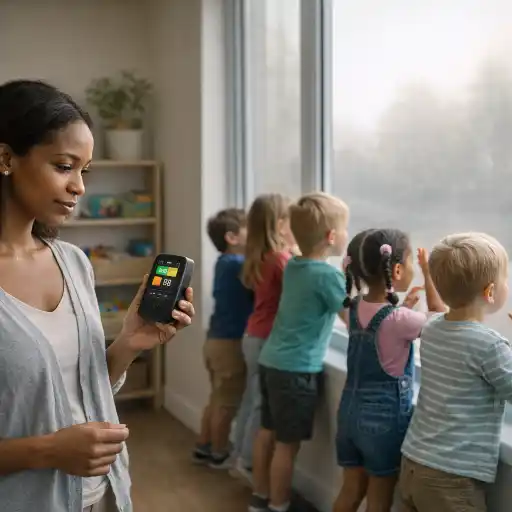
When AQI crosses your cutoff, shift to a short, numbered action plan, so staff moves quickly and calmly.
- 🏠 Seal and shelter:
- Close windows and exterior doors; limit traffic in/out of the building.
- Choose a single "clean-air room" (few doors/windows) for naps and for children with asthma or other vulnerabilities.
- 💨 Improve filtration and ventilation safely:
- Run HVAC on recirculate if outdoor smoke is heavy and use the highest-rated filters your system accepts; consult a facilities person before changing filters (see CDC ventilation guidance).
- Use portable HEPA air cleaners in high-use rooms; place units where children spend most time and follow manufacturer sizing guidance (ChildCareEd Illinois).
- 🔇 Reduce indoor pollution: stop frying foods, avoid candles/incense, and delay vacuuming that stirs dust while smoke is high (NIOSH).
- 🩺 Monitor health: keep asthma action plans and rescue meds accessible; watch for coughing, wheezing, or unusual tiredness and call for medical care if severe (Caring for Our Children). Staff can also review early signs of respiratory distress in children to recognize when symptoms may need prompt attention.
How do we train staff, communicate with families, and avoid common mistakes?
Prepared teams act steadily; unprepared teams react. Use short drills, clear roles, and a single family message template.
- 🧑🏫 Roles & training (numbered checklist):
- Assign who checks AQI each day and when (morning + before afternoon play).
- Assign who calls the indoor decision and who sets up the clean-air room.
- Run 5–10-minute drills monthly during high-risk seasons so the routine becomes muscle memory—see ChildCareEd courses on emergency preparedness (ChildCareEd guidance Buy Now $0.00).
- 📣 Family communication (simple template):
- “AQI is ___. We are using indoor plans and running filters. Please ensure we have up-to-date asthma meds and action plans.” Post and send this message via text/email.
- ⚠️ Common mistakes and fixes:
- ❌ Mistake: Using only a distant AQI reading. ✅ Fix: use the nearest reliable monitor and re-check during the day (ChildCareEd AQI guide).
- ❌ Mistake: No indoor plan. ✅ Fix: pre-designate indoor centers and movement activities so smoky days stay calm.
- ❌ Mistake: Relying on masks for toddlers. ✅ Fix: prioritize indoor shelter + filtration; staff may use respirators for brief outdoor tasks following workplace rules (NIOSH).
- 📚 Keep training resources handy: ChildCareEd emergency courses, CDC outdoor play guidance (CDC ECE outdoor safety), and your state health department templates.
What practical investments and preparedness steps pay off long-term?
Think of preparedness in three layers: policy, affordable hardware, and relationships.
- 📑 Policy (numerical actions):
- Create a written smoke/AQI policy with one posted cutoff and the daily AQI log requirement.
- Include directions for children with health needs and a plan for extreme events (evacuations, prolonged poor air).
- 🔧 Equipment & facilities:
- Invest in at least one appropriately sized HEPA air cleaner per major classroom or a centralized plan for clean-air rooms. Consider HVAC upgrades or higher-MERV filters where feasible; consult an HVAC professional before changes (Canada cleaner-air guidance).
- Keep a small stock of disposable NIOSH-approved respirators for staff who must perform brief outdoor tasks; follow workplace respiratory program rules (NIOSH).
- 🤝 Community & partners:
- Coordinate with local public health and your licensing agency for overflow cleaner-air sites, cooling centers, or shared HEPA resources (see ChildCareEd Minnesota).
- Apply for grants or community donations for HEPA units—many jurisdictions fund air-cleaning in schools and child care.
FAQ (short):
- Q: How often check AQI? A: Before each outdoor block and whenever smoke is visible or smelled.
- Q: Can infants wear masks? A: No, masks/respirators are not recommended for children under 2, and fit is poor for many toddlers—shelter indoors and use filtration instead (CDC).
- Q: What triggers evacuation? A: Follow local emergency orders and your evacuation plan; if children or staff develop severe symptoms, seek medical help immediately.
Conclusion
Protecting young lungs on poor air-quality days is a program leadership task that pays dividends in health, trust, and continuity. Use a single posted AQI cutoff, assign roles, run quick drills, and keep at least one clean-air room with HEPA filtration. Small investments—clear policy, a HEPA unit, a daily AQI log—transform reactive stress into predictable, programmatic care. For practical templates and printable charts, prioritize the ChildCareEd resources referenced above and your local public health guidance. Remember: state requirements vary - check your state licensing agency. Stay steady, keep children #safe, and make your air-quality routine part of standard care.
- CDA Certification en Español: Recursos y Consejos para Educadores Bilingües
- Proporciones de Cuidado Infantil y Tamaños de Grupo por Edad en Virginia (Guía Rápida para Centros y Hogares)
- Child Care Weather Guidelines: Using the 2026 Weather Watch Chart
- Portland Air Quality and Child Care: When Is It Safe to Play Outside?
- Air Quality and Child Care in Texas: Outdoor Play Safety Tips
- Air Quality and Child Care in Georgia: Outdoor Play Safety Tips
- Air Quality and Child Care in Nevada: Outdoor Play Safety Tips
- Air Quality and Child Care in California: Outdoor Play Safety Tips
- Air Quality and Child Care in Virginia: Outdoor Play Safety Tips
- Air Quality and Child Care in Illinois: Outdoor Play Safety Tips
- Air Quality and Child Care in Wisconsin: Outdoor Play Safety Tips
- Air Quality and Child Care in North Carolina: Outdoor Play Safety Tips
- How can Nevada child care programs keep children safe outdoors when air quality is poor?
- Safe Temperature Regulations in Daycare: Georgia Rules for Child Care Providers
- How can California child care providers prepare for wildfire smoke, power outages, and closed classrooms?
- What are Minnesota's safe temperature rules for daycare and how do we follow them?
- How can child care programs protect children on poor air-quality days?
- Air Quality and Outdoor Play: Guidance for Schools and Child Care Programs
- Weather Alerts and Child Care: How to Protect Children During Unsafe Conditions
- How to Plan Safe Outdoor Activities During Hot Weather and Poor Air Quality
