Outdoor time helps kids move, learn, and feel good. But smoke, heat, and pollution can hurt little lungs. This guide is for Nevada child care directors and teachers. It gives simple steps you can use today. Use a weather check routine, pick a clear AQI cutoff, and have a clean-air room ready. Remember: state requirements vary - check your state licensing agency. This article focuses on #airquality, #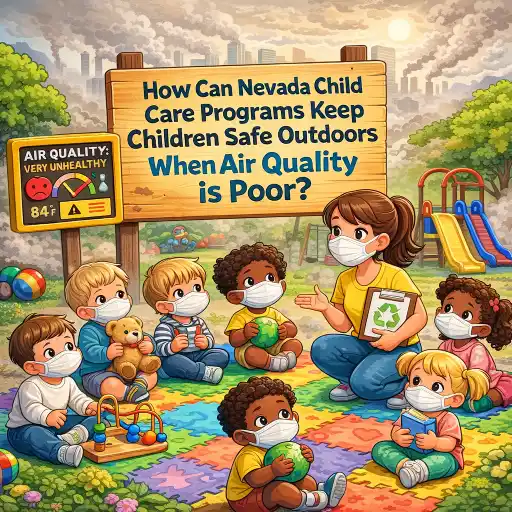 Nevada, #outdoorplay, #children, and #safety.
Why does air quality matter for young children?
- Children breathe more air for their size. Smoke and fine particles reach deep into their lungs and can cause coughing or trigger asthma. See the CDC’s notes on Wildfire Smoke and Children for short, clear reasons why kids are at higher risk.
- Clear rules reduce stress. A posted plan helps staff and families trust your choices. ChildCareEd’s Child Care Weather Watch Guidelines show a simple daily routine staff can follow.
- Small steps protect health and keep your program steady. Use one trusted AQI source and a single cutoff so decisions are fast and consistent. ChildCareEd explains AQI and decision steps in easy lists: Air Quality Index Explanation & Smoke/Fire Maps.
How do we check air quality and decide whether to go outside?
- 🌤️ Check AQI and local smoke maps using a trusted tool (AirNow or your state map). See ChildCareEd’s AQI explanation: Air Quality Index Explanation and the printable CDC guidance: Air Quality and Outdoor Activity Guidance for Schools (PDF) Buy Now $0.00.
- 👀 Do a quick yard walk: note smoke smell, visible haze, or hazards on surfaces.
- 🧾 Check your posted weather/AQI chart by the exit so everyone uses the same rule. Use the ChildCareEd Weather Watch Chart as a model.
2) Simple AQI traffic-light rule you can post (pick one clear cutoff and follow it):
- 🟢 AQI 0–50: Go outside as planned.
- 🟡 AQI 51–100: Go outside with caution; watch sensitive children.
- 🟠 AQI 101–150: Shorten outdoor time or move high-energy play indoors.
- 🔴 AQI 151+: Keep all children indoors and lower activity level. ChildCareEd recommends choosing a single posted cutoff so staff act quickly: When to keep kids inside during wildfire smoke.
What should we do on smoky, hot, or poor-air days?
- 🫁 Keep windows and doors closed. Use HVAC on recirculate if advised and run portable HEPA units in main rooms. The EPA and ChildCareEd offer tips for keeping indoor air cleaner: CDC/ChildCareEd guidance Buy Now $0.00 and EPA school IAQ ideas: EPA IAQ Reference Guide.
- 📲 Check AQI more than once a day; smoke can change fast. The California ChildCareEd post shows how programs re-check and log AQI: Wildfire Smoke and Air Quality (CA).
- 🚫 Mask note: Keep children indoors first. For staff protection, follow local public health guidance. See CDC notes on masks and children: CDC Wildfire Smoke.
2) Hot or poor-ventilation days:
- 💧 Increase water breaks, shade, and cool-down time. ChildCareEd’s Nevada heat guidance gives practical steps: How can Nevada educators keep classrooms safe in hot weather?.
- 🧊 If indoor cooling isn’t available, move kids to a cooled cleaner-air location (community center) and notify families.
How can we improve indoor air and make a clean-air room?
1) Easy, low-cost steps you can do now:
- 🔧 Close windows and doors when the outdoor AQI is bad.
- 📦 Run a portable HEPA air cleaner in the room where most children spend time. Use a unit sized for the room’s square footage. Canada and Minnesota guidance explain portable cleaners and cleaner-air spaces: Guidance for Cleaner Air Spaces.
- 🛠️ Use the best HVAC filter your system can handle (MERV 13 if possible). CDC and EPA note filtration and ventilation tips: CDC Ventilation FAQs and EPA IAQ Guide.
- 🧭 Pick one “clean-air room” with few doors and limited hallway traffic for infants and children with asthma.
How do we train staff, communicate with families, and avoid mistakes?
1) Make roles and steps clear (post them):
- 📌 Assign who checks AQI each outdoor block and who updates families. ChildCareEd suggests posting the weather chart by exits: Using the 2026 Weather Watch Chart.
- 📣 Use a short family message template. Example: “Local AQI is ___. We are keeping children indoors and using indoor movement plans. Please send meds per your child’s plan.” ChildCareEd offers family communication tools: Family Voices Matter resources.
- 🧑🏫 Run short drills: move-ins for thunder and fast indoor setups for smoke days. Train staff on spotting asthma signs and where medicines are kept.
2) Common mistakes and how to avoid them:
- ❌ Relying on a single far-away AQI reading. ✅ Fix: Use a local AQI map or AirNow and note the nearest reporting station. See AQI Explanation.
- ❌ No indoor activity plan. ✅ Fix: keep a “Smoke Day” activity list ready (quiet movement, sensory centers, yoga, story movement). For more ideas to keep children moving indoors when cold weather limits outdoor play, see indoor activities for cold days.
- ❌ Waiting for coughing to start. ✅ Fix: act on AQI early and consistently.
FAQ (short)
- Q: Who decides to cancel outdoor play? A: The director or assigned staff using the posted chart and center policy. State requirements vary - check your state licensing agency.
- Q: How often check AQI? A: Before every outdoor block and whenever you smell smoke or see haze.
- Q: What indoor steps help most? A: Close windows, run HEPA cleaners, run HVAC with good filters, and pick a clean-air room. See EPA and CDC guidance linked above.
- Q: Should kids wear masks when smoke is present? A: Prioritize keeping kids indoors. For respirators, follow CDC guidance—fit and age matter.
Conclusion
Use a simple, posted routine: check the AQI, use a traffic-light rule, run a clean-air room, and train staff. Post the rule where everyone can see it and tell families the plan. Small habits—daily checks, water and shade on hot days, quick indoor move-ins for smoke or thunder—help keep #children safe and healthy while supporting joyful #outdoorplay when it’s safe. For practical tools and printable charts, start with ChildCareEd’s weather and smoke resources listed above.
1) Smoke days: Quick checks before every outdoor block (make this a 2–5 minute habit): Why it matters:
- 45 Hour Child Growth and Development
- 45 Hours Director-Administration ONLINE
- 1,2,3, Eyes on Me: Classroom Safety
- Birth to Five CDA Credential with Portfolio Review
- CDA Family Child Care Credential with Portfolio Review
- 45 Hour School Age Methods and Materials
- CDA Bridge Bundle: Family Child Care without Portfolio Review
- Texas Director Credential
- CDA Certification en Español: Recursos y Consejos para Educadores Bilingües
- Emergency Preparedness in Nevada Child Care: What to Have, Practice, and Document
- Recursos en Español sobre el Sueño Seguro del Bebé
- Proporciones de Cuidado Infantil y Tamaños de Grupo por Edad en Virginia (Guía Rápida para Centros y Hogares)
- How can Nevada early childhood educators keep classrooms safe in hot weather?
- Portland Air Quality and Child Care: When Is It Safe to Play Outside?
- Air Quality and Child Care in Texas: Outdoor Play Safety Tips
- Air Quality and Child Care in Nevada: Outdoor Play Safety Tips
- Air Quality and Child Care in California: Outdoor Play Safety Tips
- Air Quality and Child Care in Illinois: Outdoor Play Safety Tips
- Air Quality and Child Care in North Carolina: Outdoor Play Safety Tips
- How can Nevada child care programs keep children safe outdoors when air quality is poor?
- Safe Temperature Regulations in Daycare: Georgia Rules for Child Care Providers
- How can Minnesota child care providers prepare for severe weather and poor air quality?
- Canciones, juegos y preguntas de círculo para niños
- When the Sky Turns Hazy: How Should North Dakota Child Care Providers Protect Kids from Wildfire Smoke?
- Daycare Temperature Regulations in California: What Providers Should Know
- How Can Child Care Programs Keep Outdoor Play Safe?
- How to Plan Safe Outdoor Activities During Hot Weather and Poor Air Quality
- What AQI Should Kids Stay Inside? A Child Care Guide to Safe Outdoor Play
