Turn a single day into a powerful, playful learning experience with a Daycare “Mini Olympics.” Through short bursts of #movement, cooperative challenges, and fun event-day rituals, children can strengthen gross-motor abilities, teamwork, communication, and classroom community. This guide gives directors and providers step-by-step planning support, ready-to-run activity ideas, inclusive adaptations, safety considerations, and troubleshooting tips for creating an event in which every child can participate. Educators can strengthen their planning through ChildCareEd’s self-paced online course Wellness in Action: Teaching Healthy Habits to Children  Buy Now $55.00, which explores structured and unstructured physical activity, active play, inclusion, and healthy daily habits. The guide also draws on practical ChildCareEd resources such as Team-Building Activities for Daycare and Gross Motor Games for Preschool and Kindergarten to provide low-prep, classroom-ready ideas that build movement skills, cooperation, confidence, and a positive sense of belonging.
1. How do we plan a Mini Olympics that fits our schedule and goals?
Planning is the difference between chaos and confidence. Use a short checklist and a simple theme to keep staff and children focused.
- Define outcomes (pick 1–2 targets): e.g., improve transitions, increase peer helpers, or build #balance and coordination.
- Set time blocks:
- 🔹 Opening ceremony (5 minutes): welcome, team names, and a simple torch pass.
- 🔹 Events (3–6 stations x 6–8 minutes each): rotate by team or small group.
- 🔹 Closing (5 minutes): medals for participation and a group reflection.
- Assign roles: 1 lead teacher, 1 assistant per station, floater for transitions—post short role cards so substitutes can jump in. See ChildCareEd’s practical staff-team tips at TEAM: Together Everyone Achieves More.
- Prep a materials box per station: tape, cones, beanbags, scarves, printed visuals. Low-prep keeps your day manageable.
- Communicate with families: send a one-paragraph note and invite participation tools (team bracelets, photos).
2. What low-prep events build gross motor skills and cooperation?
Choose events that combine #play, skill-building, and teamwork. Rotate short activities so children stay active and successful.
- 🏅 Relay Torch Pass: pass a lightweight 'torch' (paper cone with tissue flames) while walking a taped line—practice balance and turn-taking.
- 🐾 Animal Races: frog hops, penguin waddles, crab walks; keep lanes short and encourage cheering—adapted from Animal Races for Kids.
- 🎯 Target Toss Team: small groups tally cooperative points as they toss beanbags into baskets at varying distances—good for #handeye coordination.
- 🤝 Cooperative Obstacle Course: teams guide a blindfolded partner or pass a scarf while completing stations—see a model at Cooperative Obstacle Course and The Gross (Motor) Truth for station ideas.
- 🎖️ Hoop Team Problem: teams move a hula hoop around a linked circle without letting go—great for problem-solving and teamwork.
3. How do we include every child and keep it safe?
Inclusion and safety are nonnegotiable. Use adaptations and clear cues so all children can succeed and feel proud.
- 🔹 Safety checklist:
- Clear a movement zone, mark boundaries, and teach a one-stop cue (clap or "Freeze!").
- Keep equipment soft and lines short to avoid crowding; supervise from a position with clear sight lines.
- State rules differ—state requirements vary - check your state licensing agency.
- 🔸 Inclusion strategies:
- Offer choices: full movement, modified movement (seated march), or helper role.
- Use visuals and simple prompts so non-readers follow stations; ChildCareEd provides printable prompts in its gross motor resources (Gross Motor Games).
- Pair buddies so peers coach and model; rotate roles so every child leads once.
- 🔹 Equipment adaptations: larger targets, shorter distances, scooter boards, or seated relays (scarf pass) let children with mobility needs participate meaningfully.
4. Why does a Mini Olympics matter for learning and classroom climate?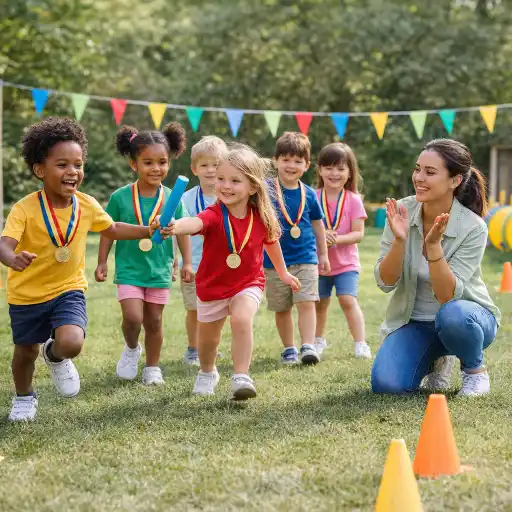
Short, joyful movement experiences support development across domains. Put simply: moving together teaches more than gross motor skills. For programs that follow Montessori principles, emphasizing active play supports holistic development, independence, and self-directed learning; see The Importance of Active Play in the Montessori Classroom.
- Physical and health benefits: known child activity guidelines recommend frequent active play for preschoolers—see CDC guidance at CDC: Child Activity and practical state models like the MSDE summary on physical activity at Physical Activity Guidelines.
- Social-emotional gains: team events build sharing, turn-taking, empathy, and positive peer attention—ChildCareEd’s team-building post explains why simple cooperative games produce calmer, kinder classrooms (Team-Building Activities for Daycare).
- Cognitive and classroom benefits: gross motor breaks improve attention and readiness for group learning; short movement bursts refresh focus before circle time or transitions (Nemours summarizes these effects).
5. How do we run the day smoothly and avoid common mistakes?
Run a Mini Olympics like a production: simple scripts, clear transitions, and quick reflection keep staff calm and children engaged.
- 🟢 Keep rules short: 1–2 steps per station. Demonstrate once and begin.
- 🔵 Use staffing scripts and role cards: lead, assistant, floater. Rotate adults so supervision is constant.
- 🟡 Time and group sizes: run 6–8-minute stations with 4–6 children per group to avoid long waits.
- 🟣 Celebrate participation, not ranking: give medals or certificates for "teamwork," "best cheer," and "most helpful" to reduce competitiveness—see family-friendly award ideas at Scholastic.
- 🔴 Common mistakes and fixes:
- ❌ Too many rules → ✅ One clear rule per station with a visual prompt.
- ❌ Long waits → ✅ More stations, smaller groups, or partner rounds.
- ❌ Competition over cooperation → ✅ Team goals (collective points) and noncompetitive awards.
For quick staff training, use short modules and on-the-floor coaching; ChildCareEd’s TEAM and gross motor resources provide ready activities and staff tips (TEAM, Gross Motor Games).
Summary & FAQ
Mini Olympics are high-return: short planning yields big gains in #teamwork, #movement, #grossmotor skills, # preschoolers' confidence, and classroom culture. Start small—one opening ceremony, 3–4 brief stations, clear roles, and inclusive options—and build from there.
- Q: How long should each event be? A: 5–8 minutes per station; keep energy high with short rotations.
- Q: What if a child refuses to join? A: Offer a helper or observer role and invite that child to try leading a mini-task later.
- Q: Can this be mixed-age? A: Yes—design tasks with tiered options (e.g., hop OR march) and pair older children as helpers (see mixed-age tips in ChildCareEd materials).
- Q: How do we measure success? A: Track one or two goals (fewer transition conflicts, more peer helpers) and note progress weekly.
- Q: Where to find ready plans? A: Start with ChildCareEd posts: Team-Building Activities for Daycare and Gross Motor Games for Preschool and Kindergarten.
You and your staff already have the strongest resource: insight into what delights the children you serve. Use small, repeatable rituals and inclusive team goals to make your Mini Olympics a memorable learning day. #play #teamwork
- Turning Behavior Around for Toddlers and Preschoolers
- From Tantrums to Triumphs: Equipping Preschoolers with Self-Regulation Skills
- The ABCs of Behavior: Turning Challenges into Learning Opportunities
- Pediatric RSV First Aid & CPR/AED
- Workplace Essentials: Communicate, Collaborate, Succeed
- Creating Engaging and Meaningful Learning Experiences
- Sensitive Periods in Montessori: Guiding Natural Learning
- Texas Director Credential
- Wellness in Action: Teaching Healthy Habits to Children
- CDA Certification en Español: Recursos y Consejos para Educadores Bilingües
- 📖 ¿Cómo puedo hacer que la hora del cuento sea la parte más poderosa de mi día?
- Cómo Abrir Una Quardería En Casa Sin Dinero?
- Que es Título 22 en California?
- Cómo Solicitar una Licencia de Guardería en Texas
- Cómo Empezar una Guardería en Casa: Requisitos y Pasos
- ¿Cómo solicito la licencia para una guardería en California?
- Regulaciones de Licenciamiento de Cuidado Infantil en California para Centros y Hogares de Cuidado Infantil Familiar
- Proporciones de Cuidado Infantil y Tamaños de Grupo por Edad en Maryland (Guía Rápida para Centros y Hogares)
- Proporciones de Cuidado Infantil y Tamaños de Grupo por Edad en Nueva Jersey (Guía Rápida para Centros y Hogares)
- Proporciones de Cuidado Infantil y Tamaños de Grupo por Edad en Virginia (Guía Rápida para Centros y Hogares)
- Lista para Guardería en Casa en Illinois: Cómo Iniciar una Guardería en el Hogar
- Lista para Guardería en Casa en Texas: Cómo Iniciar una Guardería en el Hogar
- Por Qué la Supervisión Activa Es Clave para la Seguridad en el Cuidado Infantil
- 7 Estrategias de Supervisión Activa para un Cuidado Infantil Más Seguro
- Cómo Trabajar en el Cuidado Infantil en California: Requisitos y Pasos
- Canciones, juegos y preguntas de círculo para niños
- Snacks para enviar al daycare: ideas sencillas para padres
- Cómo simplificar la capacitación para sus empleados de daycare
- How can we host a Daycare Mini Olympics that builds movement and teamwork?
