When children scoop pretend apples, gourds, or leaves into a basket, a simple harvest game can become a rich investigation: How many scoops will fill it, and will another container hold more? Build your confidence planning playful, intentional math with Math Foundations in Early Childhood  Buy Now $16.00, which explores hands-on strategies for integrating math into classroom practice. For broader ideas across measurement, counting, and mathematical reasoning, explore Early Mathematics Through Play Buy Now $24.00 as a next step while you consider how to make this station inviting and meaningful.
Why does a harvest measurement station matter?
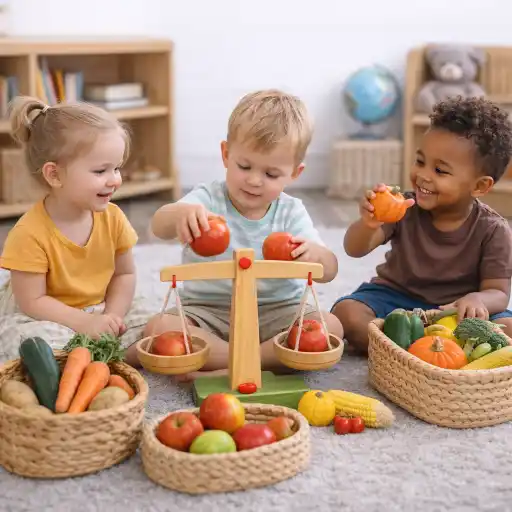
Measurement becomes meaningful when children have a real question to investigate. At a harvest pretend-play station, filling a basket gives children a purpose for scooping, counting, comparing, predicting, and explaining. The activity connects capacity—the amount a container can hold—to concrete actions children can repeat and observe.
This playful inquiry supports more than early math. Children negotiate roles, share tools, take turns, and use language to describe what they notice. A child might say, “This basket is full after four scoops,” while a peer wonders whether a wider basket will need more. These exchanges provide educators with natural opportunities to introduce words such as full, empty, more, fewer, same, estimate, and capacity.
Preschool math goals include measuring objects by different attributes and using those attributes to make comparisons. The Head Start preschool math goals include measurement with standard and nonstandard measures. In a harvest station, scoops are useful nonstandard units: children can see and count each transfer before they encounter more formal measurement tools.
Most importantly, the station helps children see themselves as capable mathematical thinkers. Their predictions do not need to be correct at first; observing, testing, and revising are central parts of learning.
How can you set up the Harvest Fill-and-Compare station?
Keep the setup simple, accessible, and open-ended. Use two or three containers with noticeably different shapes or sizes, a consistent scoop, and large pretend produce or other age-appropriate fillers. A tray beneath the materials can define the work area and make cleanup easier. Label containers with picture cards or children’s own marks if they want to record how many scoops they used.
Introduce the challenge with a question rather than a demonstration of one “right” answer: “How many scoops do you think will fill this basket?” Give children time to look, handle the tools, and make a prediction. Then invite them to scoop one measure at a time and count together.
- Use one scoop size throughout a comparison so children can make a fairer count.
- Offer baskets or containers that differ in width, height, or both, prompting children to notice that height alone does not tell us capacity.
- Place a number line, tally marks, or a simple recording page nearby for children who want to represent results.
- 🍂 Add pretend produce, market signs, or baskets to connect measurement with dramatic play and harvest storytelling.
For a ready-to-use classroom aid, adapt the Autumn Farmers Market Pretend Play Buy Now $1.50 materials, which include a harvest weighing station and dramatic-play prompts. Keep the station flexible: children may fill, sort, compare, or simply explore before they are ready to count systematically.
What math concepts can children explore as they scoop and fill?
The core idea is capacity, but a well-planned station can support several connected concepts. Children practice one-to-one correspondence when they count one number for each scoop. They build cardinality when they understand that the final number tells how many scoops they used. Predicting before testing introduces estimation, while comparing two containers encourages reasoning about more, fewer, and the same.
Use the same scoop as a consistent nonstandard unit. If children switch between a large cup and a tiny spoon, their totals cannot be compared meaningfully. Even with consistent scoops, results may vary if a child heaps material in one scoop and fills it loosely in another. Rather than treating this as failure, name the difference and invite another fair test.
- Estimate: “How many scoops might fill this basket?”
- Measure: Count each scoop as it is poured, keeping the unit consistent.
- Compare: “Which container needed more scoops? How can we check?”
- Explain: “What did you notice about the tall, narrow container and the short, wide one?”
Children may discover that a tall container does not always hold more than a short, wide one. This is a productive moment for careful observation: both height and width affect capacity. The activity is not about teaching a formula; it is about helping children test visual guesses with a concrete method. Adults can extend thinking by inviting children to order three containers from least to greatest capacity, then verify the order through scooping and transferring.
How can educators guide the play without taking it over?
Begin by observing what children do with the materials. Some may immediately count scoops; others may create a market, fill and empty repeatedly, or compare baskets by sight. Each approach offers a starting point. Join the play with a brief comment or question, then allow children time to respond and continue their own plan.
Open-ended prompts make mathematical thinking visible without turning play into a quiz. Try, “What do you notice?” “How could we find out?” or “What might happen if we use the same scoop?” If a child loses count, calmly restart together or use a visible mark for each scoop. If children disagree about which basket holds more, encourage them to test their ideas by filling one basket and transferring the contents.
Adjust the challenge to children’s interests and experience:
- For emerging counters, use a small number of scoops and count together with objects or picture cues.
- For children ready for more, compare two results, order several containers, or record predictions and findings.
- For dual-language learners, pair measurement words with gestures, pictures, and home-language vocabulary whenever possible.
- For children who prefer not to handle sensory materials, offer a scoop, tongs, a container with a wide opening, or a partner role as the recorder or predictor.
Notice the strategy, not only the final count. Brief notes such as “counted each scoop and predicted the second basket would hold more” can guide the next invitation and document emerging #reasoning, #measurement, and #math skills.
How can you keep the activity safe, inclusive, and practical?
A successful station does not need elaborate materials. Use washable containers, child-sized scoops, trays, and large pretend produce or other fillers appropriate for the children in your group. Inspect items for damage, and avoid small loose parts for children who may mouth objects. Supervise closely, establish clear expectations for keeping materials in the station, and follow your program’s sanitation and cleanup procedures. State requirements vary - check your state licensing agency.
Make participation possible in different ways. Picture labels, gestures, pointing, spoken language, and drawing can all help children communicate a prediction or result. Consider whether a container is stable, whether tools are easy to grip, and whether children have enough space to work comfortably. A child can participate by predicting, watching a transfer, counting with an adult, or documenting a peer’s result, even if scooping is not accessible or appealing.
Common pitfalls are straightforward to avoid:
- Changing the scoop size mid-comparison: Keep a consistent unit so counts can be compared.
- Correcting estimates too quickly: Let children test predictions and learn from the result.
- Focusing only on the final number: Ask how the child counted and what they noticed about the containers.
- Overloading the center: Start with a few clear choices, then add materials based on children’s play.
Small adjustments can make the activity welcoming for a wide range of learners while keeping preparation manageable for staff.
How can you extend and assess learning over time?
Repeat the station with a small variation rather than introducing an entirely new activity each time. Change the container shapes, invite children to compare pretend harvest baskets, or pose a new question: “Can we make both baskets hold the same number of scoops?” Repetition lets children revisit vocabulary and strategies while deepening their understanding.
Assessment can happen naturally during play. Observe whether a child makes a prediction, uses one count word per scoop, remembers the total, or compares containers using relevant language. Record a short quotation or take a photo of a child’s marks or arrangement, following your program’s documentation and family privacy practices. Then plan one next step based on what you observed—for example, offer a third container for ordering, or use a tally sheet to represent results.
Connect measurement to other classroom experiences. Children can use scoops in a pretend market, measure ingredients during a supervised cooking activity, or compare how many blocks fit in two baskets. The same mathematical ideas become more durable when they appear in different routines and contexts.
For educators who want to strengthen their planning and teaching approach, Math Foundations in Early Childhood Buy Now $16.00 provides practical professional learning about integrating hands-on math into teaching. The course complements classroom experimentation by helping providers think intentionally about math-friendly environments and children’s developmental learning.
Conclusion: How many scoops fill the basket?
There is no single answer until children choose a basket, use a consistent scoop, and test their prediction. That is precisely what makes the question useful: it turns pretend harvest play into an investigation of capacity, counting, comparison, estimation, and explanation.
To get started, offer a few safe containers, one consistent scoop, and open-ended prompts. Observe children’s strategies, support participation in different ways, and revisit the experience with small variations. When providers give children time to predict, test, and talk, measurement becomes part of joyful, purposeful play—not a worksheet or a one-time lesson.
Key takeaways:
- Use consistent scoops as nonstandard units for comparing capacity.
- Invite children to estimate, count, test, and explain their findings.
- Remember that container shape as well as height can affect how much it holds.
- Keep the station safe, inclusive, and responsive to children’s play.
When a child asks, “How many scoops fill the basket?” you have a ready-made invitation to explore mathematics together.
Explore these five English-language ChildCareEd courses for further professional learning:
- 45 Hour Child Growth and Development
- What Makes Me Special: An Overview of Autism and ADHD
- CDA Bridge Bundle: Preschool
- Pediatric RSV First Aid & CPR/AED
- CDA Bridge Bundle: Family Child Care
- Math Foundations in Early Childhood
- Art from the Heart for Preschoolers: Open Ended Art Projects that Build Self-Esteem
- CDA Bridge Bundle: Infant/Toddler
- CDA Certification en Español: Recursos y Consejos para Educadores Bilingües
- 10 Ejemplos de Cómo la Cultura Influye en el Desarrollo Infantil
- Proporciones de Cuidado Infantil y Tamaños de Grupo por Edad en Nueva Jersey (Guía Rápida para Centros y Hogares)
- Proporciones de Cuidado Infantil y Tamaños de Grupo por Edad en Virginia (Guía Rápida para Centros y Hogares)
- Actividades de Otoño Fáciles para Preescolares esta Temporada
- Consejos de Supervisión Activa para Salones de Preescolar y el Juego al Aire Libre
- Cómo Trabajar en el Cuidado Infantil en Carolina del Norte: Requisitos y Pasos
- Cómo Trabajar en el Cuidado Infantil en California: Requisitos y Pasos
- Cómo Ser Maestra de Preescolar en Maryland
- Celebrando la amistad en el cuidado infantil durante el Día de los Mejores Amigos
- Canciones, juegos y preguntas de círculo para niños
- Fall Challenge Accepted! Hands-On Learning Games for Pre-K
- How Can You Plan an Engaging Fall Curriculum for Preschoolers?
- How Can Simple Fall Activities Support Kindergarten Readiness Through Play?
- How Can November Classroom Activities Help Preschoolers Build School Readiness Skills?
- How Can an Apple Stand Become Meaningful Preschool Math?
- How Can You Extend Fall Dramatic Play into November Without Starting Over?
- How Can Child Care Providers Plan Food Activities for Children with Different Dietary Needs?
- How Can Harvest Pretend Play Teach Children to Measure and Compare?
- How Can a Fall Repair Shop Turn Broken Pretend Props Into Preschool Problem-Solving?
