Autumn leaves, seed pods, and twigs offer children a vivid way to explore a big mathematical idea: whether two sides resemble a mirror image. Try the ideas below to make geometry active, seasonal, and welcoming for different learners; for a deeper foundation in playful math instruction, explore ChildCareEd’s Math Foundations in Early Childhood  Buy Now $16.00 course, which helps providers bring hands-on math and problem-solving into everyday practice.
Why does symmetry in nature matter for young children?
Symmetry invites children to compare, notice, and explain. When a child studies a leaf or arranges two twigs on either side of a center line, the child is practicing more than shape recognition: they are using visual discrimination, spatial reasoning, language, and persistence. These are early mathematical habits that can grow through play rather than formal definitions.
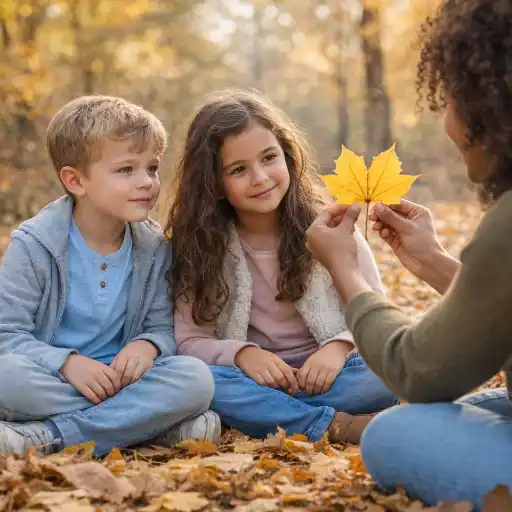
Nature makes the idea concrete. A leaf may have a central vein with two broadly similar sides, while its edges are rarely perfectly identical. That variation is useful: children can discover that real-world examples can be approximately symmetrical, and that careful observation matters more than producing a flawless copy. Outdoor exploration can also invite questions about color, texture, size, and seasonal change.
For educators, this is a low-preparation opportunity to connect math with science, art, and conversation. Use the word #symmetry alongside children’s own descriptions—“matching,” “same on both sides,” or “like a reflection.” A hands-on approach aligns with guidance in playful symmetry exploration, where children investigate a center line and test ideas instead of being expected to master technical vocabulary immediately.
How can providers introduce symmetry in child-friendly language?
Begin with an observable question rather than a definition: “Do these two sides look alike?” Hold up a leaf and trace its middle vein with a finger. Explain that this line is a possible “mirror line” or “middle line.” Invite children to compare the shape on each side, noticing similarities and differences without treating every difference as an error.
Offer a simple test when appropriate. Place the leaf beside a drawn line on paper, or fold a paper leaf shape along its center and see whether the edges meet. Real leaves may not fold into exact halves, which creates an opportunity to discuss approximate matches. A picture or loose-parts design can be checked by placing a small mirror beside the center line, with adult supervision and safe materials.
- “What do you notice on this side and the other side?”
- “Where could we imagine a middle line?”
- “What could you place over here to make the picture look balanced?”
- “How might we check whether the sides match?”
Pair words with gestures and give children time to respond by speaking, pointing, arranging objects, drawing, or using their home language. Welcome developing ideas: the purpose is to build curiosity and mathematical talk, not to require preschoolers to produce exact reflections.
How can you set up an autumn symmetry exploration?
Choose a small-group table, outdoor spot, or classroom center. Gather a few leaves of different shapes and sizes, paper, crayons or pencils, and a straight stick or strip of paper to mark the center line. You can also offer larger, age-appropriate natural loose parts such as leaves and twigs. Inspect collected materials, follow program practices for outdoor items, and avoid small objects with children who may mouth them.
- Invite children to look closely at a leaf and describe its shape, vein, edges, and colors.
- Ask them to imagine or mark a line running from the stem toward the tip.
- Place the leaf beside the line or draw one half of its outline, then invite children to sketch or arrange a possible other half.
- Compare the two sides together. Ask what looks similar and what is different.
- Offer a new challenge: create a leaf-inspired design with natural materials on one side of a stick, then make a mirror-like partner on the other side.
The Autumn Kite Activity Guide Buy Now $1.85 provides a related seasonal example of connecting geometry with patterns and counting. Likewise, a nature-based lesson can combine math and art through leaf observation and drawing, as described in this leaf symmetry activity.
How can Autumn Symmetry Exploration Mats support learning?
Autumn Symmetry Exploration Mats can give children a clear, reusable surface for investigating matching halves. A center line and fall-themed images help make the task visible, while movable pieces or drawing areas allow children to try, revise, and explain. Use the mats as an invitation rather than a worksheet test: children might match leaves, complete a pumpkin design, or create their own balanced picture.
Model one example, then invite children to take the lead. Start with only a few large shapes or picture pieces. If the challenge feels difficult, offer two matching pieces and position one near the center line. If children are ready for more, increase the number of pieces, introduce a repeating color pattern, or ask them to make a design that is intentionally not symmetrical and compare the result.
Connect the activity to broader early math goals. Children can count objects on both sides, compare colors and sizes, identify shapes, and use position words such as “beside,” “across,” and “near the middle.” Their explanations provide useful evidence of thinking. Record concise observations such as “checked the other side before placing a leaf” or “used the line to match two shapes,” then use those observations to plan the next invitation.
Keep access flexible: offer thick crayons, large pieces, visual demonstrations, extra time, and multiple ways to respond. The goal is meaningful participation, not identical products.
What common pitfalls should educators avoid?
A frequent pitfall is expecting exact symmetry too soon. Young children may recognize that two sides are “almost the same” before they can reproduce a precise reflection. Celebrate noticing and effort, and use differences as prompts for investigation: “What changed when we moved this piece?”
Another mistake is turning a playful exploration into a craft with one correct finished result. If every child copies an adult’s model, there is less space for observation, decision-making, and creative thought. Provide a small, manageable range of materials and let children choose how to test their ideas. Avoid rapid-fire questions; pause, listen, and build on what a child says or demonstrates.
Plan for safe and inclusive participation. Check collected natural materials, supervise outdoor exploration and any cutting, and select materials that are appropriate to children’s ages and abilities. Offer alternatives such as photographs or classroom-made leaves when outdoor collection is not suitable. State requirements vary - check your state licensing agency.
- 🍂 Keep the focus on noticing and trying, not perfect matching.
- Offer larger pieces and nonverbal response options when helpful.
- Use children’s questions to guide follow-up activities rather than over-directing the exploration.
How can educators extend and document children’s discoveries?
Extend the investigation by looking for other examples: butterfly wings in a book, a face, a flower, or a classroom object. Some natural forms show bilateral symmetry, while flowers and seed patterns may invite discussion of balance around a center. Be accurate and flexible: nature varies, and not every leaf or object has a clear line of symmetry.
Take the activity outdoors when practical. Lay a straight stick on the ground as a center line and invite children to arrange safe natural materials on each side. Children can work alone or in pairs, taking turns making a design and completing its partner. The approach builds collaboration as well as spatial reasoning; an outdoor loose-parts symmetry activity offers another example of this simple setup.
Document process, not just finished work. A photograph, a child’s dictated explanation, or a brief note can capture strategies: “I matched the small leaf across the line,” or “The sides are close, but this one is longer.” These records help educators choose suitable next steps, such as a mirror station, a paper-folding invitation, or an art activity. For more professional support in planning hands-on math experiences across geometry, patterns, and reasoning, explore the ChildCareEd course Early Mathematics Through Play Buy Now $24.00.
Conclusion: How can children discover symmetry in fall nature?
Children discover symmetry by looking closely, comparing sides, testing a center line, and sharing what they notice. Leaves and other autumn materials make this abstract idea tangible, while Autumn Symmetry Exploration Mats can offer a practical, reusable invitation for matching, drawing, and creative problem-solving. Keep the experience open-ended, adapt materials to children’s needs, and value approximate discoveries as meaningful mathematical thinking.
The central question—“Are both sides the same?”—does not need a perfect yes-or-no answer. It can lead to richer conversations about what matches, what differs, and how children can check their ideas. With a supportive adult and time to explore, fall nature becomes a lively setting for early geometry.
References: ChildCareEd: How Can a Kite Design Help Children Discover Symmetry?; ChildCareEd: Autumn Kite Activity Guide Buy Now $1.85; ChildCareEd: Leaf-Themed Art and Science Activities; ChildCareEd: Math Foundations in Early Childhood Buy Now $16.00; NurtureStore: Leaf Symmetry; Empowered Parents: Hands-On Symmetry Activities; NurtureStore: Nature Symmetry; ChildCareEd: Butterfly Wing Mirror Magic Buy Now $0.00; ChildCareEd: Geometry Through Building and Play; NurtureStore: Fall Math Activities.
Additional course options: Early Mathematics Through Play Buy Now $24.00, No Such Thing as Boring Math Buy Now $24.00, and Creating the Natural Outdoor Classroom Buy Now $16.00.
- Early Mathematics Through Play
- What Makes Me Special: An Overview of Autism and ADHD
- Montessori Foundations
- Math Foundations in Early Childhood
- Lesson Planning for Preschoolers
- Playful Spaces for Infants & Toddlers
- Wellness in Action: Teaching Healthy Habits to Children
- Montessori in Context: Decoding Educational Theories
- Enhancing STEM Education for Infants and Toddlers
- CDA Certification en Español: Recursos y Consejos para Educadores Bilingües
- Recursos en Español sobre el Sueño Seguro del Bebé
- Cómo ser director de cuidado infantil en Maryland
- ¿Cuáles son las mejores actividades del Día de la Tierra para niños en casa o en el aula?
- 10 Ejemplos de Cómo la Cultura Influye en el Desarrollo Infantil
- Capacitación en Salud y Seguridad Preventiva en Línea para Proveedores de Cuidado Infantil
- ¿Cómo solicito la licencia para una guardería en California?
- Regulaciones de Licenciamiento de Cuidado Infantil en California para Centros y Hogares de Cuidado Infantil Familiar
- Proporciones de Cuidado Infantil y Tamaños de Grupo por Edad en Maryland (Guía Rápida para Centros y Hogares)
- Proporciones de Cuidado Infantil y Tamaños de Grupo por Edad en Nueva Jersey (Guía Rápida para Centros y Hogares)
- Proporciones de Cuidado Infantil y Tamaños de Grupo por Edad en Virginia (Guía Rápida para Centros y Hogares)
- Actividades de Otoño Fáciles para Preescolares esta Temporada
- Lista para Guardería en Casa en Illinois: Cómo Iniciar una Guardería en el Hogar
- Las Mejores Ideas de Excursiones para Guarderías en Texas
- Las Mejores Ideas de Excursiones para Guarderías en Georgia
- Canciones, juegos y preguntas de círculo para niños
- Cómo simplificar la capacitación para sus empleados de daycare
- Juego Compartido y Autismo: Cómo Fomentar la Participación sin Exigir Contacto Visual
- How Can a Kite Design Help Children Discover Symmetry?
- Are Both Sides the Same? How Can Children Discover Symmetry in Fall Nature?
