Division practice becomes more meaningful when children can see patterns, connect answers to visual categories, and explain their reasoning. Pairing the Early Mathematics Through Play Buy Now $24.00 course with the low-prep Color by Quotient: Division Practice Buy Now $1.49 resource can help providers strengthen math instruction, gain practical planning strategies, and make practice more engaging for school-age learners.
Why does color-coded division practice matter?
Division can feel abstract when children encounter only equations on a page. Color-coding gives each answer range a visual identity, allowing learners to connect computation with a meaningful pattern. In the featured resource, children solve 144 division facts and color each response according to its quotient range: answers of five or less receive one color, while answers of six or more receive another. The teacher answer key supports efficient checking and feedback.
This approach is not a substitute for conceptual teaching. Rather, it is a structured opportunity to reinforce previously introduced ideas such as equal sharing, grouping, fact families, and the relationship between multiplication and division. Research and professional guidance emphasize the value of concrete or semi-concrete representations, clear mathematical language, and systematic practice when developing mathematical understanding.
Color also supports attention and persistence. A completed image or organized color pattern gives children visible evidence of progress without making speed the primary goal. For providers, the activity is inexpensive, printable, and easy to place in a math center or small-group rotation.
How should providers introduce division before using a worksheet?
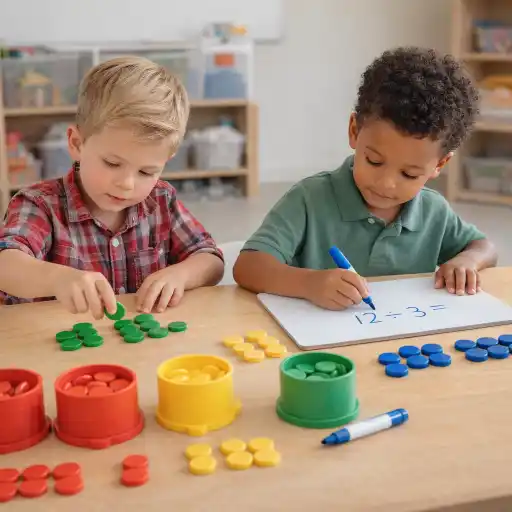
Before asking children to solve a page of facts, establish what division means. Use manipulatives, drawings, and familiar situations so children can reason about quantities before relying on symbols. For example, present 12 counters and ask children to share them equally among three plates. Then connect the action to 12 ÷ 3 = 4.
- Model partitive division: “How many objects belong in each group?”
- Model quotative division: “How many groups of this size can we make?”
- Connect division to multiplication: 3 × 4 = 12, so 12 ÷ 3 = 4.
- Invite children to draw arrays, circles, number lines, or equal groups.
Use mathematical vocabulary naturally, including dividend, divisor, quotient, equal groups, share, and remainder. Ask children to explain how they know an answer rather than requiring memorization alone. The What Works Clearinghouse recommends systematic instruction, mathematical language, and well-chosen representations as supports for learners who need additional mathematics intervention.
Once children demonstrate conceptual readiness, color-coded practice can provide repetition without requiring a completely new lesson structure. If a child is still developing the meaning of division, return to objects or drawings instead of treating errors as evidence of low ability.
How can color categories reinforce patterns and fluency?
A color key transforms a collection of isolated facts into a classification task. Children are not only solving; they are noticing which quotients belong together. This can prompt useful questions: Which facts have quotients of five or less? Which divisors produce larger quotients? What multiplication facts could help solve a difficult problem?
After several examples, pause for a brief discussion. Ask children to identify repeated relationships, compare strategies, or predict the color of an answer before calculating. Pattern-focused conversation can strengthen flexibility and reduce the feeling that every fact must be learned independently.
- Have children solve three facts, then explain the color assigned to each.
- Ask them to find a fact family represented by two or more problems.
- Invite them to circle facts they solved using multiplication knowledge.
- Let children create a new color key for a small set of teacher-selected facts.
- 🎨 Use colored pencils, crayons, or markers as a choice—not as a reward for finishing quickly.
Color should clarify the mathematical structure rather than distract from it. Keep the key visible, use consistent language, and remind children that the quotient determines the color. If coloring demands are difficult for a child, offer larger spaces, adaptive tools, stickers, or an oral response option.
How can providers differentiate the activity for varied learners?
One page can support different levels of challenge when adults adjust the facts, tools, prompts, and expected explanations. Avoid assigning permanent ability labels. Instead, use observation to determine whether a child needs conceptual support, fact-fluency practice, language scaffolding, or an extension.
- For emerging learners: reduce the number of problems, use facts with familiar multiplication relationships, and provide counters, arrays, or a multiplication chart.
- For developing learners: encourage children to solve independently, explain their strategy, and check answers with the inverse operation.
- For advanced learners: include unknown-factor problems, remainders, comparison questions, or a request to write a division story problem.
- For language learners: pair symbols with pictures, gestures, home-language vocabulary, and sentence frames such as “I divided __ into __ groups, so each group has __.”
- For children needing motor accommodations: offer larger writing tools, digital marking, verbal answers, or a partner who records while the child explains.
Flexible grouping is especially useful. One group may use manipulatives while another completes selected resource problems and discusses strategies. Later, children can switch roles or compare approaches. This preserves a shared learning goal while recognizing that children may reach it through different pathways.
How can the resource support assessment and classroom planning?
Color-coded practice can function as a formative assessment when providers look beyond the final picture. Record which facts children solve accurately, which strategies they use, and whether errors reflect multiplication knowledge, place value, vocabulary, or misunderstanding of division.
Use short conferences instead of grading every problem in isolation. Ask, “Show me how you solved this one,” or “How could multiplication help you check your answer?” The answer key can help identify patterns for reteaching, but children’s explanations provide more information about conceptual understanding.
- Note whether the child uses equal groups, repeated subtraction, skip-counting, or a fact family.
- Identify facts that require repeated support.
- Ask the child to verify a quotient with multiplication.
- Plan a follow-up game, small-group lesson, or concrete modeling activity.
- Share a simple practice suggestion with families, such as fair sharing during snack preparation.
Directors can support consistent practice by placing the resource in a shared mathematics folder and inviting teachers to document one instructional next step. The Math Foundations in Early Childhood  Buy Now $16.00 course can further strengthen providers’ ability to plan hands-on, play-based math experiences. For planning across math and literacy, consider Letter & Number Planning in Child Care Buy Now $24.00. State requirements vary - check your state licensing agency when aligning professional development or documentation with local expectations.
What common mistakes should providers avoid?
Color-coded worksheets are most effective when they are part of a broader instructional sequence. Problems arise when the visual product becomes more important than mathematical reasoning or when practice is assigned before children understand the operation.
- Mistake: Using the page as an introduction to division. Better: Begin with sharing, grouping, arrays, and discussion.
- Mistake: Emphasizing speed. Better: Value accuracy, strategy selection, explanation, and persistence.
- Mistake: Treating every error as a careless mistake. Better: Ask the child to model the problem and investigate the source of confusion.
- Mistake: Assuming coloring is accessible to every child. Better: Provide adapted materials and alternative ways to respond.
- Mistake: Sending repetitive practice home without guidance. Better: Offer families a short conversation prompt or real-life sharing activity.
Also monitor whether the color rule itself creates unnecessary cognitive load. Keep directions brief, demonstrate one example, and check understanding before children begin independently. A calm, encouraging tone communicates that mistakes are useful information and that mathematical fluency develops over time.
Conclusion: How can color-coded practice reinforce early division skills?
Color-coded practice reinforces division most effectively when it connects computation to concepts, patterns, language, and reflection. Color by Quotient: Division Practice Buy Now $1.49 offers 144 division facts, a simple two-color answer key, and a low-preparation format that can support school-age math centers or targeted review.
Use the resource after children have explored division through equal sharing and grouping. Encourage multiple strategies, differentiate the number and type of facts, and assess explanations as carefully as finished colors. With thoughtful facilitation, a short coloring activity can become a practical bridge between concrete experiences, symbolic reasoning, and growing #fluency.
For broader professional learning, explore Early Mathematics Through Play Buy Now $24.00, No Such Thing as Boring Math Buy Now $24.00, Math Foundations in Early Childhood Buy Now $16.00, Letter & Number Planning in Child Care Buy Now $24.00, and Classroom Setup for Child Care Buy Now $24.00. Together, these options can help providers design engaging, inclusive, and developmentally responsive math experiences.
- Early Mathematics Through Play
- CDA Home Visitor Subject Area 2 Part 3 Birth to 5
- 3 Hour Aide Orientation
- Power of Art: Bldg Self-Esteem & Positive Behavior for ALL Abilities
- Birth to Five CDA Credential with Portfolio Review
- Children at the Wheel: Emergent Curriculum
- Emergent Learning & Development
- Creating Environments that Nurture Growth and Community
- Texas Director Credential
- Every Moment Matters: Schedules and Transitions
- Helping children develop Fine Motor Skills
- Cultivating Literacy, Language, and Cultural Awareness: The Hanukkah Minibook in Early Childhood Education
- CDA Certification en Español: Recursos y Consejos para Educadores Bilingües
- Recursos en Español sobre el Sueño Seguro del Bebé
- Proporciones de Cuidado Infantil y Tamaños de Grupo por Edad en Virginia (Guía Rápida para Centros y Hogares)
- Actividades de Otoño Fáciles para Preescolares esta Temporada
- Cómo Trabajar en el Cuidado Infantil en Carolina del Norte: Requisitos y Pasos
- Cómo Ser Maestra de Preescolar en California
- Cómo Ser Maestra de Preescolar en Virginia
- Celebrando la amistad en el cuidado infantil durante el Día de los Mejores Amigos
- Canciones, juegos y preguntas de círculo para niños
- Cómo simplificar la capacitación para sus empleados de daycare
- What Can DC Child Care Providers Learn from the City’s Pay Equity Wage Fight?
- Pay Equity Is a Compliance Story Too: What DC Providers Need to Know About Minimum Salary Rules for Early Educators
- How Can Children Connect Multiplication Facts to Visual Patterns?
- How Can Color-Coded Practice Reinforce Early Division Skills?
- How Can Visual Feedback Support Multiplication Fluency?
- ¿Cómo puede la retroalimentación visual apoyar la fluidez en la multiplicación?
- How Can Children Practice Division Without Overloading Working Memory?
- How Can After-School Programs Support Math Learning for Children with IEPs?
