Celebrations can bring children together—and also create moments of waiting, sharing space, and navigating differences. Practicing Montessori grace and courtesy gives children concrete ways to participate with care, while Raising Peaceful Learners: The Montessori Advantage  Buy Now $16.00 offers a deeper look at Montessori principles, peace education, and social development. Pair that learning with a simple visual reminder, such as the Preschool Classroom Rules Poster Buy Now $1.49, to help make shared expectations easier to see and practice.
Why does grace and courtesy matter during celebrations?
Special events change the familiar rhythm of a classroom. Children may encounter guests, different foods, music, decorations, crowded spaces, or unfamiliar routines. Even an enjoyable celebration can ask a lot of preschoolers: waiting, listening, greeting others, respecting personal space, and helping with cleanup. These are not skills children are expected to know automatically; they develop through clear modeling and repeated, supportive practice.
Montessori grace and courtesy lessons are brief demonstrations of how to interact respectfully and care for oneself, other people, and the environment. A celebration gives children authentic reasons to use these skills—not simply to recite manners, but to contribute to a community. A child who carries a napkin carefully, asks before joining a group, or welcomes a guest is practicing responsibility and belonging.
It also helps to remember that not every family observes the same holidays or celebrates in the same way. NAEYC recommends distinguishing between learning about a tradition and asking children to participate in its observance. Thoughtful choices can support inclusion and curiosity without assuming that one celebration represents everyone.
How can educators prepare children before a celebration?
Preparation starts before decorations appear. Decide what the gathering is for, what children will do, and which routines will remain familiar. Talk with families when a celebration involves cultural or religious traditions; invite their guidance rather than relying on assumptions. A shared community event—such as a garden gathering or friendship meal—can also focus on connection without centering a particular observance.
Then teach one or two specific social skills in a calm moment. Model the action slowly, say a short phrase, and let children try. For example: “We can say, ‘Hello, I’m Maya,’” or “If you want to see the display, stand beside your friend and look without touching.” Keep directions concrete and suited to the group’s age, language, and abilities.
- Preview the sequence with photos or a simple picture schedule.
- Practice greetings, waiting, passing food, and asking for a turn through role-play.
- Offer ways to participate: speaking, pointing, helping, watching, or taking a quiet break.
- Use a visual cue such as the Preschool Classroom Rules Poster Buy Now $1.49 to reinforce kind words, safe hands and feet, walking indoors, taking turns, and cleanup.
Predictability does not remove the excitement; it gives children a secure base from which to enjoy it. Adults can also model respectful greetings and calm transitions with families and colleagues, since children learn from what they observe.
Which Montessori skills can children practice during the event?
Choose a small number of skills that fit the actual celebration. Trying to teach every social expectation at once can overwhelm children and staff. Instead, build practice into meaningful jobs and routines, then offer a brief reminder when needed.
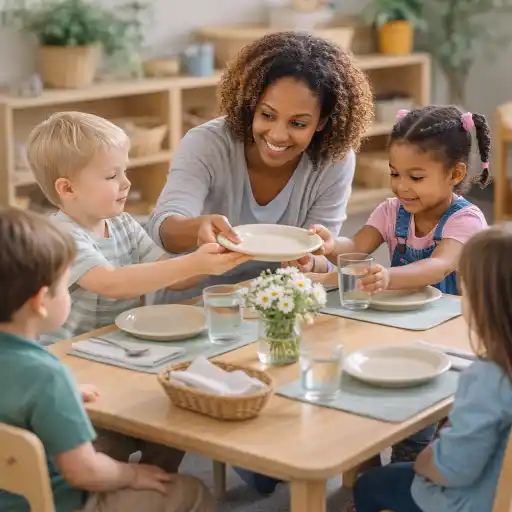
- Welcoming: Invite children to greet a visitor with a wave, words, or another comfortable gesture. Participation should not require physical affection.
- Moving with care: Practice walking around tables, carrying a tray with two hands, and making room for others.
- Taking turns: Use a visible turn card or simple timer at a popular activity. Model language such as, “May I have a turn when you’re finished?”
- Sharing space and materials: Show children where to stand, how to observe another person’s work, and how to ask before touching.
- Contributing: Offer real tasks—setting out cups, passing napkins, watering plants, or returning materials—to build independence and care for the environment.
- 😊 Expressing gratitude: Model a genuine “Thank you for helping” and notice children’s helpful actions without turning courtesy into a performance or reward contest.
Celebrations may bring heightened energy, so keep the learning flexible. Some children will want to join quickly; others may prefer to observe before taking a role. Both can be valid ways to participate. Montessori-inspired practice emphasizes respectful guidance and opportunities for children to act with increasing independence.
How can staff support inclusion and family traditions?
Begin with listening. Ask families what the event means to them, whether they want to share anything, and what forms of participation feel comfortable. Families should not be expected to represent an entire culture or provide materials. When children share traditions, educators can acknowledge the child’s experience while making clear that families may celebrate differently—or not observe the occasion.
NAEYC’s guidance on holidays in a diverse world encourages accurate, age-appropriate learning and attention to whose histories and experiences are represented. That means avoiding a “tourist” approach that reduces a tradition to costumes, crafts, or food. Use family-informed stories, photographs, music, or objects when available, and explain that there is variation within communities as well as across them. Consider whether a child might feel pressure to explain or perform a family practice; sharing should be invited, never demanded.
Inclusion also means planning multiple ways to engage. Provide visual cues, a quieter space, predictable transitions, and options to watch or help behind the scenes. Use familiar words in children’s home languages when possible, and coordinate with families about communication needs. The goal is not identical participation; it is a respectful opportunity for every child to feel recognized and safe.
When plans are uncertain, pause and consult families and colleagues rather than improvising cultural details. A thoughtful, humble approach strengthens trust and models the curiosity and respect we hope children will show one another.
What should educators do when excitement leads to conflict?
Conflicts over a place in line, a desired role, or a special material are predictable in a stimulating event. They are not proof that children have failed to learn courtesy. First maintain safety and offer calm, concise guidance. When children are ready, coach them to name the problem, listen, and consider a manageable next step.
Try language such as: “You both want to carry the basket. Let’s pause. One person can carry it now, and the other can choose the next job. What would work?” If a child needs help, offer two concrete options rather than a long explanation. Adults can demonstrate a repair—returning an item, checking whether someone is okay, or helping restore the space—without forcing an apology or affection.
Common pitfalls include introducing too many rules, correcting children publicly, and expecting perfect manners during an exciting change in routine. Instead:
- Teach one or two relevant skills in advance and revisit them briefly.
- Describe the expected action positively: “Use walking feet” or “Ask before touching.”
- Notice effort specifically: “You waited while your friend finished.”
- Keep a familiar routine and provide a calm area for children who need a pause.
- Afterward, reflect as a team: which supports helped, and what should change next time?
If a child needs additional support, adapt the language, visuals, timing, or role to match the child rather than treating the same response as fair for everyone. State requirements vary - check your state licensing agency.
How can providers make these practices part of everyday classroom life?
Courtesy becomes more meaningful when it is part of ordinary classroom life, not reserved for special occasions. A brief greeting lesson, a snack-serving routine, or a practiced way to ask for space can prepare children for many social situations. The ChildCareEd article Grace and Courtesy Activities for Montessori Classrooms describes short demonstrations, role-play, and repeated practice as practical ways to teach these behaviors.
After a celebration, revisit the experience with open-ended questions: “What helped us feel welcome?” “How did we make room for one another?” “What would we like to do differently next time?” Invite children to share through conversation, drawing, or acting out a moment. Their reflections help adults notice which routines were clear and where children need more rehearsal.
Directors can support consistency by agreeing on a few shared phrases and giving staff time to plan with families. A poster can serve as a reminder, but it works best when adults explain the visuals, model each behavior, and practice together. Use the poster as a conversation starter, not as a substitute for responsive guidance.
For a more complete foundation in Montessori peace education and grace and courtesy, explore Raising Peaceful Learners: The Montessori Advantage Buy Now $16.00. Related professional learning includes Implementing the Montessori Curriculum Buy Now $32.00, Raising Peaceful Learners: The Montessori Advantage Buy Now $16.00, Cultures in the Classroom Buy Now $24.00, You're Not My Friend Anymore: Learning Conflict Resolution Buy Now $16.00, and Social Foundations and Responsive Classrooms Buy Now $24.00.
Conclusion: What is the most helpful way to practice grace and courtesy during celebrations?
Make celebrations opportunities for children to experience community, not tests of their manners. Prepare with families, teach a few concrete skills before the event, model them in the moment, and offer flexible ways for every child to participate. When conflicts arise, respond calmly and coach problem-solving rather than expecting instant compliance.
Small practices—welcoming a guest, waiting for a turn, helping set the table, or restoring a shared space—carry Montessori respect into everyday relationships. A visual poster can remind children of shared expectations, while consistent adult modeling gives those expectations meaning. With thoughtful preparation and repeated practice, celebrations can nurture belonging, #empathy, and peace in the classroom.
- CDA Home Visitor Subject Area 3 Part 3 Birth to 5
- CDA Home Visitor Subject Area 2 Part 3 Birth to 5
- Engaging Parents in the Montessori Toddler Classroom
- CDA: Special Needs: Understanding the Whole Child
- Sensitive Periods in Montessori: Guiding Natural Learning
- Texas Director Credential
- Access for All: Inclusion and the ADA
- Montessori Cultural Activities: Exploring the World Through Play and Learning
- Every Moment Matters: Schedules and Transitions
- Raising Peaceful Learners: The Montessori Advantage
- The Montessori Advantage in Early Childhood
- 💛🧩 ¿Cómo puedo hacer que mi enseñanza sea inclusiva para los niños con autismo?
- Recursos en Español sobre el Sueño Seguro del Bebé
- 10 Ejemplos de Cómo la Cultura Influye en el Desarrollo Infantil
- Actividades de Fiesta para Niños de Preescolar y Primaria
- Proporciones de Cuidado Infantil y Tamaños de Grupo por Edad en Maryland (Guía Rápida para Centros y Hogares)
- Proporciones de Cuidado Infantil y Tamaños de Grupo por Edad en Nueva Jersey (Guía Rápida para Centros y Hogares)
- Proporciones de Cuidado Infantil y Tamaños de Grupo por Edad en Virginia (Guía Rápida para Centros y Hogares)
- Canciones, juegos y preguntas de círculo para niños
- Cómo simplificar la capacitación para sus empleados de daycare
- Montessori Social Skills: Grace and Courtesy Lessons
- Grace and Courtesy Activities for Montessori Classrooms
- ¿Todos los niños deben participar en el tiempo de círculo?
- How Can Montessori Grace and Courtesy Shape More Meaningful Classroom Celebrations?
