Every day you care for little ones and keep them safe. Emergencies can happen anytime. Being ready helps you protect #children, support your #staff, and show families you are prepared. Why it matters: plans save time, reduce panic, and help everyone get back to normal faster. State requirements vary - check your state licensing agency.
How can we make a simple emergency plan for our program?
- Identify hazards: Walk through your building and list things that could happen (fire, storm, power loss, intruder). Use tools like ChildCareEd’s guide and FEMA’s childcare materials (FEMA) to help.
- Pick actions: Keep just 3–4 clear actions: Evacuate, Shelter-in-Place, Lockdown, Reunify. The SRP gives simple words staff and responders understand.
- Assign roles: Numbered roles help. Example:
- Leader — directs the group.
- Attendance — checks names.
- Communicator — calls families and 911 if needed.
- Mark routes & meeting places: show primary and backup exits and an off-site reunification site. Post the map in each room.
- Write it down: Keep a 1–2 page plan that fits in your Go-Bag. Use a fillable template like the ChildCareEd Emergency Preparedness Plan Buy Now $0.00.
- Review: Update at least yearly, after drills, or when staff or layout changes. Document reviews for licensing.
Why this helps: a short plan is easier to teach, practice, and follow when seconds matter.
What should be in classroom Go-Bags and center supplies?
- 📘 Information (keep in a waterproof folder): attendance list, emergency contacts, allergy and medication notes, your written plan. See the ChildCareEd list at Emergency Supply List Buy Now $0.00.
- 🩹 Medical & first aid: full first-aid kit, gloves, spare prescriptions if policy allows, CPR mask. Check training like ChildCareEd health and safety resources Buy Now $0.00.
- 💧 Food & water: small water bottles and non-perishable snacks for at least 72 hours. Include formula, diapers, wipes, and blankets for little ones.
- 🔦 Tools & communication: flashlight with extra batteries, battery radio (NOAA if possible), charged power bank, whistle, pens and paper.
- 🧸 Comfort items: quiet books, small toys, comfort blankets to calm children during sheltering.
- 🧴 Sanitation: hand sanitizer, trash bags, gloves, spare masks, and cleaning wipes.
Check kits every 3–6 months and after drills. Keep a copy of licensing and insurance papers in the center kit. For detailed checklists, consult the ChildCareEd resources and Ready.gov.
How do we train staff and practice drills without scaring children?
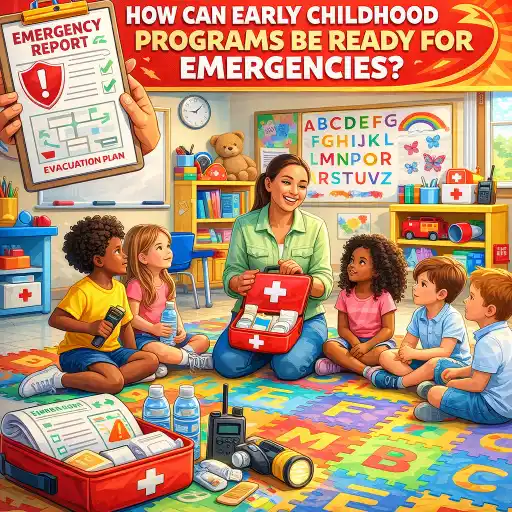
Training should be calm, simple, and practiced often. Children learn by routine. Staff learn by repeating short steps.
- 🔹 Teach in steps: Start with staff meetings. Go over the written plan, roles, and Go-Bag location. Use courses like ChildCareEd: Emergency and Disaster Preparedness
 Buy Now $55.00 for staff training.
 - 🔸 Table-top exercises: Talk through what-if stories before doing live drills. This helps staff think through problems without loud alarms.
- 🔹 Use age-appropriate drills: For toddlers, keep drills short and quiet. For preschoolers, use songs or simple directions: “Line up, hold a buddy’s hand, walk to the safe spot.”
- 🔸 Avoid scary simulations: Don’t stage frightening role-play. Follow trauma-informed guidance from sources like the SRP and Red Cross materials.
- 🔹 Debrief: After each drill, ask 3 quick questions: What went well? What can we fix? Who needs extra practice? Write notes and update the plan.
Remember: calm adults help children stay calm. State requirements vary - check your state licensing agency. Invite local responders to review drills and offer tips. Consider recognizing responders and strengthening those partnerships by participating in or acknowledging National Responders Day on October 28, which can be a helpful opportunity to thank local fire, EMS, and police and build collaborative relationships.
How do we reunify families and work with emergency responders?
Reunification is a top priority. Plan ahead so parents and staff know what will happen after an event.
- Designate sites: Choose a primary on-site meeting place and a secondary off-site location if you must evacuate. Share these with families in your handbook and at drop-off.
- Verification steps: Release children only to authorized adults. Use photo ID and sign-out logs. The CDC reunification guide has helpful ideas.
- Visual tools: Use Red/Green cards or colored signs (from the SRP) to show which classrooms are ready for release.
- Communicate widely: Phone trees, text alerts, social media, and an out-of-area contact number help if local lines are down. Keep printed contact lists in your Go-Bag.
- Work with responders: Share your plan and floor maps with police, fire, and emergency management. Invite them to observe or help with drills. See how states like Oklahoma coordinate support (Oklahoma OCC plan).
Document every reunification and drill. After the event, give families a short written update and resources for emotional support. The faster children are back with trusted adults, the better they recover — this is backed by CDC.
Summary
Quick checklist to keep where staff can see it:
- Write a short, 1–2 page plan and post it in every room. Use the ChildCareEd template Buy Now $0.00.
- Pack Go-Bags and a center kit and check them often.
- Train staff, run calm drills, and document results. Consider in-person or Zoom training Buy Now $60.00.
- Make a clear reunification plan and practice it with responders.
- Review and update your plan yearly or after any change. State requirements vary - check your state licensing agency.
Common mistakes & how to avoid them
- Not updating contact lists — fix: review monthly.
- Skipping staff practice — fix: schedule short drills each quarter.
- Using scary simulations — fix: use trauma-informed, age-appropriate practice.
- Not including children with special needs — fix: write specific accommodations into the plan and practice them.
FAQ
- Q: How often should we do drills? A: Monthly for fire and quarterly for other scenarios is a good start. Check your state rules.
- Q: Can staff carry meds in the Go-Bag? A: Follow licensing and parental consent rules and document storage and permissions.
- Q: What if phones fail? A: Use printed lists, radios, and an out-of-area contact. Keep paper copies in the Go-Bag.
- Q: Who approves our plan? A: Your director and licensing agency should review it; invite local responders for feedback.
For more step-by-step help, trainings, and templates, start with ChildCareEd courses Buy Now $55.00 and the free ChildCareEd planning resources. You protect what matters most by planning for the unexpected: your #children, your #staff, your #preparedness, #reunification, and #emergency.
- Stay Alert! Steps for Emergency Prep
- 45 Hour Child Growth and Development
- Basic Health & Safety and Breastfeeding Awareness
- 45 Hour Preschool Methods and Materials
- 45 Hour Infant and Toddler Methods and Materials
- Pediatric RSV First Aid & CPR/AED
- 45 Hour School Age Methods and Materials
- Texas Director Credential
- Keeping Our Youngest Students Safe: The Vital Importance of Pediatric First Aid and CPR Training for Teachers
- Summer Fun Meets Summer Safety: The Importance of Pediatric First Aid and CPR Training
- Life in the Fast Lane: Why First Aid Training & CPR is Critical for Those Working With Children
- First Aid & CPR ~ Empowerment Through Lifesaving Skills
- CDA Certification en Español: Recursos y Consejos para Educadores Bilingües
- 🌪️Fire Drills, Flashlights & Fast Thinking: Why Emergency Preparedness Is a Must
- How Should North Dakota Childcare Programs Handle Medical Emergencies?
- How can Oklahoma child care providers stay ready with CPR and AED skills?
- How can DC early childhood classrooms stay ready with CPR and AEDs?
- Why Does Child Care Cost So Much in Michigan — and How Can Providers Explain Value to Families?
- How can my North Dakota program make the most of food programs like CACFP?
- How can child care centers be ready for emergencies?
- How Old Do You Have to Be to Start Working in Daycare?
- Including Every Child: What Child Care Providers Should Know About the ADA
- How Can Child Care Programs Build Effective Emergency Preparedness?
