Every brushstroke, dab, and colorful trail gives young children a reason to reach, grasp, coordinate, and try again. With intentional, age-appropriate art invitations, child care providers can nurture fine motor development while honoring each child’s pace and imagination; the Meaningful Lesson Planning for Infants/Toddlers course  Buy Now $24.00 can help you turn these experiences into responsive plans grounded in children’s interests and abilities. Keep reading for practical ways to make creative art meaningful, inclusive, and manageable in a busy classroom.
For another relevant professional learning option, explore Open Heart, Open Art Buy Now $16.00, which focuses on open-ended art and its benefits for children’s social-emotional development.
Why does creative art matter for early fine motor development?
Fine motor skills involve the small muscles and coordinated movements children use to handle objects, tools, and materials. Painting, drawing, tearing paper, pressing, and placing materials invite children to practice grasping, releasing, finger movement, visual attention, and hand-eye coordination. These actions are also connected to everyday participation: opening containers, using utensils, turning pages, and eventually exploring early writing tools.
Art offers an especially welcoming context for practice because the movement has a purpose children can see. A toddler presses a sponge and watches a print appear; a preschooler follows a broad curve with a brush and sees color travel across the page. As the Head Start resource on supporting the arts with infants and toddlers explains, early arts experiences can support development across domains, encourage creative problem-solving, and give children ways to express ideas.
This matters because practice should feel engaging rather than like a test. A child does not need to produce a recognizable picture or hold a tool in one “perfect” way for an art experience to be worthwhile. Providers can focus on exploration, comfort, and growing independence while respecting different developmental pathways.
- Offer a variety of safe tools and materials so children can explore different movements.
- Notice effort and choices, not just the finished page.
- Remember that development varies; observe skills over time rather than comparing children.
Which art movements and materials build useful hand skills?
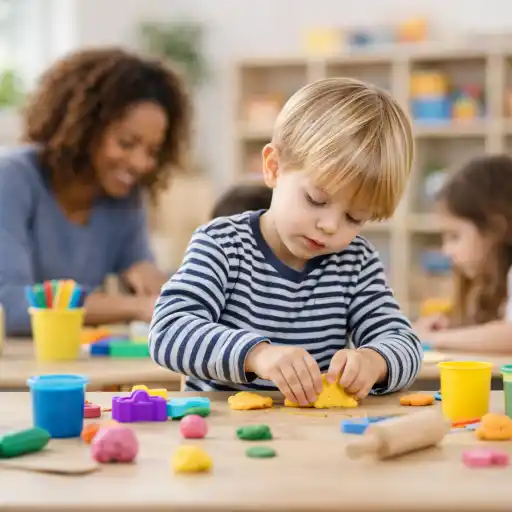
Creative art supports fine motor development through many small actions. Holding a chunky brush or crayon gives children practice with grasp and release. Dabbing, stamping, and making short marks encourage controlled movements. Tearing paper, peeling large stickers, pressing playdough, and turning a sponge can invite finger strength and coordinated use of both hands. As the NAEYC guide to building fine motor skills notes, familiar creative activities such as finger painting, using a paintbrush, drawing, and playing with dough provide opportunities for children to strengthen hand coordination.
Match the tools to the child and the goal, not to a fixed age-based expectation. Infants may explore safe, large surfaces and materials with close adult support; toddlers may enjoy broad strokes, dabbing, and pressing; preschoolers may choose narrower brushes, simple paths, or more detailed collage work. A child can use a whole-hand grasp and still be gaining valuable experience.
- Try large paper, washable paint, chunky crayons, short brushes, sponges, and child-safe stampers.
- Use playdough or soft clay for squeezing, rolling, pinching, and pressing.
- Offer simple tracing or painting paths as an option, not a requirement.
- 🎨 Invite children to choose a tool and describe the marks it makes.
With the Trace & Paint resource Buy Now $1.49, educators can explore tracing-and-painting activity ideas as one possible invitation. Adapt printed paths with broad lines, larger paper, or a free-painting alternative, especially for younger children.
How can providers plan an art invitation that is developmentally appropriate?
Start with a simple learning intention: for example, “children will explore making marks with different tools” or “children will practice grasping, pressing, and releasing.” Then select a few accessible materials and prepare a clear work area. A small number of choices is often more inviting than a crowded table. For infants and toddlers, keep the activity brief and flexible; children may watch, touch, make one mark, or move on. Their participation can look different and still be meaningful.
Model a movement without requiring children to copy it. You might slowly drag a brush across the page, press a sponge once, or describe a child’s action: “You pushed down, and the paint made a dot.” Use descriptive language rather than evaluating the art as good or bad. When a child shows interest, you can extend the experience with a new tool, color, texture, or surface.
- Prepare washable, age-appropriate materials and supervise closely.
- Secure paper to a table or offer a vertical surface if that suits the child’s comfort and access.
- Provide smocks or a defined art area and build in time for cleanup and handwashing.
- Connect the activity to children’s interests, familiar routines, and family or community experiences.
For infant and toddler teams, Meaningful Lesson Planning for Infants/Toddlers Buy Now $24.00 offers a way to deepen planning around age-appropriate experiences. Use the training to support thoughtful decisions, then adapt activities based on what you observe in your own group.
How can art be adapted for different abilities and sensory preferences?
Inclusive planning asks what adjustments will help each child participate with agency. Some children may enjoy finger paint; others may prefer a brush, sponge, water painting outdoors, or a dry tool. A child who finds a small brush difficult may manage a chunky handle or a sponge dabber. Paper can be secured with tape, placed on a tray, or positioned vertically. Children can also point, choose colors, direct an adult, or describe an idea while someone helps with a physical step.
Offer alternatives without presenting them as lesser choices. Avoid insisting on a particular grasp, hand, texture, or finished result. Observe whether the child is engaged, comfortable, and able to make decisions. If a child becomes frustrated or tired, simplify the path, reduce the number of materials, take a break, or switch to open-ended mark-making.
Art is not a developmental test. Use observations to understand how a child approaches materials over time, not to label or diagnose. If you notice persistent difficulty that limits participation across activities, document objective examples and follow your program’s family communication and consultation procedures.
- Offer different tool sizes, surfaces, and ways to participate.
- Reduce steps or use larger materials when precision is a barrier.
- Allow children to observe before joining and to stop when they are ready.
- Celebrate communication, curiosity, experimentation, and self-directed choices.
As the Head Start guidance on early arts experiences emphasizes, creative materials should be accessible and activities adapted so children with disabilities or suspected delays can take part meaningfully.
How can educators observe progress and avoid common pitfalls?
Brief, respectful observations can make planning more responsive. Note which tools a child chooses, how they grasp or release them, whether they use one or both hands, how they respond to a change in texture, and what holds their attention. A dated photo, a short anecdotal note, or a child’s words can help staff notice change across repeated experiences. These records are not grades; they are clues for choosing the next useful invitation.
One common pitfall is focusing on a polished product. When adults correct every mark or finish the task for the child, children have fewer chances to make decisions and practice. Another is introducing too many materials or steps at once. Keep the invitation clear and allow time for experimentation. A third is expecting every child to participate in the same way; flexibility makes art more welcoming and developmentally useful.
- Instead of: “That’s not how you paint the line.” Try: “You chose to move the brush in a new direction.”
- Instead of: requiring a completed template, try: offering a broad path alongside blank paper.
- Instead of: measuring success by neatness, try: recording a child’s strategy, persistence, or growing independence.
Choose age-appropriate materials, follow product directions, and maintain active supervision. State requirements vary - check your state licensing agency for applicable material, supervision, and classroom requirements.
Conclusion: What should providers remember about art and fine motor growth?
Creative art gives young children repeated, purposeful opportunities to reach, grasp, press, release, coordinate, and communicate. The strongest experiences are responsive rather than rigid: provide safe materials, make room for choice, model without taking over, and adapt tools and participation to each child. Tracing and painting can be useful options, but free mark-making, collage, dough, and everyday creative routines also offer valuable practice.
Keep the central question in view: how can art support early fine motor development? By making exploration accessible, enjoyable, and intentional, providers help children build hand skills while expressing ideas and discovering what they can do. Observe small changes over time, share learning with families, and let the process—not a perfect product—guide your next plan.
To strengthen your planning practice, explore Meaningful Lesson Planning for Infants/Toddlers Buy Now $24.00. For a focused exploration of expressive, open-ended art, consider Open Heart, Open Art Buy Now $16.00.
- CDA Home Visitor Subject Area 2 Part 3 Birth to 5
- Power of Art: Bldg Self-Esteem & Positive Behavior for ALL Abilities
- CDA Bridge Bundle: Family Child Care without Portfolio Review
- Art from the Heart for Preschoolers: Open Ended Art Projects that Build Self-Esteem
- CDA Bridge Bundle: Infant/Toddler without Portfolio Review
- CDA Bridge Bundle: Preschool without Portfolio Review
- Texas Director Credential
- Montessori Cultural Activities: Exploring the World Through Play and Learning
- Power of Art: Bldg Self-Esteem & Positive Behavior for ALL Abilities ONLINE
- Terrible Two's Can Be Terribly Fun!
- Pumpkin Spice and Sensory Delight: Easy Autumn Sensory Bins for Early Learners
- How to boost fine motor skills: Holiday Edition
- DIY Snow Globes: The Fine Motor Craft That’ll Keep Kids (and Adults) Busy for Hours
- Increasing Fine Motor Skills in the Early Childhood Education Classroom
- How motor skills shape child development and creative ways educators can foster them.
- CDA Certification en Español: Recursos y Consejos para Educadores Bilingües
- 🔍 ¿Qué ves cuando observas a un niño aprender?
- Cuáles Son las Señales de Alerta en el Desarrollo Infantil que Todo Educador Debe Conocer?
- Creative Daycare Activities to Help Children Learn and Grow
- Learning Through Creative Daycare Activities
- How Do Art Activities Support Cognitive Growth in North Dakota Preschoolers?
- How can New York child care providers use art and creativity to help young children learn?
- Crayon Activities for Preschoolers: Color, Creativity, and Fine Motor Skills
- How can I turn viral crafts into real learning activities?
- Why Should Children’s Artwork Not All Look the Same?
- How Can Early Childhood Programs Support Creativity Through Process Art?
- Can recycled materials build real creativity in early childhood classrooms?
- How Can Child Care Providers Strengthen Fine Motor Development Through Play and Daily Routines?
- How Can Creative Art Support Early Fine Motor Development?
