Viral craft videos and pinned projects can provide a steady stream of colorful inspiration, but the most popular idea is not always the most meaningful or developmentally appropriate for young children. Child care providers can turn trending #crafts into intentional learning #activities by identifying a clear developmental goal, simplifying complicated steps, choosing safe materials, and leaving room for children to make their own creative decisions. This guide offers practical strategies for evaluating and adapting online projects so they strengthen young #children’s fine motor abilities, language, problem-solving, self-expression, and early #art skills. You’ll also find safety checks, inclusive adaptations, family engagement ideas, and simple documentation methods that connect the creative process—not just the finished product—to children’s learning.
To strengthen your use of open-ended creative experiences, explore ChildCareEd’s self-paced online course Open Heart, Open Art  Buy Now $16.00. The course examines how child-led art can support self-expression and development, helping educators shift viral crafts away from identical, adult-directed products and toward meaningful exploration. Providers can also take From Play to Planning: Building Culturally Competent, Child-Centered Curriculum Buy Now $55.00 for strategies that connect children’s interests and play experiences to intentional, inclusive curriculum planning.
Why it matters:
Viral projects are popular because they're visual, inexpensive, and fun.
When we turn them into curriculum-aligned invitations,s they can support fine motor development, vocabulary, problem-solving, and social-emotional learning — not just a photo for social media. Thoughtful adaptation respects cultural context, health rules, and developmental goals.
What makes a viral craft worth adapting for learning?
- Learning alignment: Does the craft support a clear developmental objective (fine motor, counting, vocabulary, sequencing)? If yes, it's easier to document and assess. See ideas for aligning crafts with outcomes in Process Art or Product Art and Open-Ended Art Activities.
- Material access and safety: Are materials non-toxic, age-appropriate, and affordable? Refer to toy and material safety guidance like KidsHealth's safe-toy tips and product rules in Health Canada guidance.
- Cultural & ethical fit: Does it respect families and cultures (no caricatures or stereotypes)? For multicultural approaches and family voice ideas, see Fiesta Crafts for Kids.
- Feasibility: Time, prep, staff ratios, and clean-up load — can you run it without sacrificing supervision? If cleaning or disinfecting is required after messy activities, follow procedures such as the CDC's cleaning and disinfecting guidance.
How do I transform one viral craft into a clear learning activity?
- Define the objective: Choose 1–2 measurable goals (e.g., practice pincer grasp, count to five, use three new words).
- Adapt materials: Replace choking-risk items or toxic glitters with classroom-safe alternatives. For food-based steps, label and check allergies — state requirements vary - check your state licensing agency. Consider substituting recycled, found, or "junk" materials to create open-ended art invitations that build creativity and social-emotional skills; see From Rags to Riches: Junk Art for practical ideas and examples.
- Plan roles & timing: Assign a station lead, a floater, and a materials manager. Keep rotations to 15–20 minutes for preschool groups where attention is limited.
- Make it process-friendly: Offer choices (colors, tools, placement) instead of a fixed model so the activity supports creativity and confidence. See Open-Ended Art Activities.
- Embed prompts: Use focused questions to scaffold learning ("How many feathers did you use?", "Tell me about your picture").
- Document learning: Photograph the process, collect a child quote, and note the skill observed. Small notes link directly to next-step planning.
Example: A viral "glue-and-sequin" sun becomes a counting and fine-motor station by offering numbered sequin trays, tweezers for grasp practice, and a vocabulary chart with words like "shiny" and "adhere". For holiday or event crafts that are product-driven, reserve them for family gift projects while keeping daily art mostly open-ended (Process vs Product). For ready-made, age-appropriate holiday lesson ideas and crafts you can adapt to specific learning objectives, see our Memorial Day activities for children.
How can I run viral-craft stations safely and manage materials?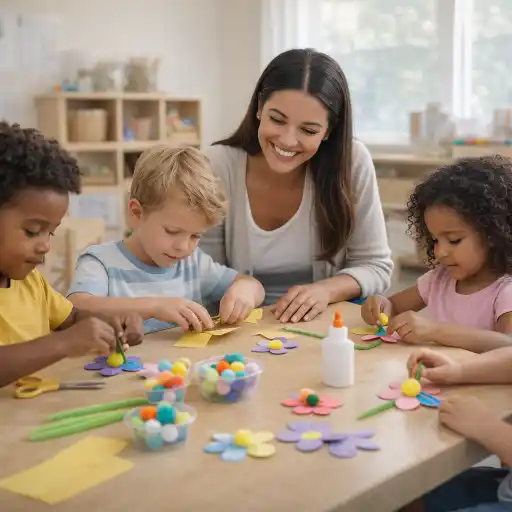
- Prep kits: Pre-cut, pre-portioned trays and labeled bins reduce transitions and limit how much supervision is needed at each table.
- Sanitation rules: Clean visibly soiled surfaces after snack or messy craft; sanitize shared mouth-contact items. Follow CDC steps for cleaning, sanitizing, and disinfecting in early care settings: CDC guidance.
- Age and choking checks: Use a small-parts tester or refer to age-safety guidance (see KidsHealth). Remove beads, buttons, or tiny decorations for toddlers.
- Allergy & food safety: If the craft includes food, label ingredients, offer alternatives, and communicate with families. State requirements vary - check your state licensing agency.
- Supervision plan: Assign a roamer who monitors behavior and corrects unsafe use (scissors, hot glue, etc.).
- Storage & reuse: Store dried projects and reusable materials separately; maintain a first-aid checklist and report system as part of your center's safety plan.
How do I document learning and involve families so crafts become curriculum evidence?
Documentation turns a cute craft into proof of learning and strengthens family partnerships.
- Two-minute notes: After each station, record one observed skill and one child quote. Over time, these build a learning story.
- Photo + caption: Photograph the child during the process and caption with the objective observed (e.g., "Ava used tweezers to pick 5 pom-poms"). Share these in daily reports or a classroom blog. For documentation and parent communication strategies, see Welcoming Families resources and program materials in the Preschool Methods & Materials collection.
- Family invites: Ask families to contribute one photo, ingredient, or story related to the craft theme; invite a 10–15 minute volunteer slot during a station. For culturally respectful family engagement, review Fiesta Crafts for Kids.
- Share learning goals: Post a short note: "Today we practiced counting to 10 using buttons." This helps families see purpose beyond the product.
- Training & scaling: Build staff capacity with short in-house demos or the ChildCareEd course Art from the Heart for Preschoolers Buy Now $35.00 to align practice across your team.
What common mistakes should we avoid,d and what quick FAQs do providers ask?
Common pitfalls are fixable. Here are frequent stumbles and quick remedies:
- ❌ Too many steps at once — Fix: Offer 1–2 learning targets per station and time-box activities to 15–20 minutes.
- ⚠️ Over-directing the project (everyone makes the same thing) — Fix: Turn it into a teacher-guided invitation and allow choice; see Process vs Product.
- 🚫 Safety blind spots (small parts, toxic glues) — Fix: Substitute safe materials and consult safety resources like KidsHealth and follow cleaning protocols from the CDC.
FAQ
- Q: How long should a viral-craft station run? A: 15–20 minutes for preschoolers; rotate so children stay engaged.
- Q: What if parents expect a take-home masterpiece? A: Share documentation showing the learning goals and process; offer occasional product projects for family gifts.
- Q: Can messy viral ideas be adapted for indoors? A: Yes — use trays, smocks, pre-portioned materials, or do the messy part outdoors. Alternatively, choose low-mess activities such as paper airplanes — simple folding and flight tests work well outdoors and support fine-motor control, sequencing, and basic physics vocabulary.
- Q: How do I track developmental progress from crafts? A: Use quick notes: skill observed, level of independence, and next-step goal. Aggregate notes weekly.
- Q: Who approves materials and activities? A: Your program director and licensing regulations — state requirements vary - check your state licensing agency.
Quick takeaways:
- Pick projects that map to 1–2 learning goals.
- Adapt materials for age-safety and inclusivity.
- Use short rotations, prep kits, and a documentation routine.
- Communicate the "why" to families and invite their voice.
- Train staff to favor process-rich invites with occasional product pieces.
Want more ready-to-use resources and training? Explore ChildCareEd's practical guides like Open-Ended Art Activities, holiday and theme collections such as Fiesta Crafts for Kids, and instructor-led courses like Art from the Heart Buy Now $35.00. Small pilots (one viral craft reworked per week) build staff confidence and produce measurable learning evidence. You're doing important work turning bright ideas into meaningful learning—keep adapting, documenting, and celebrating children's choices.
Safety and sanitation are non-negotiable. Run stations with clear systems to reduce risk, mess, and staff stress. Use a quick vetting checklist to decide whether to keep, rework, or skip a viral craft. Consider these four evidence-informed filters: Turn a flashy clip into a classroom-ready plan using a simple 6-step process. Numbered steps make this scalable across staff teams.
- 45 Hour Child Growth and Development
- Moving About the Classroom: Effective Transitions for Everyday
- The ABCs of Behavior: Turning Challenges into Learning Opportunities
- CDA Bridge Bundle: Preschool
- CDA Bridge Bundle: Family Child Care
- Art from the Heart for Preschoolers: Open Ended Art Projects that Build Self-Esteem
- CDA Bridge Bundle: Infant/Toddler
- Sensitive Periods in Montessori: Guiding Natural Learning
- Texas Director Credential
- Thanksgiving Booklet Activity
- CDA Certification en Español: Recursos y Consejos para Educadores Bilingües
- 🤯 ¿Por qué este niño está teniendo un comportamiento difícil de repente?
- 👶 ¿Cuáles son las proporciones y grupos requeridos en Dakota del Norte? 🏫
- Recursos en Español sobre el Sueño Seguro del Bebé
- ¿Cómo puedo usar escenarios de juego de roles de primeros auxilios en mi aula?
- ¿Cómo puedo enseñar habilidades de primeros auxilios con escenarios de juego de roles?
- Actividades de Fiesta para Niños de Preescolar y Primaria
- Cómo Empezar una Guardería en Casa: Requisitos y Pasos
- Proporciones de Cuidado Infantil y Tamaños de Grupo por Edad en Virginia (Guía Rápida para Centros y Hogares)
- Cómo Celebrar el Día Nacional del Kindergarten
- Actividades de Otoño Fáciles para Preescolares esta Temporada
- Lista para Guardería en Casa en Illinois: Cómo Iniciar una Guardería en el Hogar
- Ejemplos de Crianza Respetuosa vs. Crianza Permisiva
- Calabazas, hojas y manzanas: actividades de otoño para preescolares
- Celebrando la amistad en el cuidado infantil durante el Día de los Mejores Amigos
- Diversión fresca de verano: actividades del Día Nacional del Helado para niños
- Canciones, juegos y preguntas de círculo para niños
- Cómo simplificar la capacitación para sus empleados de daycare
- How can I turn viral crafts into real learning activities?
