Children learn best when activities are simple, hands-on, and part of the day. This article gives child care providers practical ideas you can use right away. You will find short plans, safety notes, and ways to measure success. Two short reasons why this matters:
1) Early activities shape brain growth, social skills, and school success. See why ECE matters at the CDC review of early childhood education.
2) Small daily choices—play, routines, books, and simple science—make big learning gains over time. Many ChildCareEd posts have ready ideas you can copy and adapt, like Playful Learning and Preschool STEM.
What classroom activities help learning every day?
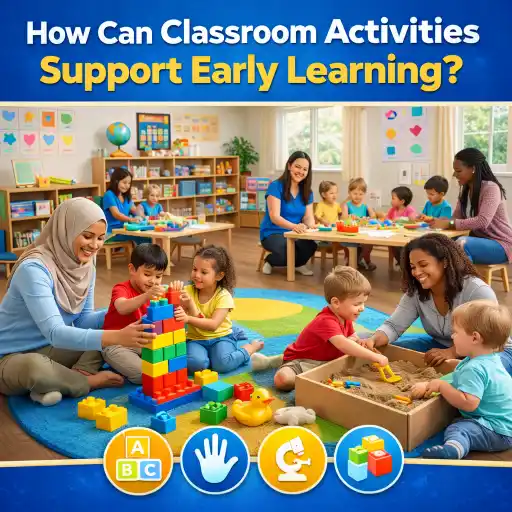
Use a mix of play, language, movement, and small projects. Try these easy activity types:
- 🎲 Play-based learning: child-led play with adult prompts. These build problem solving and social skills — find ideas in How to Bring Play into the Classroom.
- 🧪 Hands-on #STEM: short experiments, ramps, or water play. See examples at Preschool STEM Activities.
- 🎨 Sensory and art: calm bins, paint, or texture walks. Try no-cost sensory setups at No-Cost Sensory Activities.
- 📚 Literacy and phonological play: rhymes, sound games, and puppet stories. Use tips from Phonological Awareness to boost #literacy.
- 🧩 Math and fine motor: sorting, counting games, and bead lacing build thinking and #play skills. See ChildCareEd math and fine motor resources like Math Activities and the fine motor center ideas referenced in our resources. For story-based counting activities that combine narrative, vocabulary, and early number sense, see Math Stories.
Quick tip: keep activities short (10–20 minutes for new skills), repeat often, and let children explore first. Use simple props and rotate materials to keep interest high.
How do I plan routines and make activities fit the day?
Routines turn learning into habit. Use a clear daily flow so children know what to expect and practice skills often. CSEFEL and PBS both explain how schedules and routines help children feel secure and learn faster — see CSEFEL What Works Brief on routines and the PBS guide to daily routines.
- Plan: write 1 short goal per activity (example: “count to 5” or “use tweezers”).
- Materials: list 2–3 items and where they live.
- 🧰 Example: Rice tray — scoop, cup, and picture cards.
- Steps: 1) Intro (30–60 sec), 2) Play (10–20 min), 3) Wrap-up (1–2 min). Use a song or a quick question to close.
- Jobs and repetition: give children small roles (snack helper, prop passer). CSEFEL shows how jobs boost peer interaction in daily routines: Using Classroom Activities & Routines.
Safety and rules: post short reminders and supervise transitions. State requirements vary - check your state licensing agency. Keep backup activities for children who need extra support or quiet time.
How can activities build social-emotional and language skills?
Use simple, repeated activities to teach kids how to share, ask for help, name feelings, and talk about ideas. Programs and studies show that embedding SEL into daily lessons works best — for example, RAND’s PEDALS evaluation highlights how SEL lessons and teacher coaching improve classroom practice: PEDALS program findings.
- 🗣️ Language through play:
- Read short books, act out stories, and use puppets. Add rhymes and sound games from Phonological Awareness to grow #literacy.
- 😊 SEL moments:
- Use emotion charts, calm corners, and role play. ChildCareEd has ready-made social skills lesson plans at Social Skills Lesson Plan Buy Now $0.00.
- 🤝 Peer practice: set up paired tasks (passing props, snack captains) so children practice asking, waiting, and saying thank you. CSEFEL provides examples of peer interaction during snack and circle time at Using Classroom Activities & Routines.
Tip: praise specific actions (“You put the cup on the table — thank you!”). Short, consistent feedback helps skills stick.
What common mistakes should I avoid and how do I measure success?
Many programs try great ideas but stumble on a few common points. Here’s how to avoid pitfalls and check that activities help children learn.
- 😬 Too much adult talk — let children try first. Then ask open questions like, “What do you notice?”
- 😕 Too many goals at once — pick one clear goal per activity (counting, turn-taking, pincer grasp).
- 🧼 Poor cleanup and rotation — keep a short bin checklist so staff can swap materials quickly.
- ⚠️ Safety oversights — check allergies, choking hazards, and always supervise messy or small-piece play. Remember: state requirements vary - check your state licensing agency.
Measuring impact (simple steps):
- Pick 1 child and 1 skill each week (example: “holds pencil with tripod grip”).
- Record 1 short note after the activity: who, what skill, next step.
- Use photos and child quotes to document learning — share one quick note with families each week.
FAQ (quick):
- Q: How often should we run an activity? A: Short, repeated sessions (daily or 3–4 times a week) work best.
- Q: How long should circle or group time be? A: Keep young children’s group time short and active (5–15 minutes). CSEFEL recommends predictable, engaging routines in Promoting Children's Success.
- Q: Where to find more ready ideas? A: ChildCareEd has many ready posts like Pre-K Ideas and activity toolkits.
Summary: Pick a few activity types (play, #STEM, #sensory, #literacy, #SEL), plan one clear goal, repeat activities often, and track small wins. Small, daily choices build big results. Your role as a warm, organized guide makes the classroom a place where children grow every day.
- 45 Hour Child Growth and Development
- Early Mathematics Through Play
- 45 Hour Preschool Methods and Materials
- Injury Prevention: Their Safety Is In Your Hands
- 45 Hour Infant and Toddler Methods and Materials
- Pediatric RSV First Aid & CPR/AED
- Texas Director Credential
- Wellness in Action: Teaching Healthy Habits to Children
- Preschool Arithmetic Activity
- How Can Childcare Educators Thrive in the Big Apple?
- Tiny Tots, Big Learning: Crafting Curriculums for the Littlest Learners!
- CDA Certification en Español: Recursos y Consejos para Educadores Bilingües
- 🎉STEM-sational Fun: How Can You Spark Preschoolers’ Curiosity with Engaging STEM Activities? 🔬🧪🔢
- 💛🧩 ¿Cómo puedo hacer que mi enseñanza sea inclusiva para los niños con autismo?
- Proporciones de Cuidado Infantil y Tamaños de Grupo por Edad en Virginia (Guía Rápida para Centros y Hogares)
- How Do Art Activities Support Cognitive Growth in North Dakota Preschoolers?
- Can Toddlers Do STEM in the Sandbox at Minnesota Daycares?
- How can Michigan providers teach community and citizenship for the 250th anniversary?
- How can ocean-themed sensory bins and water play boost learning while staying safe in preschool programs?
- How can we explore sand, space, and science with young children in preschool settings?
- How can pumpkin science create meaningful, hands-on fall learning for preschool classrooms?
- STEM for Preschoolers: Fun Activities That Encourage Curiosity
- How Can STEM Activities Turn Everyday Preschool Play Into Powerful Learning?
- Learning Through Choice: Why Do Classroom Choice Boards Work?
