Nature-based learning turns an ordinary yard, garden, sidewalk, or park into a setting for inquiry, movement, creativity, and belonging. If your team wants practical support designing richer outdoor experiences, explore Creating the Natural Outdoor Classroom  Buy Now $16.00, which offers classroom-ready ideas for using colors, textures, sounds, scents, and natural materials while adding relevant professional learning to your development plan.
Why does nature-based learning matter in early childhood?
Nature-based learning is not simply “taking children outside.” It is an intentional approach in which the natural world becomes an organizing context for play, relationships, investigation, and curriculum. Natural Start Alliance describes nature-based preschool as having dual goals: supporting whole-child development and building environmental literacy. This means children may be developing balance while climbing, vocabulary while describing a leaf, cooperation while constructing a shelter, and stewardship while caring for a garden.
The approach also responds to a real challenge facing many programs: children need meaningful movement, sensory experiences, and opportunities to practice attention and self-regulation, yet schedules can become crowded and indoor environments can feel overstimulating. Research summarized by the University of Minnesota’s Center for Early Education and Development connects nature play with executive-function practice, while noting that programs do not need to spend the entire day outdoors to gain value. Consistent, moderate experiences can be a realistic starting point.
For directors, nature-based learning can integrate several priorities at once:
- Physical development through climbing, balancing, digging, carrying, and running.
- Language and cognitive growth through observation, prediction, comparison, and storytelling.
- Social-emotional development through collaboration, manageable challenges, and calming sensory experiences.
- Environmental literacy through repeated contact with local plants, animals, weather, and seasonal change.
The evidence base is promising but not uniform. A systematic review discussed by Outdoor Play Canada found possible benefits in self-regulation, social skills, well-being, motor competence, and nature relatedness, while emphasizing that more rigorous research is needed. That balanced conclusion matters: nature should complement high-quality early childhood practice rather than be presented as a cure-all.
How can educators connect outdoor experiences to curriculum goals?
Effective outdoor learning begins with a learning intention, but it should remain flexible enough to follow children’s interests. Natural Start Alliance recommends an emergent, play-based curriculum in which children’s questions and abilities guide opportunities. A teacher might plan to explore measurement, then notice that children are fascinated by worms. The curriculum can shift toward length, habitat, moisture, and respectful observation without abandoning intentional teaching.
Use a simple planning cycle:
- Notice: Observe what children repeatedly touch, collect, discuss, or revisit.
- Interpret: Identify possible developmental domains and learning goals connected to the interest.
- Invite: Add a small set of materials, vocabulary, or questions that extend exploration.
- Document: Record a child’s words, actions, drawing, construction, or emerging theory.
- Extend: Revisit the experience through books, art, measurement, dramatic play, or indoor reflection.
For example, children collecting stones might sort them by color, compare weight, create patterns, dictate a story about a “stone family,” or build a small habitat. Infants can experience nature through close adult narration, safe textures, changing light, and sounds. Toddlers benefit from short investigations such as filling containers, noticing shadows, or matching picture cards to outdoor objects. Preschoolers can make predictions, tally findings, sketch changes, and collaborate on longer projects.
Outdoor curriculum does not require elaborate lessons. A 15-minute invitation with one clear question—“Which surface feels warmer?”—can support sensory language, comparison, scientific reasoning, and social conversation. The Building Early Science Foundations Buy Now $16.00 course may help staff strengthen their use of exploration, experimentation, and discovery with young children. If children's outdoor observations turn toward the moon, stars, or planets, ideas for celebrating Space Exploration Day can help extend that curiosity into classroom science activities.
How can programs design welcoming nature-rich spaces?
A high-quality nature space is purposeful without becoming overly manufactured. The Children & Nature Network recommends incorporating elements such as trees, pathways, boulders, logs, gardens, native plants, sand, water, and loose parts. These features offer open-ended possibilities: a log can become a balance beam, bridge, boundary, bench, or part of an imaginary animal habitat.
Begin with an audit of the space rather than purchasing equipment immediately. Ask:
- Where can children move vigorously, and where can they pause quietly?
- Which areas invite sensory exploration without creating unnecessary hazards?
- Can children with varied mobility, sensory, communication, and regulation needs participate meaningfully?
- Are natural elements visible, reachable, and connected to children’s everyday experiences?
- Can staff maintain effective sight and sound supervision from their assigned positions?
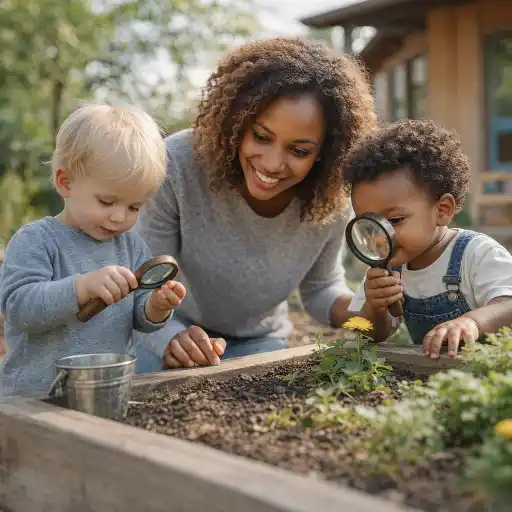
Organize the environment into flexible micro-zones, such as movement, construction, gardening, sensory exploration, observation, and gathering. Small programs can use portable materials: a nature cart with magnifiers, clipboards, buckets, picture cards, fabric, and writing tools. A container garden, vertical planter, or small seasonal display can create meaningful contact with living things even when a center has no large yard.
Inclusive design requires more than adding an accessible path. Offer multiple ways to participate: children might touch, look, listen, gesture, use adaptive tools, or observe before joining active play. Provide quiet spaces for children who need reduced stimulation and predictable visual cues for transitions. Invite families and children to contribute ideas about culturally meaningful plants, outdoor routines, and comfort needs.
For staff who want to connect environmental design with children’s independence and curiosity, Environments That Inspire Independence and Exploration Buy Now $55.00 offers broader strategies for inclusive, engaging learning spaces.
How can educators balance healthy risk with responsible safety?
Nature-based learning involves uncertainty: a child may climb, carry a heavy stick, encounter mud, or test whether a structure will hold. Healthy risk can support judgment, confidence, motor planning, and resilience, but it must be distinguished from a hazard. A risk is a challenge children may understand and negotiate with appropriate support; a hazard is an unreasonable source of potential harm that adults should remove or control.
Natural Start Alliance recommends benefit-risk assessments, regular site checks, emergency procedures, suitable clothing, hygiene practices, and supervision strategies. Build these systems into everyday operations rather than treating them as separate paperwork.
- Complete a brief hazard scan before children enter the area.
- Define boundaries that preserve exploration while maintaining line of sight and auditory connection.
- Assign adults to zones and require active supervision—watching, listening, positioning, counting, and interacting.
- Use weather and air-quality guidance to determine whether outdoor time should continue, shorten, or move indoors.
- Plan for hydration, sun protection, insect awareness, toileting, hand hygiene, allergies, and emergency communication.
- Review incidents and near misses with staff so policies improve over time.
CDC guidance highlights precautions related to sun, heat, insect bites, playground injuries, water play, and constant supervision near water. Follow applicable public health and licensing guidance, and remember that state requirements vary—check your state licensing agency. The Effective Supervision in Child Care Buy Now $25.00 course can support staff understanding of active supervision across indoor and outdoor settings.
How can programs make nature-based learning equitable and sustainable?
Equity begins with recognizing that families may have unequal access to outdoor clothing, transportation, safe green spaces, or culturally familiar environments. A nature-based program should reduce those barriers rather than assume every child arrives prepared for the same experience.
- Maintain a labeled lending collection of rain pants, boots, hats, coats, sunscreen, and spare clothing.
- Use nearby sidewalks, courtyards, gardens, parks, and container plants when a large natural site is unavailable.
- Offer sensory and participation choices so children can engage without touching mud, insects, or unfamiliar materials.
- Use home languages, family knowledge, and community traditions to shape nature stories and investigations.
- Select plants and materials thoughtfully and teach care rather than extraction.
Family communication is especially important. Explain what children are learning, what clothing is needed, how hazards are managed, and how families can share knowledge. Photos, child quotations, and short learning notes help caregivers see that mud, sticks, and wandering conversations are meaningful curriculum rather than unstructured downtime.
Sustainability can also become a daily practice. Children can compost food scraps where appropriate, collect rainwater for plants under adult supervision, reuse containers, monitor shade, or notice how weather affects a garden. These experiences develop agency: children learn that their choices can contribute to the well-being of a shared place.
What common mistakes should programs avoid?
- Overplanning every minute: Replace a rigid outdoor lesson with one intention, a few materials, and time for child-led inquiry.
- Equating mess with learning: Mud and water can be valuable, but children also need quiet observation, movement, conversation, and imaginative play.
- Removing every challenge: Eliminate hazards while allowing developmentally appropriate, supervised risks.
- Ignoring weather and air quality: Create clear thresholds and backup plans.
- Using nature as a reward: Outdoor learning should be a regular part of the program.
- Documenting only finished products: Capture process—the child’s question, strategy, revision, collaboration, and persistence.
FAQ
Do children need access to a forest?
No. A yard, balcony garden, sidewalk tree, community garden, or nearby park can support meaningful learning when educators plan intentionally.
How much outdoor time is enough?
There is no single universal schedule. Begin with frequent, predictable blocks and adjust for age, weather, staffing, space, and licensing requirements.
How can infants participate?
Provide safe sensory experiences, close observation, movement opportunities, and rich adult narration.
How do we show families that outdoor play is educational?
Share a photo, a child quotation, and one sentence linking the experience to a developmental goal.
Conclusion: How can programs begin this week?
Nature-based learning becomes meaningful when nature is treated as a consistent learning partner rather than an occasional backdrop. Begin with one manageable change: schedule a short daily nature walk, create a loose-parts basket, plant one container garden, or establish a quiet observation space. Choose one learning goal, invite children’s questions, and document what unfolds. Professional learning such as CDA: Creating the Outdoor Classroom Buy Now $16.00, Building Early Science Foundations Buy Now $16.00, Effective Supervision in Child Care Buy Now $25.00, Environments That Inspire Independence and Exploration Buy Now $55.00, and Creating the Natural Outdoor Classroom Buy Now $16.00 can help teams turn enthusiasm into consistent practice.
- 45 Hour Child Growth and Development
- 45 Hour Preschool Methods and Materials
- Bienvenido! Welcoming All Families
- Children at the Wheel: Emergent Curriculum
- 45 Hour School Age Methods and Materials
- CDA: Creating the Outdoor Classroom
- Sensitive Periods in Montessori: Guiding Natural Learning
- Texas Director Credential
- Enhancing STEM Education for Infants and Toddlers
- Today Is Earth Day!
- 💛🧩 ¿Cómo puedo hacer que mi enseñanza sea inclusiva para los niños con autismo?
- Recursos en Español sobre el Sueño Seguro del Bebé
- Proporciones de Cuidado Infantil y Tamaños de Grupo por Edad en Virginia (Guía Rápida para Centros y Hogares)
- How can Washington classrooms be more inclusive using nature, play, and community?
- How can learning environments support children's development?
- Canciones, juegos y preguntas de círculo para niños
- Can forest preschool activities be integrated into traditional programs?
- Including Every Child: What Child Care Providers Should Know About the ADA
- What Makes a Great Home Daycare? 10 Things Parents Notice First
- Go on a Fall Hunt! Outdoor Learning Challenges for Preschoolers
- Can You Build a Leaf Bridge? Fall STEM Challenges for Pre-K
- Field Trips for Elementary Students: 15 Adventures That Bring Learning to Life
- How Can STEM Activities Turn Everyday Preschool Play Into Powerful Learning?
- How Can Child Care Programs Make Nature-Based Learning Meaningful, Inclusive, and Safe?
- How Can Child Care Providers Make Outdoor Learning Meaningful, Safe, and Inclusive?
- How Can Providers Bring Nature-Based Learning Into Any Program?
- How Can You Adapt Nature-Themed Art for Children with Different Support Needs?
- How Can Family Child Care Providers Carry Individualized Support Into Everyday Activities?
- How Can Child Care Providers Make Room for Floor Projects That Grow Beyond Their Starting Area?
