When addition feels abstract, a familiar object can give children something meaningful to count, combine, and explain. The Early Mathematics Through Play Buy Now $24.00 course can help providers strengthen this approach with practical strategies for number sense, early operations, mathematical language, and hands-on learning throughout the day.
Why do familiar objects make early addition meaningful?
Young children often understand mathematical relationships before they can express them with symbols. They notice that one friend has more crackers, that two blocks can join another group, or that additional pieces make a tower taller. Familiar objects connect these informal discoveries to the formal idea of addition: combining quantities to find a total.
Research on play-based mathematics emphasizes the educator’s role in recognizing children’s existing understanding, introducing precise mathematical language, and observing how children reason. The ECRP discussion of teacher professional growth highlights these practices as central to guiding children from behavioral knowledge toward representational understanding.
Using everyday materials also supports a strengths-based classroom culture. Children can participate through touching, moving, drawing, speaking, or demonstrating. This flexibility is especially helpful for multilingual learners, children developing fine-motor skills, and children who need repeated experiences before connecting quantities with written numerals.
- Concrete objects make quantity visible and movable.
- Real contexts give addition a purpose, such as sharing or combining collections.
- Conversation helps children explain strategies instead of merely naming answers.
- Repeated play allows children to revisit the same concept with increasing complexity.
Which familiar objects work well for addition?
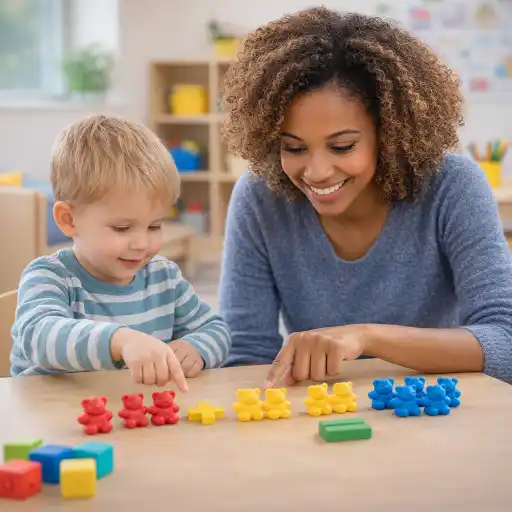
Choose objects that are safe, plentiful, easy to separate into groups, and connected to children’s interests. Blocks, toy animals, large buttons, fabric squares, snack containers, cups, and natural materials can all represent addition. The material itself is less important than the opportunity to combine two visible groups and discuss the result.
Seasonal materials can make an activity especially engaging. In Watermelon Seed Addition Buy Now $0.50, children count seeds on separate watermelon slices, combine the groups, and record the corresponding number sentence. The resource offers a playful bridge from concrete counting to symbolic representation and is available as a low-cost, one-time resource.
For safety, use large alternatives with children who mouth objects and supervise all loose parts. Real seeds, small counters, and buttons may present choking hazards. Sanitize reusable materials and follow program procedures. State requirements vary - check your state licensing agency.
- Blocks: combine two towers and count the total number of blocks.
- Large toy animals: create simple arrival or habitat stories.
- Paper fruit pieces: model “some more” during dramatic play.
- Large counters: show parts and the whole on a tray or mat.
- Watermelon slices and oversized paper seeds: connect a seasonal theme to addition.
How can educators move from objects to number sentences?
Begin with action and language, then introduce drawings and symbols when children are ready. For example, place two paper seeds on one watermelon slice and three on another. Say, “Here are two seeds. Here are three more. We are putting the groups together.” Invite children to move the seeds into one collection and count the total.
Next, represent the experience visually. Children might draw the two groups, use dots, or place numeral cards beneath each group. Only after the quantities are understood should the educator connect the model to 2 + 3 = 5. This sequence respects the progression from concrete action to pictorial representation to abstract notation.
Use open-ended prompts rather than requiring one prescribed method:
- “How many are in the first group?”
- “How many are in the second group?”
- “What could we do to find the total?”
- “Can you show the same addition another way?”
- “How does your picture match the number sentence?”
Some children will recount every object; others may count on from the larger group. Both strategies provide useful information. Avoid rushing to correct a child who arrives at an answer differently. Ask the child to explain, then model an efficient strategy as an additional possibility.
How can Watermelon Seed Addition become a rich small-group experience?
Prepare watermelon slice visuals, large paper seeds or safe counters, numeral cards, and writing tools. Begin with a brief conversation about watermelon or read a related picture book. Then present one problem at a time, keeping quantities small enough that children can physically manage them.
Invite children to complete the activity collaboratively. One child can place the first group, another can place the second group, and a third can combine and count. Rotate roles so every child experiences the full mathematical process. Encourage children to justify the answer with objects, drawings, gestures, or words.
Differentiate without separating children into permanent ability groups:
- Beginning learners: use totals within five, dot cards, and adult modeling.
- Developing learners: use totals within ten and ask children to match numerals to quantities.
- Extending learners: ask children to find two different combinations that make the same total.
- Children needing motor support: provide larger seeds, magnetic pieces, tongs, or verbal response options.
- Dual language learners: pair comparison and operation words with gestures, pictures, and home-language support.
Watch for one-to-one correspondence, cardinality, accurate combining, and the child’s explanation. A short note such as “Sam counted both groups accurately, combined them, and stated the total without recounting” is more useful than simply marking an answer correct.
How can providers extend addition beyond the activity?
Once children understand the watermelon context, carry the same structure into routines and play. At snack, ask how many fruit pieces are on two plates altogether. In the block area, combine two groups of blocks and compare the total with a partner’s collection. During dramatic play, add pretend groceries to a basket or place additional dishes on a table.
Story problems help children understand that addition describes relationships, not just worksheets. Try: “Maya placed three seeds on her slice. Jordan added two more. How many seeds are there altogether?” Children can act out the story, draw it, use counters, or dictate an explanation.
Invite families to use safe household objects for brief conversations: socks in two piles, toy cars in two groups, or fruit pieces during meal preparation. Emphasize reasoning rather than speed. Families can ask, “How do you know?” and “Can you show it with objects?”
Common mistakes include introducing symbols before children understand the quantities, using too many objects at once, treating counting speed as evidence of mastery, and correcting before listening to a child’s strategy. Keep the materials manageable, repeat key vocabulary such as add, more, altogether, and total, and allow children to return to concrete models whenever needed.
For additional professional learning, No Such Thing as Boring Math  Buy Now $24.00 explores how intentional play and developmental theory can support engaging early mathematics, while Math Foundations in Early Childhood Buy Now $16.00 focuses on hands-on strategies for creating a math-friendly environment.
Conclusion: How can familiar objects make addition concrete?
Familiar objects make addition concrete when children can see two groups, physically combine them, count the resulting whole, and explain what happened. Watermelon Seed Addition provides a memorable seasonal context, but the instructional principle extends to blocks, toys, snack items, and classroom materials.
The most effective sequence is simple: observe what children understand, present a meaningful combining situation, use concrete materials, invite mathematical talk, connect the experience to drawings and numerals, and document the next step. Keep quantities developmentally appropriate, adapt access, and value multiple strategies.
- Start with real or recognizable objects.
- Model addition as combining parts into a whole.
- Use questions that reveal thinking.
- Move gradually from objects to pictures to symbols.
- Extend addition into routines, stories, and family experiences.
When children place one more seed, combine two collections, or defend how they found the total, they are building both mathematical understanding and confidence. Those small, joyful experiences are the foundation for later operations.
What other ChildCareEd courses can support this practice?
- Early Mathematics Through Play Buy Now $24.00 — integrates number sense, operations, patterns, geometry, measurement, and reasoning through play.
- No Such Thing as Boring Math Buy Now $24.00 — connects developmental theory with playful mathematics experiences.
- Math Foundations in Early Childhood Buy Now $16.00 — offers practical approaches for hands-on early math instruction.
- Letter & Number Planning in Child Care Buy Now $24.00 — supports intentional planning that considers individual children’s needs.
- Enhancing STEM Education for Infants and Toddlers Buy Now $16.00 — explores early mathematical thinking through exploration with younger children.
- Early Mathematics Through Play
- Power of Art: Bldg Self-Esteem & Positive Behavior for ALL Abilities
- CDA Bridge Bundle: Family Child Care without Portfolio Review
- CDA Bridge Bundle: Infant/Toddler without Portfolio Review
- CDA Bridge Bundle: Preschool without Portfolio Review
- Emergent Learning & Development
- Creating Environments that Nurture Growth and Community
- No Such Thing as Boring Math
- Texas Director Credential
- Professional Integrity in Child Care
- Preschool Arithmetic Activity
- 💛🧩 ¿Cómo puedo hacer que mi enseñanza sea inclusiva para los niños con autismo?
- Canciones, juegos y preguntas de círculo para niños
- Social Studies Activities for Toddlers: Start With Home, Helpers, and Their Little World
- What Makes Task Cards Perfect for Small-Group Instruction?
- What Does a Developmentally Appropriate Daily Schedule Look Like?
- How Does Counting Shapes Build Early Number Sense Through Play?
- How Can Children Connect Multiplication Facts to Visual Patterns?
- How Can Child Care Providers Make Counting and Simple Operations Playful?
- How Can Familiar Objects Make Addition Concrete for Young Children?
- How Can Child Care Providers Build One-to-One Correspondence with Small Objects?
- How Can Concrete Models Help Children Understand Subtraction Before Worksheets?
- How Can Providers Build Addition Understanding Before Written Problems?
- How Can Addition Review Feel Purposeful and Engaging for Young Children?
- How Can Patterned Practice Help Young Children Master Subtraction Facts?
- How Can Children Practice Division Without Overloading Working Memory?
- Why Do Task Cards Work Well for Active Addition Practice?
- When Do Too Many Materials Make a Learning Center Harder to Use?
