Children can pass the same tree, garden bed, or patch of sky every day without noticing how it changes—until an adult invites them to pause and look again. Build a simple, repeatable routine for observation with Building Early Science Foundations  Buy Now $16.00, which supports providers in fostering young children’s curiosity, exploration, and inquiry; for ideas on shaping inviting outdoor spaces, explore Creating the Natural Outdoor Classroom Buy Now $16.00. These courses can help you translate everyday discoveries into more intentional practice as you read on for practical approaches that work in different settings.
Why does noticing environmental change matter?
Change is everywhere in children’s daily surroundings: a bud opens, a puddle dries, shadows shift, birds call from a different place, or the air feels cooler. When providers help children notice these details, they make time and natural processes more visible. Children begin to compare what they see now with what they remember, and to recognize that careful observation can help answer questions.
This matters beyond science. Children practice descriptive language, attention, early math, memory, and collaboration as they share what they observe. A conversation about a fallen leaf can lead to comparing color and shape; a weather chart can prompt children to count sunny and rainy days. Outdoor experiences also invite movement and sensory exploration, while nurturing respect for living things. The CDC describes outdoor play as an opportunity for physical activity and new experiences that can support learning, language, and emotional development.
Keep the purpose modest and meaningful: not every outdoor moment needs to become a formal lesson. A few minutes of shared attention can help children feel that their questions matter. Repeated experiences build familiarity and strengthen #curiosity, while making the natural world part of the program’s everyday #learning environment.
How can educators create a routine for observation?
Choose a feature children can revisit safely and regularly: a plant near the entrance, a tree visible from a window, a sunny patch, or a bird feeder placed where staff can supervise. A small area is enough. What matters most is returning to it and helping children compare observations over time. Guidance on using one plant to notice gradual change outdoors offers a practical example of how a simple repeated focus can support inquiry.
Try a short routine: pause, look and listen, invite children to share, record one observation, and compare it with a previous visit. Ask open-ended questions rather than testing children for the “right” answer:
- “What do you notice today?”
- “What looks the same as last time? What seems different?”
- “What do you wonder about?”
- “How could we remember what we saw?”
Provide different ways to contribute. Children may point, gesture, draw, dictate a phrase, use a home-language word, or simply watch before joining a conversation. A small journal, photo, or class chart can hold the group’s thinking. Nature journals can include children’s marks and drawings as well as adult-recorded words; they are records of observation, not tests of writing or artistic ability.
Consistency need not mean a rigid schedule. A weekly visit or a brief daily look through a window can make patterns easier to notice. Let children’s ideas guide the next question, and keep the routine flexible enough for the realities of staffing, weather, and children’s needs.
How can seasonal, weather, and living changes become investigations?
Begin with changes children can observe directly, then help them compare and ask questions. Depending on your region, children might notice plants sprouting, leaves falling, shadows lengthening, ice melting, or birds gathering. Not every location experiences four sharply distinct seasons, so use the local climate and the changes that are meaningful where your program is situated. The goal is attentive observation, not memorizing a seasonal script.
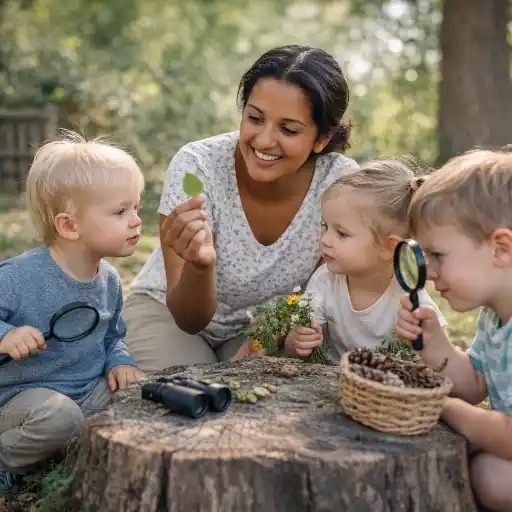
Small investigations make these observations concrete:
- 🌱 Revisit one plant and draw or describe a new leaf, bud, or change in height.
- Keep a simple weather chart using pictures for sun, clouds, wind, and rain; compare several days.
- Observe a shadow at two times of day, using the same place as a reference point.
- Compare leaves or other safely gathered materials by color, size, texture, or shape.
- Notice how rain or dry weather affects a designated outdoor area, without disturbing plants or small animals.
Invite prediction, but distinguish it from evidence: “What do you think might happen?” can be followed by “What did we actually observe?” Children can count, sort, measure with a consistent method, or create a picture graph of what they noticed. These activities connect science with early math, language, art, and movement.
How can providers make nature observation inclusive and safe?
Children do not have to participate in identical ways to investigate together. Offer ways to look from a seated spot, use a magnifier or tongs, listen for sounds, draw indoors from a photograph, or dictate an observation to an adult. Visual prompts, adaptive tools, clear boundaries, accessible routes, and a quieter observation area can help more children take part. For infants and toddlers, close adult narration and brief, safe opportunities to notice light, air, textures, and sounds can be meaningful forms of outdoor exploration.
Before each activity, check the area and materials. Identify plants before children handle them; avoid tasting unknown plants, mushrooms, or seeds; and account for allergies, choking hazards, weather, and handwashing. Use active supervision, with adults positioned to maintain sight and sound awareness and respond as children explore. The CDC’s outdoor play and safety guidance for early care and education includes considerations such as sun, heat, insects, injuries, water, and supervision.
Safety planning should preserve exploration while reducing preventable hazards. Explain where children may go, what they may touch, and how they can ask for help. State requirements vary - check your state licensing agency. If outdoor conditions do not allow a visit, use a window view, indoor plant, photograph, or collected object that has been checked for safe use. The inquiry can continue even when the setting changes.
How can documentation and conversation extend children’s discoveries?
Documentation helps children revisit ideas and helps staff notice what sustains their attention. It does not need to become a large assessment task. Record the date, one child’s observation, and a drawing or photograph. For example: “We saw two new leaves today. Amari pointed to the smaller one and said, ‘This one is just starting.’” Such a note captures both the observed change and the child’s thinking.
Return to documentation with children. Compare a new drawing with an earlier one, look at photographs in sequence, or revisit a question the group posed. Use specific language—“the shadow moved,” “the leaf is curled,” “the soil looks dry”—and invite children to add their own words and interpretations. If a child offers an explanation, record it respectfully, then ask what evidence could help the group explore the idea.
Share brief observations with families through a display, a message, or a conversation at pickup. Invite families to contribute knowledge about local plants, weather, and traditions, while keeping participation voluntary and accessible.
Conclusion: What is the simplest way to help children notice change?
Help children notice environmental change by choosing something accessible, returning to it consistently, and giving them time to observe before explaining. Use open questions, simple records, and comparison to make changes visible. Everyday investigations can support science, language, math, creativity, movement, and care for living things without requiring elaborate materials.
Keep the experience inclusive and safe by offering varied ways to participate, checking the environment, and supervising actively. Then revisit children’s drawings, words, and questions so their thinking can grow from one observation to the next. A small routine—looking at the same plant, sky, or outdoor space together—can turn an ordinary moment into a lasting invitation to wonder.
Five relevant ChildCareEd courses
- Building Early Science Foundations Buy Now $16.00 — strategies for supporting young children’s scientific curiosity and inquiry.
- Creating the Natural Outdoor Classroom Buy Now $16.00 — ideas for planning engaging natural outdoor environments.
- CDA: Creating the Outdoor Classroom Buy Now $16.00 — outdoor classroom design and implementation, addressing CDA Subject Area 2.
- Effective Supervision in Child Care Buy Now $25.00 — active supervision strategies for varied child care settings.
- Basic Science in Early Childhood Buy Now $25.00 — practical approaches to everyday science experiences.
- SIDS: Saving Babies: A Change of Position, A Change in Tradition
- SIDS: Saving Babies: A Change of Position, A Change in Tradition
- What Makes Me Special: An Overview of Autism and ADHD
- Pediatric RSV First Aid & CPR/AED
- Anxiety: Signs & Strategies
- CDA Bridge Bundle: Family Child Care without Portfolio Review
- CDA Bridge Bundle: Infant/Toddler without Portfolio Review
- CDA Bridge Bundle: Preschool without Portfolio Review
- Teacher-Child Interactions for Stronger CLASS® Outcomes
- Self-Regulation & Change: Helping Children Cope
- Bye Bye Winter: The Role of Outdoor Play in Early Childhood Development
- CDA Certification en Español: Recursos y Consejos para Educadores Bilingües
- 🩺 Cumplimiento de Salud e Inmunización en Cuidado Infantil de Nevada ✔️
- Proporciones de Cuidado Infantil y Tamaños de Grupo por Edad en Maryland (Guía Rápida para Centros y Hogares)
- Proporciones de Cuidado Infantil y Tamaños de Grupo por Edad en Virginia (Guía Rápida para Centros y Hogares)
- How can learning environments support children's development?
- How Can We Teach Young Children to Care for the Environment?
- Go on a Fall Hunt! Outdoor Learning Challenges for Preschoolers
- How Can One Plant Help Children Notice Gradual Change Outdoors?
- How Can Fall Nature STEM Activities Spark Preschoolers’ Scientific Thinking?
- How Can November Outdoor Activities Help Children Explore and Appreciate Nature?
- How Can Child Care Providers Help Children Notice Changes in Nature and the Environment?
- What Happens to Fallen Leaves? Exploring Decomposition With Young Children
- How Can Child Care Providers Teach Fall in Warm Climates Without Red Leaves or Cold Weather?
- What Happens to a Fallen Leaf? How Can Preschoolers Investigate Decomposition?
- How Can You Create an Autumn Classroom Children Help Shape—Without Overdecorating?
- Why Can Observing the Same Tree Teach Preschoolers More Than a Nature Walk?
- When Fall Decorations Overwhelm the Classroom, How Can You Create a Calmer Seasonal Environment?
- How Can You Create a Winter Nature Discovery Center with Everyday Classroom Materials?
