When children wonder why last year’s leaves have disappeared, they are ready for a lively investigation of nature’s recycling system. Try a forest-floor inquiry with [Creating the Natural Outdoor Classroom  Buy Now $16.00] and [Building Early Science Foundations Buy Now $16.00] to strengthen your ability to design meaningful outdoor explorations and nurture children’s scientific curiosity. The ideas below offer a practical place to begin—and a question that can keep young scientists looking closely.
Why does leaf decomposition matter for young children?
A carpet of fallen leaves is not simply yard debris. On a forest floor, leaves become part of a living process: fungi, bacteria, and small animals help break down dead plant matter, returning materials and nutrients to the environment. Earthworms, millipedes, and other tiny animals feed on or shred decaying matter; microscopic organisms and fungi continue its breakdown. Together, these processes help transform leaf litter and support soil life and new plant growth.
For preschool and kindergarten children, this is a concrete way to encounter change, cycles, and interdependence. They can compare a crisp, newly fallen leaf with a dark, soft fragment, then ask what might have happened between the two. Rather than beginning with a long explanation, educators can invite children to observe, describe, and build ideas over time.
This investigation supports more than science vocabulary. Children practice careful attention, classification, prediction, conversation, and collaboration. They may draw a leaf, count its veins, sort it by texture, or explain a theory to a peer. These modest acts of reasoning are foundational early science practices. Welcoming children’s uncertainty also matters: “I’m not sure yet—let’s look again” models curiosity as a strength, not a gap to rush past.
How can children observe the forest floor respectfully?
Start in a suitable outdoor space, such as a garden bed, shaded area, or approved nearby greenspace. Before the group arrives, check the route and activity area for hazards, including traffic, sharp objects, stinging or poisonous plants, and animals that should not be disturbed. Set clear boundaries and choose whether children will observe in place, use a hand lens, or gently move loose leaves with a stick.
Invite children to notice the many stages of leaf change. A simple observation walk can include fresh leaves, dry leaves, partially broken leaves, and dark fragments near the soil. Encourage children to look, listen, and describe rather than collecting everything they find. A hand lens, picture cards, clipboard, and paper for drawing can extend attention without requiring specialized equipment.
- Ask: “Where do leaves collect? What is different underneath a bush or near a log?”
- Offer sensory words: brittle, damp, smooth, crumbly, spotted, or dark.
- Invite children to compare two leaves and explain what they notice.
- Remind the group that this small habitat is home to living things; observe gently and return moved material to its place.
- 🍂 Let children record a discovery with a drawing, a dictated sentence, or a photograph taken by an adult.
Use open prompts instead of turning the walk into a hunt for correct answers. A child who notices a white thread or tiny crawling animal has made an important observation, even if the group cannot identify it. The goal is attentive, respectful engagement with the local #nature and its living relationships.
How can educators explain decomposers in age-appropriate ways?
Young children do not need a detailed lecture on nutrient cycles to understand that nature reuses some materials. A simple explanation might be: “Tiny living things and small animals help break old leaves into smaller pieces. Over time, those pieces become part of the soil, where plants can grow.” This is accurate enough for an introduction while leaving room for more complex ideas later.
It can help to distinguish between different kinds of helpers without insisting that preschoolers memorize technical categories. Fungi and bacteria break down organic matter in ways children often cannot see without tools. Earthworms and many small invertebrates move through or consume decaying material; creatures such as millipedes can shred leaves into smaller pieces. Children may call all of these “forest-floor recyclers,” then learn that organisms contribute in different ways.
Use familiar comparisons carefully. A fallen leaf does not vanish like magic; it changes gradually. Weather, moisture, and organisms all influence that change. Ask children to support their claims with evidence: “What do you see that makes you think this leaf has been here longer?” If children believe every insect eats leaves, respond with curiosity and explain that different creatures have different food sources.
Place the process within a simple cycle: trees grow leaves, leaves fall, living helpers break them down, and materials return to the environment. Invite children to act it out, draw arrows, or arrange picture cards. The aim is not perfect recall but an emerging understanding of #decomposers as part of a connected system.
Which hands-on activities make decomposition visible?
Repeated observation is often more powerful than a one-day demonstration. Choose a small number of activities that are manageable for your group and safe for your setting. Keep the focus on noticing change rather than expecting a quick transformation.
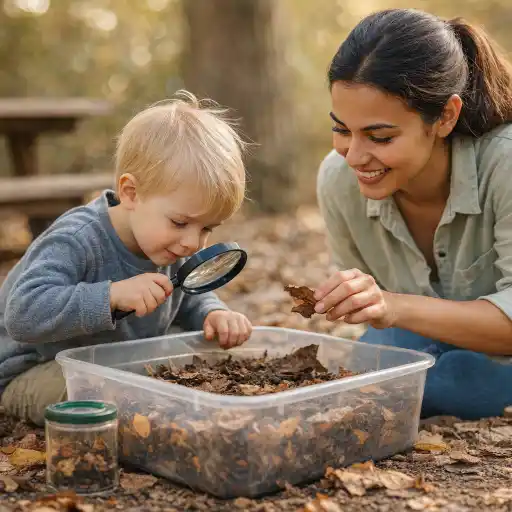
- Leaf sorting: Provide clean, fallen leaves and shallow trays. Children can sort by color, size, shape, or condition, then explain the categories they chose. Invite them to revise their groups as they notice new features.
- Forest-floor layers: Mark a small patch with string. With adult guidance, compare the visible layers from loose leaves toward soil. Avoid removing live plants or animals, and gently replace anything moved.
- Observation bag or jar: With adult preparation, place a few leaves and a small amount of soil in a breathable, secure container. Keep it out of children’s mouths and observe it over time. Follow program hygiene and supervision practices; do not seal a living compost sample airtight.
- Prediction and revisit: Place a fallen leaf in a consistent, approved observation spot. Have children draw or describe it, then revisit weekly. Ask what changed and what stayed the same.
- Compost connection: If your program has an appropriate composting system, compare dry “brown” materials such as leaves with suitable fruit and vegetable scraps. Follow local compost guidance and center procedures.
Keep a simple class record: date, child observation, drawing or photograph, and one question for the next visit. Avoid promising exactly when a leaf will break down; conditions and materials vary. Children’s predictions are useful starting points, not commitments to a fixed timeline. These repeated investigations let children see that scientific #inquiry includes close looking, wondering, and revising ideas.
How can providers support safety, inclusion, and learning?
Outdoor science works best when safety and access are planned alongside curiosity. Check the site before use, supervise actively, set boundaries, and teach children how to observe without tasting plants, mushrooms, soil, or small animals. Never invite children to eat wild mushrooms or unidentified plants. Use handwashing after outdoor exploration, and follow your program’s procedures for allergies, hygiene, and outdoor materials. State requirements vary - check your state licensing agency.
Make participation flexible. Some children may enjoy touching leaves; others may prefer looking, listening, pointing, drawing, or using a tool. Offer adaptive options such as large-handled magnifiers, lightweight containers, seated observation positions, picture prompts, and vocabulary in children’s home languages. A child who watches closely before joining is participating meaningfully.
For preschoolers, use questions such as “What do you notice?” and “What might happen next?” Kindergarteners may be ready to compare observations across several weeks, make a simple chart, or consider how damp and dry places differ. Mixed-age groups can investigate together while adults adjust the complexity of the prompts. Educators can document learning unobtrusively through brief notes, photographs, and children’s words—then use those observations to plan the next invitation.
Avoid common pitfalls: identifying every organism before children have time to wonder, collecting or disturbing too much habitat, and expecting visible change after one session. Nature-based learning is strongest when adults protect children’s questions and the small world being studied. Thoughtful observation helps children connect the classroom to the forest-floor #soil and the organisms that sustain it.
Conclusion: What should children understand about fallen leaves?
What happens to fallen leaves? They gradually change as weather, fungi, bacteria, and small animals break them into smaller pieces and return materials to the environment. The process is not instant, and it may look different from place to place, but children can notice clues: softer textures, darker colors, fragments, and tiny organisms in the leaf litter.
Providers can make this process understandable through respectful nature walks, leaf classification, repeated observations, simple records, and thoughtful conversation. Focus on the questions children ask, help them compare evidence, and adapt participation so every child can take part. Above all, present decomposition as nature’s ongoing recycling—not as something dirty or mysterious to avoid. With time and attentive guidance, a handful of leaves can become a rich investigation of change, life, and connection.
Explore five relevant ChildCareEd courses:
- Creating the Natural Outdoor Classroom
- 45 Hour Child Growth and Development
- Building Early Science Foundations
- Pediatric RSV First Aid & CPR/AED
- CDA: Creating the Outdoor Classroom
- Emergent Learning & Development
- Sensitive Periods in Montessori: Guiding Natural Learning
- CDA Home Visitor Credential Birth to 5
- Milestones: By Leaps & Bounds
- CDA Certification en Español: Recursos y Consejos para Educadores Bilingües
- 🔍 ¿Qué ves cuando observas a un niño aprender?
- 💛🧩 ¿Cómo puedo hacer que mi enseñanza sea inclusiva para los niños con autismo?
- 🤯 ¿Por qué este niño está teniendo un comportamiento difícil de repente?
- Capacitación en Salud y Seguridad Preventiva en Línea para Proveedores de Cuidado Infantil
- ¿Qué preguntas aparecen en el examen CDA para preescolar?
- Regulaciones de Licenciamiento de Cuidado Infantil en California para Centros y Hogares de Cuidado Infantil Familiar
- Proporciones de Cuidado Infantil y Tamaños de Grupo por Edad en Maryland (Guía Rápida para Centros y Hogares)
- Proporciones de Cuidado Infantil y Tamaños de Grupo por Edad en Wisconsin (Guía Rápida para Centros y Hogares)
- Proporciones de Cuidado Infantil y Tamaños de Grupo por Edad en Nueva Jersey (Guía Rápida para Centros y Hogares)
- Cómo Celebrar el Día Nacional del Kindergarten
- Actividades de Otoño Fáciles para Preescolares esta Temporada
- Lista para Guardería en Casa en Illinois: Cómo Iniciar una Guardería en el Hogar
- Apoyo en Preescolar para Retrasos del Habla: Estrategias Simples que Ayudan
- Las Mejores Ideas de Excursiones para Guarderías en Texas
- Canciones, juegos y preguntas de círculo para niños
- Go on a Fall Hunt! Outdoor Learning Challenges for Preschoolers
- What Happens to Fallen Leaves? Exploring Decomposition With Young Children
