Strong early #math experiences create confident learners and calmer classrooms — but many providers wonder how to make math daily, playful, and developmentally appropriate. This article gives practical, research-informed steps you can start using Monday morning and points to targeted professional learning like Math Foundations in Early Childhood  Buy Now $16.00 and No Such Thing as Boring Math Buy Now $24.00 that expand the strategies here. For guidance on making play the central vehicle for learning across domains, see Let's Play, which explores the role of play and related training for providers. Taking these courses can help you gain useful training hours, strengthen classroom practice, and translate ideas into ready-to-use activities for infants through pre-K.
Why does early math matter and why should I care?
Early math is not an add-on; it trains thinking, language, and problem-solving that children use across all learning. Research and practice show that everyday counting, patterning, and spatial play predict later achievement and make transitions and routines smoother. For busy directors and teachers, prioritizing early #preschool math means fewer frustrations, richer conversations, and measurable growth in children’s reasoning skills.
Why it matters:
- Math builds executive skills: comparing, estimating, and planning.
- Math talk strengthens vocabulary and peer interactions.
- Short, repeated experiences add up—3–10 minute moments across the day produce durable learning.
Practical note: state requirements vary - check your state licensing agency when counting training hours or documenting learning.
How can I embed math into daily routines and play without extra prep?
Embed math across arrival, snack, transitions, and centers so it’s seamless, low-prep, and child-centered. The key moves are observation, intentional prompts, and tiny, repeatable activities that invite #play and conversation.
- Pick one weekly goal (e.g., 1–1 correspondence to 10) and three built-in moments to practice it (arrival, snack, clean-up).
- Short rituals: count steps to the playground, set the table by number, or graph attendance with stickers.
- Center-level supports: keep a "math shelf" with one roll-and-graph game, ten-frame cards, and counters so children can revisit skills independently. See free activity PDFs such as the Hibernating Bear Flip & Cover Buy Now $0.00 or the Dreidel Roll & Graph Buy Now $0.00 to rotate weekly.
- State-friendly documentation: use one-line observation notes rather than heavy worksheets. Keep records actionable for lesson planning.
What activities and materials work best by age and developmental level?
Match tasks to motor skills, attention spans, and representational understanding. Choose manipulatives that invite conversation and multiple representations of ideas (concrete counters, pictures, gestures).
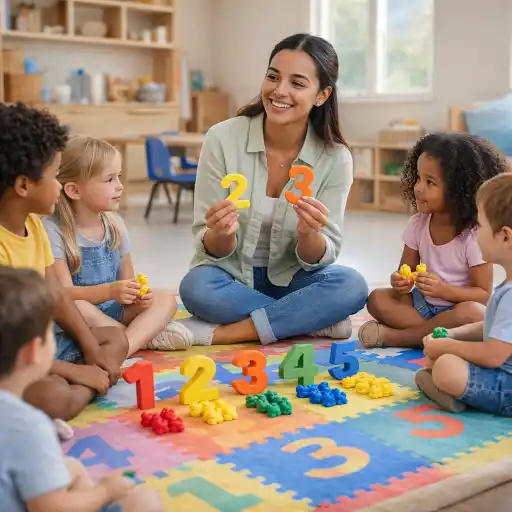
- Infants & toddlers (0–2): sensory bins with large objects, stacking toys to explore size and order, and counting routines during diapering or feeding. For practical guidance on responsive adult roles and high-quality infant-toddler strategies that support early math and play, see Building Up Infants and Toddlers.
- Three-year-olds: snack-time counting, simple sorting trays, and short roll-and-cover boards for early data play.
- Four-year-olds: shape crafts (pizza shapes), block challenges that focus on positional language, and ten-frame work for early addition.
- Five-year-olds: measurement stations, place-value explorations with bundled sticks, and small-group story problems with props.
Use focused open questions: "How many? Which group has more? What comes next?" These prompts encourage mathematical reasoning and vocabulary such as #counting, more, fewer, before, and after.
How should I check progress, avoid common mistakes, and engage families?
Assessment in preschool should be brief, authentic, and embedded in play. Use observation checklists, short task-based probes, and work samples (photos, quick video clips, graphs made with the class).
- 📝 Quick strategies: one-line observation entries after an activity (e.g., "Ava counts to 7 with 1:1 correspondence").
- Short probes: ask a child to match a numeral to dot cards, complete a five-piece number puzzle, or sort objects by two attributes.
- Common mistakes and fixes:
- ⚠️ Overusing worksheets — switch to manipulatives and conversation.
- ⚠️ Introducing too many vocabulary words at once — teach 2–3 target words and reinforce them across routines.
- ⚠️ One-size-fits-all pacing — observe to find each child’s next step.
- Family partnership: send one micro-activity each week (count stairs, sort socks, roll-and-graph at the table). Host a short math-play night to model play-based strategies and share take-home PDFs.
Helpful courses to build assessment and family strategies include Letter & Number Planning in Child Care Buy Now $24.00 and resources in the Math Foundations library.
How do we build staff capacity and sustain a math-friendly classroom culture?
Systemic change comes from short, targeted professional learning, accessible materials, and regular team reflection. Make math learning part of staff routines so it becomes a shared strength across classrooms.
- Plan short PD: enroll staff in focused courses such as Math Foundations in Early Childhood Buy Now $16.00, No Such Thing as Boring Math Buy Now $24.00, or Enhancing STEM Education for Infants and Toddlers Buy Now $16.00 to translate theory into simple classroom moves.
- Keep a shared math shelf stocked with 4–6 ready-to-use games and rotate weekly; this reduces prep and supports consistency across rooms.
- Weekly huddles: share 1 observation per child and swap one center activity — small steps that make practice consistent.
- Equity and families: use culturally responsive materials and invite families to contribute objects or games. Celebrate small gains publicly with class graphs or a "math moments" board.
For early STEM alignment and ideas that strengthen both science and math, consider Building Early Science Foundations Buy Now $16.00 as part of staff development.
Conclusion
Early #math learning grows from many small, playful decisions: observe, choose one weekly goal, embed brief practice across routines, use manipulatives and math talk, and assess through play. Avoid the common traps of over-reliance on worksheets and one-size-fits-all pacing. Build staff capacity with targeted courses like Math Foundations in Early Childhood Buy Now $16.00, No Such Thing as Boring Math Buy Now $24.00, Letter & Number Planning in Child Care Buy Now $24.00, Enhancing STEM Education for Infants and Toddlers Buy Now $16.00, and Building Early Science Foundations Buy Now $16.00 to turn ideas into routine practice. Small, consistent, playful math moments add up to big learning.
FAQ (short)
- Q: When should I start math? A: From infancy—count during routines and make it playful.
- Q: Are worksheets okay? A: Very sparingly; prefer manipulatives and guided conversation.
- Q: How often to assess? A: Brief play-based checks every 2–4 weeks give good signals without heavy paperwork.
- Q: Where to get ready-to-use games? A: See ChildCareEd’s free PDFs and course resources like the Math Foundations library (free resources).
Key hashtags: #math #preschool #play #counting #assessment
- Early Mathematics Through Play
- 45 Hour Preschool Methods and Materials
- Math Foundations in Early Childhood
- CDA Bridge Bundle: Family Child Care without Portfolio Review
- CDA Bridge Bundle: Infant/Toddler without Portfolio Review
- CDA Bridge Bundle: Preschool without Portfolio Review
- Texas Director Credential
- Enhancing STEM Education for Infants and Toddlers
- Professional Development & Teddy Bear Activities
- Preschool Curriculum for Educators to Choose
- Teaching Math to Young Children
- Preschool Arithmetic Activity
- Mathematical Skill Development
- Tiny Tots, Big Learning: Crafting Curriculums for the Littlest Learners!
- CDA Certification en Español: Recursos y Consejos para Educadores Bilingües
- 🎉STEM-sational Fun: How Can You Spark Preschoolers’ Curiosity with Engaging STEM Activities? 🔬🧪🔢
- How can Florida preschool staff assess children during everyday activities?
- Celebrando la amistad en el cuidado infantil durante el Día de los Mejores Amigos
- How Can I Use Fun Math Activities for Preschoolers Every Day?
- How Does Guided Play Build School-Ready Skills in New York Preschoolers?
- How can preschool classrooms effectively support early math skills?
- How Can Preschool Programs Best Prepare Children for Kindergarten?
- How Can Preschool Teachers Effectively Support Early Math Skills in the Classroom?
- How Can Preschool Math Become Meaningful, Playful, and Part of Every Day?
- How Do Light vs. Heavy Activities Build Early Measurement Skills?
