Want to bring the benefits of a #forest preschool into your existing program without rebuilding your whole model? Integrating regular, intentional nature-based #outdoor experiences can increase children’s movement, curiosity, and resilience while strengthening classroom practice; a practical first step is ChildCareEd’s Creating the Natural Outdoor Classroom  Buy Now $16.00, which offers concrete design and activity ideas to improve daily practice and earn training credit. For programs that want a certification-focused option, consider CDA: Creating the Outdoor Classroom Buy Now $16.00 to deepen curriculum alignment and documentation strategies.
What is a forest preschool approach and how can it fit into a traditional center?
Forest-preschool philosophy centers on regular, child-centered learning in natural settings that emphasize exploration, risk-managed play, and connection to place. You do not need to convert your license or open a separate site to use core elements: schedule consistent outdoor blocks, design nature-rich invitations to play, and train staff in active supervision. When you bring elements of a #play-focused forest day into your center you are adapting pedagogy rather than abandoning standards—this matters for staffing, planning, and family communication.
Practical integration steps:
- Audit nearby natural spaces (schoolyard trees, side lot, local park) and map safe, repeatable routes.
- Start with short, daily outdoor invitations (15–45 minutes) before expanding to half-day rotations.
- Use loose parts and open‑ended materials (logs, sieves, fabric, crates, natural collections) so the environment supports exploration.
- Document and communicate routines with families so expectations and clothing needs are clear.
See practical planning guidance as part of Identify specific considerations and resources for implementing an outdoor classroom program for checklists and age-specific resources.
How do I design safe, developmentally appropriate forest activities for infants through preschoolers?
Design activities that intentionally target motor, language, cognitive, and social-emotional goals while keeping safety and supervision in focus. For infants and toddlers, prioritize sensory exploration with large, supervised natural materials and simple gross-motor circuits; for preschoolers, add problem-solving challenges, loose-parts construction, and scaffolded risk (low log balances, supervised climbing). #children need choice, and #teachers must plan prompts and extensions that build on observed interests. For concrete, play-based curriculum strategies tailored to infants and toddlers, see Tiny Tots, Big Learning: Crafting Curriculums for the Littlest Learners, which outlines ways to connect outdoor sensory work to age-appropriate learning goals.
Key design practices:
- Rotate invitations: a sensory table with soil and scoops; an engineering area with planks and crates; a nature art station.
- Use clear boundaries and buddy systems so children know where to play and how to return.
- Plan teacher moves: observe, narrate, add materials, ask open questions (“What happens if…?”).
- Keep ratios and supervision strategies explicit: position adults to maintain visual and auditory contact with the group.
For injury and illness prevention, align practice with public-health guidance on outdoor play—for example see the CDC’s Outdoor Play and Safety guidance (sun protection, bugs, water safety) and the American Academy of Pediatrics recommendations on active play outdoors for appropriate activity planning.
Why does adding forest preschool activities matter for child development and program quality?
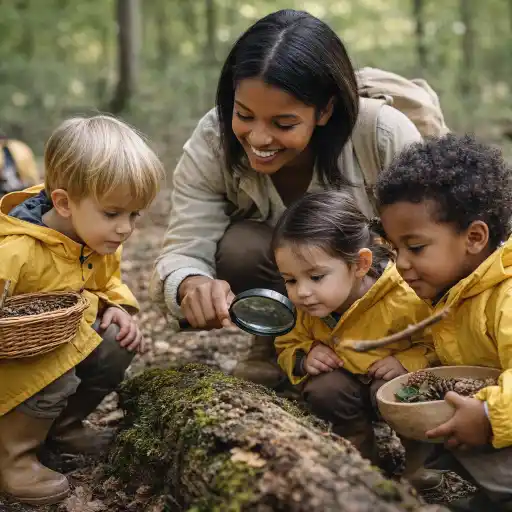
Nature-based experiences support physical health (gross motor strength, balance), cognitive gains (attention, problem solving), language growth (descriptive vocabulary) and social skills (cooperation, perspective-taking). Research shows children are more active and less sedentary outdoors, and open-ended outdoor time often delivers more moderate-to-vigorous activity than indoor teacher-led sessions. Integrating nature-rich play also increases opportunities for inquiry-based STEM and multi-sensory learning.
Why it matters for your program:
- Stronger outcomes: outdoor time supports milestones across physical, emotional, and cognitive domains.
- Program differentiation: offering daily nature experiences makes your program more attractive to families seeking active, experiential learning.
- Staff development: teaching outside builds supervision, observation, and documentation skills that raise overall program quality.
National reviews and position statements underscore these benefits; consider this a targeted strategy to boost both child outcomes and your center’s curriculum depth.
How do I avoid common mistakes and manage risks while preserving learning value?
Common mistakes in translating forest ideas into traditional settings include: overloading materials, under-preparing staff, unclear boundaries, and treating outdoor time as optional or a reward. Avoid these by setting routines, limiting choices, and building staff confidence through short, regular practice sessions.
Risk-management checklist:
- Conduct a simple site risk assessment each season and remove hazards where feasible.
- Implement active supervision policies—positioning, scanning, counting, and predictable whistle cues. See the ChildCareEd course Safe Supervision in Child Care: Birth to School Age Buy Now $24.00 for practical strategies.
- Maintain weather and health plans: sun protection, hydration, and contingency for poor air quality or extreme temperatures.
- Train staff in appropriate first-aid, water safety, and field-trip procedures and review relevant outcomes such as Identify safety activities to perform during the field trip.
Be explicit about compliance: state requirements vary - check your state licensing agency. Keep daily checklists for clothing, boundaries, and supervision to reduce variability and protect both children and staff.
What practical schedule, activities, and documentation strategies make forest preschool activities sustainable?
Start small, iterate, and document. A reliable weekly rhythm helps staff and families adapt. Example starter schedule for preschoolers in a center with a traditional day:
- Morning arrival & welcome (indoor): 15 min
- Outdoor exploration block (group invitations + free choice): 30–45 min
- Snack & story (outdoor or transition indoors): 20 min
- Small-group focused learning (rotations that may include an outdoor STEM or nature art table): 30–40 min
- Quiet rest / reflection and documentation: 20–30 min
Activity ideas you can try this week:
- 🍂 Nature scavenger with vocabulary focus (collect, describe, sort)
- Log-balance circuits for gross-motor and risk assessment practice
- Loose-parts engineering: planks, crates, rope (teacher supports scaffolded challenges)
- Story-based foraging walk and reflective drawing
Documentation and assessment tips:
- Use quick photo + one-line caption to capture the child’s idea and teacher observation.
- Map learning goals to observed behaviors (vocabulary, persistence, motor control) for progress notes.
- Share a weekly nature-note home to involve families and reinforce clothing/gear expectations.
If you want a practical course that links outdoor curriculum to classroom assessment and CDA competencies, explore CDA: Creating the Outdoor Classroom Buy Now $16.00 and consider Creating the Natural Outdoor Classroom Buy Now $16.00 for hands-on set-up strategies.
FAQ (short):
- Q: How often should we go outside? A: Daily is ideal; begin with short blocks and build to longer sessions.
- Q: What about children who dislike mud or messy play? A: Offer parallel invitations (observe first, offer tools like gloves or scoops).
- Q: Do teachers need special licensing to teach outside? A: Not usually—train staff on supervision and safety; state requirements vary - check your state licensing agency.
- Q: How do we handle sanitation? A: Bring handwashing stations or sanitizer and clean shared materials regularly per health guidance.
- Q: What are quick wins for parent buy-in? A: Share photos, learning goals, and a short safety plan so families feel informed and confident.
Conclusion
Yes—you can add forest-preschool activities to a traditional child care program without launching a separate school. Begin with intentional small steps: map safe outdoor spaces, schedule daily outdoor invitations, train staff in active supervision, and document learning with simple photo-and-caption records. These actions increase child #engagement and give teachers practical ways to meet developmental goals through nature-based #play. For hands-on how-to and training credit, explore Creating the Natural Outdoor Classroom Buy Now $16.00 and strengthen supervision and safety with Safe Supervision in Child Care: Birth to School Age Buy Now $24.00. Start with one outdoor invitation this week—observe, document, and iterate. Your program will gain richer learning experiences and families will notice the difference.
- 45 Hour Child Growth and Development
- CDA Preschool Credential
- CDA Home Visitor Subject Area 3 Part 3 Birth to 5
- School Age Regs and Professionalism ONLINE
- CDA Bridge Bundle: Family Child Care without Portfolio Review
- CDA Bridge Bundle: Infant/Toddler without Portfolio Review
- CDA Bridge Bundle: Preschool without Portfolio Review
- Emergent Learning & Development
- Texas Director Credential
- CDA Certification en Español: Recursos y Consejos para Educadores Bilingües
- Cómo Abrir Una Quardería En Casa Sin Dinero?
- Recursos en Español sobre el Sueño Seguro del Bebé
- Actividades de Fiesta para Niños de Preescolar y Primaria
- Cómo Iniciar el Proceso de Obtención de la Licencia de Cuidado Infantil
- Cómo Empezar una Guardería en Casa: Requisitos y Pasos
- Normas de Licenciamiento de Cuidado Infantil en Virginia para Centros Diurnos Infantiles y Hogares Diurnos Familiares
- Proporciones de Cuidado Infantil y Tamaños de Grupo por Edad en Maryland (Guía Rápida para Centros y Hogares)
- Proporciones de Cuidado Infantil y Tamaños de Grupo por Edad en Virginia (Guía Rápida para Centros y Hogares)
- Horas de Capacitación Anual para Proveedores de Cuidado Infantil en Maryland
- ¿Cuál es la Diferencia Entre la Crianza Respetuosa y la Crianza Permisiva?
- Lista para Abrir una Guardería en Casa en Carolina del Norte: Cómo Empezar
- Lista para Abrir una Guardería en Casa en Dakota del Norte: Cómo Empezar
- Cómo Celebrar el Día Nacional del Kindergarten
- Lista para Abrir una Guardería en Casa en Georgia: Cómo Empezar
- Calabazas, hojas y manzanas: actividades de otoño para preescolares
- Cómo simplificar la capacitación para sus empleados de daycare
- Can forest preschool activities be integrated into traditional programs?
- How can I bring a Forest Preschool (nature-based learning) to my program?
- Can traditional child care programs add forest preschool activities without starting a new program?
