Honoring Latino cultures in early childhood classrooms is most meaningful when it moves beyond costumes and occasional celebrations into everyday relationships, language, books, music, and play. The Strength in Differences: Cultural Diversity  Buy Now $24.00 course can help providers build cultural competence and earn focused professional-development hours while strengthening inclusive classroom practices. For programs serving children who use Spanish or another home language, Building Bridges for Dual Language Learners Buy Now $25.00 offers practical strategies for language development and family partnership.
Why does honoring Latino cultures matter in early childhood?
Young children notice language, skin color, names, food, music, family routines, and other differences. When educators respond with warmth and accuracy, children learn that their identities are valued and that difference is a natural part of belonging. Representation also supports confidence, participation, social-emotional development, and relationships between families and programs.
Latino is not a single culture. Families may have roots in Mexico, Puerto Rico, Cuba, the Dominican Republic, Central America, South America, Spain, or Indigenous and Afro-Latino communities. Some families speak Spanish, Portuguese, an Indigenous language, English, or several languages; some do not identify with the same labels. A respectful approach begins with curiosity rather than assumptions.
NAEYC’s anti-bias framework emphasizes identity, diversity, justice, and action. This means children can develop pride in their own families, learn accurate language for differences, recognize unfairness, and practice standing up for others. The four goals of anti-bias education provide a useful foundation for planning.
How can educators adapt experiences for infants and toddlers?
For infants and toddlers, cultural learning is relational and sensory. Children do not need lengthy explanations or country fact sheets. They benefit from hearing familiar words, seeing their families represented, listening to varied music, and experiencing responsive routines that connect school and home.
- Use family-approved photographs, cloth books, and board books showing Latino children and families in ordinary settings.
- Learn and use key words for greetings, comfort, eating, toileting, and routines, while pronouncing names carefully.
- Play short songs and lullabies from specific communities; describe the music rather than labeling all Latin music as one style.
- Offer textured materials, safe household objects, and photographs connected to family life.
- Invite caregivers to share a recorded greeting, song, or phrase when participation feels comfortable.
Keep activities brief and repetitive. A caregiver might say, “Agua—water,” while offering a cup, or sing a family-approved greeting during arrival. These moments support attachment, communication, and early vocabulary without turning culture into a performance.
Never require a child to speak Spanish, explain a family tradition, or serve as the class representative for a community. Home-language use should be welcomed throughout the year, not only during Hispanic Heritage Month.
What experiences are appropriate for preschoolers and school-age children?
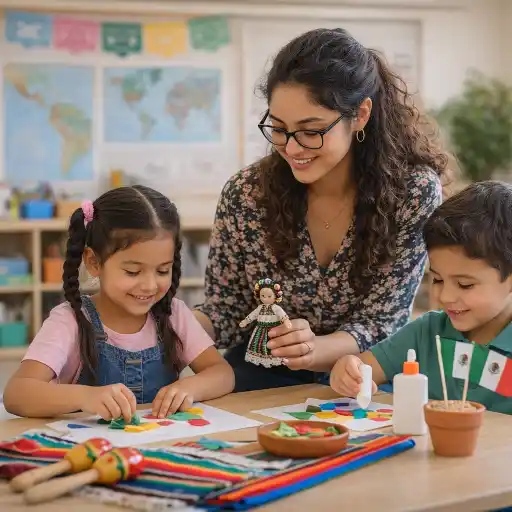
Preschoolers can explore culture through stories, music, movement, art, dramatic play, maps, and family inquiry. Each experience should have a developmental purpose and a specific cultural context. Instead of saying “Today we will learn about Latino culture,” identify the focus: “We are listening to a Puerto Rican rhythm,” “We are reading a bilingual story by a Mexican American author,” or “We are learning how one family remembers loved ones.”
- 📚 Story studio: Read books by Latino authors and illustrators. Invite children to retell stories with puppets, sequence cards, or family figures.
- Music laboratory: Compare tempo, instruments, and movement patterns from several traditions. Children can clap, sway, or create rhythms without imitating stereotyped dances.
- Art inquiry: Study child-friendly images by artists such as Frida Kahlo, Carmen Lomas Garza, or Diego Rivera, then invite self-portraits, family murals, or nature-inspired art.
- Language center: Add bilingual labels, menus, pretend-store signs, family-made books, and picture cards to meaningful play areas.
- Community mapping: Explore photographs of neighborhoods, homes, parks, markets, schools, and landscapes from specific communities rather than presenting Latin America as interchangeable.
Activities should remain open-ended. Children might notice colors, patterns, family roles, sounds, or similarities between homes. Avoid turning cultural learning into a quiz; assess through conversation, observation, drawing, cooperation, and play.
How can programs partner with families respectfully?
Families are knowledge holders and partners, not decorations for a themed event. Begin with an optional, translated question such as, “What songs, words, stories, foods, or family routines would you like us to know?” Offer several ways to participate: a photograph, voice recording, book recommendation, recipe story, classroom visit, or written response.
- Ask families what names, cultural identities, pronouns, and terms they prefer.
- Invite caregivers to contribute routine words in the home language.
- Use interpreters or translated communication for important health, developmental, enrollment, and safety matters.
- Provide flexible participation options that do not require time, money, public speaking, or bringing food.
- Thank contributors and return borrowed materials promptly.
Avoid asking one Latino child or family to represent an entire group. One family’s experience is valuable but never universal. Directors can strengthen this work by reviewing whether Spanish-speaking families receive equal opportunities to respond, whether displays reflect enrolled families, and whether materials include Indigenous, Afro-Latino, Caribbean, multiracial, and varied socioeconomic experiences.
For deeper family-partnership strategies, consider Bridging Cultures: Family Communication & Collaboration Buy Now $55.00 or Family Voices Matter: Tools for Meaningful Collaboration Buy Now $55.00.
How can educators avoid stereotypes and cultural appropriation?
Good intentions require thoughtful review. Problems arise when diverse cultures are reduced to sombreros, tacos, flags, sugar-skull makeup, exaggerated accents, or a single holiday. Before using an activity, ask who created the material, which community it represents, whether the context is accurate, and whether families would recognize it as respectful.
- Replace costumes with context: Use authentic books, family stories, photographs, art, music, and everyday objects rather than dressing children as caricatures.
- Name specificity: Identify the country, region, community, artist, or tradition being explored.
- Explain traditions carefully: If discussing Día de los Muertos, present it as a varied family remembrance tradition—not as Halloween or a costume theme.
- Preview resources: Remove inaccurate history, stereotyped illustrations, mock accents, and commercialized activities.
- Integrate representation: Include Latino authors, languages, scientists, artists, leaders, and families throughout the year.
For a hands-on food-based experience, educators can explore Hispanic Heritage Month cooking activities for kids that connect culture and learning. Food activities require allergy review, handwashing, supervision, choking-risk precautions, family consent, and compliance with program policy. State requirements vary - check your state licensing agency. If a mistake occurs, acknowledge it, listen to affected families or colleagues, revise the plan, and explain what will change.
How can directors sustain culturally responsive practice all year?
A single celebration cannot carry the responsibility of representation. Directors can build sustainable practice through an annual audit of curriculum, environment, communication, and professional development. Ask whose voices are present, whose are missing, and whether children encounter Latino identities in ordinary, joyful, and complex ways.
- Create a rotating library with bilingual and Spanish-language books selected for accuracy and literary quality.
- Add family-approved words and photographs to daily routines, not only bulletin boards.
- Include music, art, science, geography, and biographies connected to specific Latino communities.
- Use staff meetings to examine assumptions, review materials, and plan responses to children’s questions.
- Collect family feedback and document changes made because of that feedback.
- Observe participation: Who joins, speaks, initiates play, uses new words, or sees their family reflected?
Directors may also use professional learning to create shared expectations. The Cultures in the Classroom Buy Now $24.00 course focuses on helping providers celebrate culture and diversity in ways that foster acceptance. The From Play to Planning: Building Culturally Competent, Child-Centered Curriculum Buy Now $55.00 course can support curriculum decisions that connect cultural responsiveness with play, observation, and developmental goals.
Conclusion: What are the most age-appropriate ways to honor Latino cultures?
Age-appropriate cultural learning is concrete, relational, voluntary, accurate, and connected to children’s real lives. Infants and toddlers need responsive routines, family photographs, songs, and familiar words. Preschoolers and school-age children can explore books, music, art, maps, dramatic play, biographies, and community stories with increasing depth.
The central goal is not to produce a colorful event; it is to build a classroom where children experience belonging every day. Center family knowledge, avoid stereotypes, use precise language, and revisit representation across the year. With reflection and partnership, educators can honor Latino cultures while strengthening language, identity, empathy, creativity, and community.
- CDA Home Visitor Subject Area 3 Part 3 Birth to 5
- Moving About the Classroom: Effective Transitions for Everyday
- Birth to Five CDA Credential with Portfolio Review
- The Best Promotion is Play
- Emergent Learning & Development
- Texas Director Credential
- Montessori Cultural Activities: Exploring the World Through Play and Learning
- Supporting Families and Caregivers in Language and Literacy
- Moving About the Classroom: Effective Transitions for Everyday
- Rooted in History: Early Childhood
- ❤️ ¿Cómo ayudan los educadores a las familias a acceder a los servicios que necesitan?
- 😫🧸 ¿Qué hacer cuando un bebé no quiere dormir la siesta en el aula?
- ❄️ ¿Qué actividades al aire libre funcionan bien para los niños de Illinois en cada estación? 🌷🍂
- Recursos en Español sobre el Sueño Seguro del Bebé
- ¿Cuáles son los pasos, los requisitos y las opciones en línea para la certificación de 90 horas para cuidado escolar en Maryland?
- 10 Ejemplos de Cómo la Cultura Influye en el Desarrollo Infantil
- Actividades de Fiesta para Niños de Preescolar y Primaria
- ¿Cómo solicito la licencia para una guardería en California?
- Regulaciones de Licenciamiento de Cuidado Infantil en California para Centros y Hogares de Cuidado Infantil Familiar
- Proporciones de Cuidado Infantil y Tamaños de Grupo por Edad en Maryland (Guía Rápida para Centros y Hogares)
- Proporciones de Cuidado Infantil y Tamaños de Grupo por Edad en Wisconsin (Guía Rápida para Centros y Hogares)
- Proporciones de Cuidado Infantil y Tamaños de Grupo por Edad en Nueva Jersey (Guía Rápida para Centros y Hogares)
- Consejos de Supervisión Activa para Salones de Preescolar y el Juego al Aire Libre
- Retraso del Habla en la Guardería: Cómo Pueden Ayudar los Proveedores
- Capacitación Previa al Servicio para Proveedores de Cuidado Infantil en Dakota del Norte
- Las Mejores Ideas de Excursiones para Guarderías en Texas
- How Can Child Care Programs Celebrate Hispanic Heritage Month Meaningfully?
- How Can Preschools Celebrate Hispanic Heritage Month Meaningfully?
- What Are Age-Appropriate Ways to Honor Latino Cultures in the Classroom?
