Art can be much more than a seasonal craft: it can help young children think, communicate, collaborate, and make sense of their experiences. To strengthen your classroom practice, explore Art from the Heart for Preschoolers: Open-Ended Art Projects that Build Self-Esteem Buy Now $35.00 and Mind’s Medicine: Music in Early Childhood  Buy Now $16.00; these courses offer practical strategies for using creative experiences to support confidence, development, and daily learning.
Why does art belong in the curriculum?
For young children, the arts are ways of thinking and communicating. Drawing, painting, building, singing, dancing, and dramatic play allow children to represent ideas before they can fully explain them with words. The NAEYC creative arts guidance emphasizes that music, movement, drama, and visual art can support social-emotional development, language and literacy, cognition, and physical development.
Art also creates multiple entry points into learning. A child who is hesitant to speak in a large group may tell an elaborate story through puppets. Another child may explore mathematical ideas by arranging shapes, repeating rhythms, or comparing lengths in a collage. These experiences honor children’s strengths while building new skills.
Art matters because it invites children to:
- Experiment, revise, and solve problems.
- Develop fine- and gross-motor coordination.
- Expand vocabulary and narrative language.
- Express feelings and strengthen self-regulation.
- Collaborate, negotiate, and appreciate different perspectives.
Rather than treating art as an “extra,” directors and providers can view it as a flexible curriculum language that connects domains of development. This perspective is central to an intentional, play-based program.
How can educators prioritize process over product?
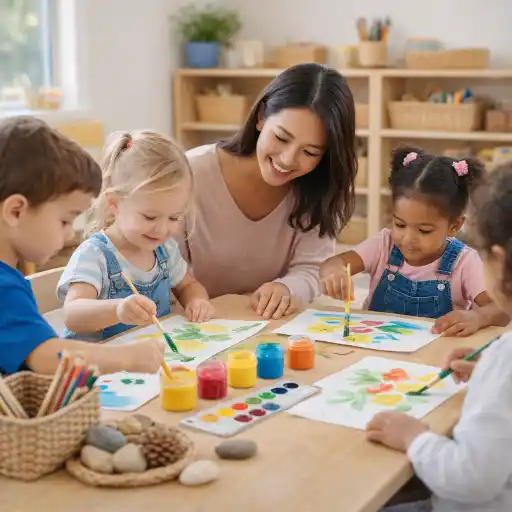
Process-focused art emphasizes children’s choices, experimentation, and discoveries rather than a predetermined finished object. According to NAEYC’s process-art guidance, these experiences generally have no model to copy, no single correct outcome, and no step-by-step sequence that every child must follow.
A product-focused activity might ask every child to reproduce the same paper turkey or flower. Although such activities can practice isolated skills, they may communicate that adult approval and visual similarity matter more than children’s ideas. Process art, by contrast, communicates that children are capable decision-makers.
Try replacing a craft template with an invitation such as, “What can these materials become?” Offer paper, paint, clay, recycled materials, natural objects, scissors, and glue, then observe how children combine them. Comment descriptively rather than evaluating appearance:
- “You layered three textures on your paper.”
- “You changed your plan after the tower fell.”
- “I notice the rhythm became faster.”
Protect uninterrupted time. Children may need several attempts before an idea develops, and they may return to the same work across multiple days. The goal is not to remove teacher intentionality; it is to use intentional preparation and responsive interaction without taking ownership away from the child.
How can art connect with literacy, mathematics, science, and social studies?
Arts integration is strongest when it grows from meaningful questions and children’s interests. The NAEYC discussion of music, drama, and dance integration describes how performance arts can make core learning active, embodied, and memorable. For ideas on combining Montessori principles with music and rhythm, explore how Montessori and music can work together.
- Literacy: Invite children to illustrate a story, retell it with props, create a new ending, or dictate captions for their work. Dramatic play supports sequencing, vocabulary, perspective-taking, and narrative structure.
- Mathematics: Explore rhythm patterns, symmetry, sorting, measurement, spatial relationships, and geometric shapes through movement, collage, block construction, and music.
- Science: Encourage observational drawings of plants or insects, paint shadows, model habitats with clay, or use movement to represent weather and animal behavior.
- Engineering: Use dramatic scenarios and loose parts to identify a problem, plan, build, test, revise, and explain a solution.
- Social studies: Invite children to represent familiar places, family roles, community helpers, and neighborhood experiences through maps, songs, photographs, and dramatic play.
Ask open-ended questions that reveal reasoning: “What changed when you added water?” “How could we make this structure stronger?” or “How can your bodies show a storm?” These prompts extend learning while preserving children’s agency.
How can providers create an inclusive and culturally responsive arts environment?
An inclusive arts curriculum assumes that every child can participate meaningfully, even when participation looks different. Begin by observing barriers: noise, texture, tool size, visual complexity, language demands, or limited mobility. Then adapt the environment rather than interpreting a child’s hesitation as unwillingness.
- Offer thick-handled brushes, adaptive scissors, vertical surfaces, tactile materials, and stabilized paper.
- Provide visual choices, gestures, picture cards, and communication supports.
- Create quieter alternatives for children who are sensitive to sound or crowding.
- Allow children to observe first, participate briefly, or return later.
- Collaborate with families and specialists when individualized supports are needed.
🖌️ Use culturally responsive materials every day—not only during an annual “culture week.” Include authentic books, music, instruments, artwork, patterns, and family knowledge that reflect the children in your program and the wider world. Avoid stereotypes, token displays, or asking one child to represent an entire culture. Families can contribute songs, stories, photographs, or artistic traditions voluntarily and on their own terms.
ChildCareEd’s Montessori Cultural Activities Buy Now $24.00 course offers additional ideas for connecting art, music, culture, language, and hands-on exploration.
How can educators document and improve arts-based learning?
Documentation helps providers make children’s thinking visible to families, colleagues, and administrators. The NAEYC resource on documenting process art recommends capturing children’s work at different stages, recording their words, and connecting observations to learning goals.
A practical documentation note can include:
- What happened: “Maya mixed blue and yellow paint, then added water.”
- What the child said: “It is getting lighter because the water is spreading.”
- What learning was visible: Color experimentation, prediction, descriptive language, and sustained attention.
- What comes next: Offer droppers, transparent containers, and additional color-mixing opportunities.
Display photographs, transcripts, and work samples with children’s permission and in formats families can access. Documentation should not turn creative expression into a test; it should help adults recognize growth and plan responsive invitations.
Common mistakes include praising only beauty, correcting children’s interpretations, rushing cleanup, or using art primarily to produce gifts. Avoid these pitfalls by describing effort and strategy, scheduling adequate time, and explaining the learning purpose to families. State requirements vary—check your state licensing agency when selecting materials, planning supervision, and documenting required curriculum experiences.
Which professional learning can strengthen arts integration?
Providers do not need to consider themselves artists to create a strong arts curriculum. They need a willingness to explore alongside children, knowledge of developmentally appropriate practice, and practical planning tools. Professional learning can help staff move from isolated crafts toward intentional, open-ended experiences.
- Power of Art: Building Self-Esteem and Positive Behavior for All Abilities Buy Now $35.00 connects open-ended art with self-esteem, positive guidance, and support for children with differing abilities.
- Open Heart, Open Art Buy Now $16.00 focuses on how children’s artistic choices can support social-emotional development.
- CDA Subject Area 2 Buy Now $80.00 addresses physical and intellectual development, including language, mathematics, science, music, and the arts.
- Many Colors, One Canvas: MD ECE Conference Buy Now $315.00 offers learning focused on inclusive art, cultures in the classroom, and the language of art.
Directors can support implementation by scheduling shared planning time, maintaining a rotating materials inventory, and inviting staff to bring documentation to team meetings. Start with one manageable change: a self-serve art shelf, a weekly music-and-movement invitation, or a story-prop basket.
Conclusion: How can art become a meaningful part of the curriculum?
Art becomes meaningful when it is regular, accessible, child-directed, and connected to authentic questions. Process-focused experiences give children room to experiment and develop confidence; music, movement, and drama strengthen communication and problem-solving; and culturally responsive materials help every child see that their identity and ideas belong in the classroom.
The central question is not whether children can produce attractive projects. It is whether the curriculum gives them meaningful opportunities to think, express, collaborate, revise, and make meaning. When providers prepare rich materials, protect time, document learning, and respond with curiosity, art becomes a powerful foundation for whole-child development.
Key takeaways:
- Prioritize process, choice, and exploration over uniform products.
- Integrate visual art, music, movement, and drama across curriculum domains.
- Adapt materials and communication supports so every child can participate.
- Represent cultures respectfully and partner with families.
- Use documentation to understand children’s thinking and plan next steps.
- CDA Home Visitor Subject Area 3 Part 3 Birth to 5
- Many Colors, One Canvas: MD ECE Conference
- Emergent Learning & Development
- Children at the Wheel: Emergent Curriculum
- Art from the Heart for Preschoolers: Open Ended Art Projects that Build Self-Esteem
- Creating Environments that Nurture Growth and Community
- Texas Director Credential
- Montessori Cultural Activities: Exploring the World Through Play and Learning
- 45-Hour Infant and Toddler Curriculum
- CDA Certification en Español: Recursos y Consejos para Educadores Bilingües
- Cómo Ser Maestra de Preescolar en Illinois
- Cómo Ser Maestra de Preescolar en California
- How can New York early childhood programs use garden-based learning?
- What Counts as Professional Development for Early Childhood Educators?
- Do You Need a Bachelor’s Degree to Be a Preschool Teacher—or Can a CDA Be Enough?
- How Can You Turn a Superhero Theme Into a Full Week of Preschool Learning Centers?
- Labor Day Makers: Creative Projects That Get Pre-K Kids Thinking and Building
- More Than ABCs and 123s: The Real Importance of Early Childhood Education
- Field Trips for Elementary Students: 15 Adventures That Bring Learning to Life
- Common After School Activities Kids Get Bored With—and What to Try Instead
- How Can Smoother Classroom Transitions Reduce Challenging Behavior?
- How Can Loose Parts Play Turn Everyday Objects Into Powerful Learning Opportunities?
- How Can We Celebrate Every Family and Create a Classroom Where Everyone Is Represented?
- How Can Teachers Build Learning Centers on a Tight Budget?
- What Are the Benefits of Open-Ended Play Materials for Young Children?
- How Can Child Care Providers Make Outdoor Learning Meaningful, Safe, and Inclusive?
- How Can Art Become a Meaningful Part of the Early Childhood Curriculum?
- How Can Child Care Programs Celebrate Juneteenth Through Respectful, Child-Centered Art?
