Outdoor learning can transform an ordinary yard into a place for movement, inquiry, imagination, and connection. If your team wants practical guidance for designing a nature-rich environment, explore Creating the Natural Outdoor Classroom  Buy Now $16.00; this self-paced course can strengthen classroom practices and provide a focused professional-learning experience for providers.
Outdoor learning is more than moving children outside. It is an intentional approach in which educators use natural environments, open-ended materials, and responsive interactions to support development across domains. When planned thoughtfully, outdoor experiences can help children build physical competence, language, problem-solving abilities, social relationships, emotional regulation, and environmental awareness. For a broader look at how play and engaging activities can support these areas, explore ways to advance children’s physical and intellectual development.
Why does outdoor learning matter in early childhood?
Young children learn through their whole bodies. Outdoors, they can run, climb, balance, dig, carry, observe, and experiment in ways that indoor spaces may not allow. The CDC identifies outdoor play as an opportunity to support healthy bodies, attention, behavior, language, and emotional development. Similarly, a review of research on outdoor learning in early childhood found benefits related to holistic development, well-being, hands-on learning, and children’s experiences with nature (ERIC review of outdoor learning in early childhood education).
Outdoor learning also matters because it makes curriculum concrete. A child counting stones is developing mathematical thinking; a group constructing a shelter is practicing engineering, communication, and cooperation; a child describing a bird’s movement is expanding vocabulary and observation. The environment becomes a responsive teaching partner rather than a backdrop.
For providers, outdoor learning can support more engaged play and smoother transitions when routines are predictable. It does not require an expensive playground or a large property. A small courtyard, garden bed, porch, or portable materials cart can provide meaningful opportunities when educators plan with purpose.
How can educators design an effective outdoor learning environment?
Effective outdoor spaces offer both challenge and security. Begin with the children’s ages, abilities, interests, and sensory needs, then organize the environment into flexible zones. A useful starting point includes movement, sensory exploration, construction, creative expression, and quiet observation.
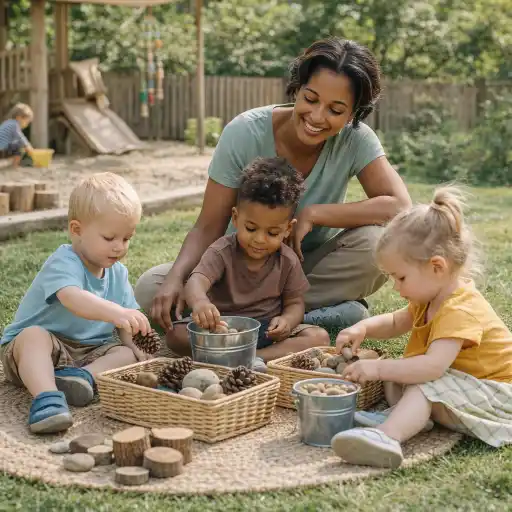
- Movement: Include pathways, balance opportunities, low climbing challenges, and open space for running.
- Sensory exploration: Offer sand, water, soil, plants, textured materials, and opportunities to listen for natural sounds.
- Construction: Provide crates, cardboard, logs, fabric, tubes, and other safe loose parts that children can move and combine.
- Creative expression: Add easels, chalk, clipboards, natural collage materials, and space for dramatic play.
- Quiet observation: Create a shaded reading nook, nature table, garden-viewing area, or place for drawing and reflection.
Head Start emphasizes that rich nature play can be created affordably, even in limited spaces (25 Easy Ideas for Nature Play for Early Childhood Centers). Rotate materials rather than presenting everything at once. A smaller selection invites deeper engagement and makes supervision easier. For additional design strategies, the CDA: Creating the Outdoor Classroom Buy Now $16.00 course connects environmental design with children’s physical and intellectual development.
How can outdoor experiences connect to curriculum goals?
Outdoor learning is strongest when teachers connect children’s spontaneous discoveries with intentional learning goals. The goal is not to turn every moment into a formal lesson; rather, educators observe, listen, ask thoughtful questions, and extend children’s ideas.
- 🍃 Science: Observe insects, compare leaves, investigate shadows, track weather, or test what sinks and floats.
- Math: Count natural objects, compare length and weight, measure plant growth, identify patterns, and map pathways.
- Language and literacy: Read outdoors, dictate nature stories, create vocabulary cards, conduct sound walks, or make observational journals.
- Social-emotional learning: Invite children to collaborate on structures, negotiate roles, solve conflicts, and reflect on challenges.
- Creative arts: Use leaves, sticks, stones, water, and light as inspiration for drawing, movement, music, and dramatic play.
One practical planning method is to identify one learning intention, one material invitation, and one teacher question for each outdoor block. For example: “Children will compare size; offer baskets of leaves; ask, ‘How could we organize these?’” This keeps planning manageable while preserving child-led exploration.
Outdoor inquiry also supports early science foundations. Providers who want more guidance on observation, experimentation, and discovery may find Building Early Science Foundations Buy Now $16.00 useful for translating children’s curiosity into developmentally appropriate experiences.
How can providers balance safety, supervision, and healthy risk-taking?
Safety is essential, but eliminating every challenge can limit development. Head Start explains that children benefit from environments offering high challenge with low risk, while NAEYC encourages educators to help children assess manageable risks rather than automatically stopping exploration. The adult’s role is to remove serious hazards, maintain active supervision, and provide support that matches each child’s abilities.
- Complete a brief hazard scan before children enter the space: look for broken equipment, sharp objects, animal waste, standing water, poisonous plants, and choking hazards.
- Position adults so they can see and hear children, move through zones, scan continuously, and count during transitions.
- Use age- and developmentally appropriate equipment, protective surfacing, shade, drinking water, and accessible first-aid supplies.
- Teach clear outdoor expectations, such as staying within boundaries, reporting hazards, and using materials respectfully.
- Use weather and air-quality information to determine whether to proceed, shorten outdoor time, or move learning inside.
The CDC recommends planning for sun, heat, hydration, insects, playground injuries, and water safety (Outdoor Play and Safety for Children in ECE). For a broader framework for planning a safe and healthy learning environment, consider how everyday health practices complement these outdoor precautions. Water play requires constant, attentive supervision because drowning can occur quickly and silently. Remember that state requirements vary - check your state licensing agency. A focused course such as Active Supervision: A Strategy That Works Buy Now $35.00 can help teams develop consistent supervision practices.
How can outdoor learning become inclusive and sustainable?
Inclusion begins with the assumption that every child belongs outdoors. Observe how children access the space, then adapt materials, pathways, seating, communication supports, and activity expectations. A child who cannot climb a structure may still participate by navigating a textured path, directing a peer, collecting materials, or investigating from a comfortable observation point.
Offer multiple ways to engage: moving, touching, listening, looking, communicating, building, and resting. Use visual cues, predictable routines, adaptive tools, and peer collaboration. Consider sensory differences as well; some children may need a quiet retreat, noise-reducing supports, or gradual exposure to messy materials.
Families can strengthen outdoor learning by sharing cultural knowledge, gardening traditions, weather practices, and children’s interests. A gear-lending shelf with rain pants, boots, hats, and extra clothing can reduce barriers. Communicate learning through photographs, child quotes, and short notes rather than assuming families recognize the educational value of play.
Sustainability can remain simple: care for plants, reuse containers, compost when appropriate, protect living things, and model respect for habitats. Track a few indicators—participation, new vocabulary, problem-solving, peer cooperation, or calmer transitions—to guide improvement without burdening staff.
What common mistakes should programs avoid?
Outdoor learning often falters because systems are inconsistent, not because educators lack commitment. A strengths-based review can help teams adjust without blaming themselves.
- Too many materials: Rotate a few purposeful invitations and observe how children use them.
- Outdoor time as a reward: Treat it as part of the curriculum and daily rhythm rather than something children earn.
- Overly adult-directed activities: Begin with an invitation, then allow children’s questions and theories to shape the experience.
- Inconsistent supervision: Assign zones, clarify responsibilities, and practice transitions during staff meetings.
- Ignoring weather or access barriers: Maintain a decision chart, spare clothing, shade, hydration, and indoor adaptations.
- Documenting only products: Record children’s words, strategies, relationships, and changing theories—not just finished crafts.
Directors can support implementation by starting with one reliable outdoor block, one staff checklist, and one shared learning goal. Professional learning can build common language and confidence; the Creating Environments that Nurture Growth and Community Buy Now $55.00 course also addresses intentional environments, inclusion, and community-building. Verify any training-hour or approval questions with the relevant agency before relying on a course for a specific requirement.
Conclusion: How can your program begin outdoor learning tomorrow?
Outdoor learning becomes meaningful when children have frequent access to nature, educators plan intentionally without over-controlling play, and safety systems protect exploration rather than restricting it. The strongest programs begin modestly: a daily observation walk, a portable loose-parts basket, a shaded story space, or a small planting container can become the foundation for rich learning.
Remember the central question: how can child care providers make outdoor learning meaningful, safe, and inclusive? Design for varied participation, connect experiences to curriculum, supervise actively, allow manageable challenges, communicate with families, and reflect on what children are showing you. With thoughtful routines and responsive teaching, the outdoors can become a vibrant extension of your program—one that supports healthy, curious, capable, and connected #children.
Key takeaways:
- Outdoor learning supports physical, cognitive, social, emotional, and environmental development.
- Small spaces and low-cost natural materials can offer substantial learning opportunities.
- Active supervision and developmentally appropriate risk-taking can coexist.
- Inclusive design gives every child meaningful ways to participate.
- Consistent routines and targeted professional learning help teams sustain practice.
- Creating the Natural Outdoor Classroom
- CDA Infants/Toddlers: Health and Safety
- CDA Infants/Toddlers: Abuse and Neglect Reporting Requisites
- Pediatric RSV First Aid & CPR/AED
- CDA: Creating the Outdoor Classroom
- CDA Infants/Toddlers: Classroom Setup
- Sensitive Periods in Montessori: Guiding Natural Learning
- Texas Director Credential
- Preventative Health and Safety
- CDA Infants/Toddlers: Smart Nutrition & Feeding
- Today Is Earth Day!
- Daycare Training 101: Building a Safe, Fun, and Educational Environment
- 💛🧩 ¿Cómo puedo hacer que mi enseñanza sea inclusiva para los niños con autismo?
- Capacitación en Salud y Seguridad Preventiva en Línea para Proveedores de Cuidado Infantil
- Proporciones de Cuidado Infantil y Tamaños de Grupo por Edad en Virginia (Guía Rápida para Centros y Hogares)
- Canciones, juegos y preguntas de círculo para niños
- Cómo simplificar la capacitación para sus empleados de daycare
- What Makes a Great Home Daycare? 10 Things Parents Notice First
- National Massachusetts Day for Kids: Explore the Bay State Through Play
- Go on a Fall Hunt! Outdoor Learning Challenges for Preschoolers
- How Can Child Care Providers Support Gross Motor Development in Every Child?
- How Can Child Care Providers Use Project-Based Learning to Deepen Young Children’s Learning?
- How Can Child Care Programs Make Nature-Based Learning Meaningful, Inclusive, and Safe?
- How Can Child Care Providers Make Outdoor Learning Meaningful, Safe, and Inclusive?
- How Can Providers Create an Inclusive Classroom for Every Child?
- How Can Providers Bring Nature-Based Learning Into Any Program?
- What Should Teachers Do When Children Don’t Want to Play Outside?
- How Can Camping Themes Expand Preschool Vocabulary?
- “Save My Work!” How Can Child Care Providers Protect Unfinished Projects Between Days?
- How Can Child Care Providers Ensure Every Child Can Participate in Outdoor Play?
