When circle time becomes a predictable checklist, young children can lose curiosity—and providers can miss valuable opportunities for connection, inquiry, and meaningful learning. Explore practical alternatives that build language, social-emotional development, movement, and early thinking, then deepen your planning with From Play to Planning: Building Culturally Competent, Child-Centered Curriculum  Buy Now $55.00, a course designed to strengthen responsive, play-based curriculum decisions and support professional learning.
Why should circle time move beyond routine calendar tasks?
Weather, days of the week, and calendars can provide familiarity, but they should not define the entire group experience. A meaningful #circletime is a shared space where children listen, communicate, investigate, move, and contribute ideas. The circle itself can symbolize belonging: every child has a place, every voice matters, and learning is created through relationships rather than delivered as a lecture.
When providers broaden the agenda, they can address multiple developmental domains in short, intentional experiences. A mystery object can support descriptive language and reasoning. A cooperative movement game can strengthen self-regulation and peer awareness. A picture discussion can invite children to make predictions, connect experiences, and practice respectful disagreement.
ChildCareEd’s Preschool Circle Time Ideas for Learning and Connection emphasizes that circle time can connect routines to learning goals while supporting talking, listening, and turn-taking. The goal is not to eliminate familiar routines, but to balance them with experiences that are relevant to the children in front of you.
- Use the calendar when it serves a real purpose, such as counting down to a field trip.
- Replace repetitive questioning with observation, prediction, and conversation.
- Plan one clear objective rather than attempting to teach every domain at once.
What language and storytelling topics can replace calendar talk?
Language-rich topics are especially effective because they grow from children’s experiences and invite many kinds of responses. Consider a “question of the day” connected to classroom life: “What helps you feel welcome?” “How did you solve a problem yesterday?” or “What would you pack for a trip?” Children may answer verbally, point to a picture, gesture, draw, or share in a home language.
Interactive storytelling is another strong alternative. Select a short book, felt story, or oral narrative with repetition and assign children actions or props. Pause to ask, “What might happen next?” “How does the character know?” and “What could the character try?” These prompts support comprehension, sequencing, vocabulary, and perspective-taking without turning the read-aloud into a quiz.
Try a mystery bag containing an everyday object. Invite children to feel it, describe its features, and propose possibilities before revealing it. Extend the conversation by introducing two or three precise words—such as smooth, flexible, heavy, or transparent—and using them again in centers.
For additional language ideas, the ChildCareEd resource on language-learning games recommends short, repeatable activities involving rhymes, story stones, syllables, and sign-supported communication. Keep the pace brisk, provide wait time, and value attempts as well as polished answers.
How can circle time support social-emotional learning?
Circle time offers a natural setting for practicing #empathy, emotional vocabulary, cooperation, and conflict resolution. Rather than asking every child to publicly disclose feelings, offer low-pressure choices: point to an emotion card, select a color, make a facial expression, or pass when they are not ready. Participation should be invited, never forced.
Use brief role-play scenarios drawn from classroom life. Two puppets might both want the same toy. Ask children to suggest words, gestures, or solutions: “Can I have a turn when you are finished?” “Let’s use a timer.” “We can find another block.” The educator models respectful language, then lets children practice in pairs or with props.
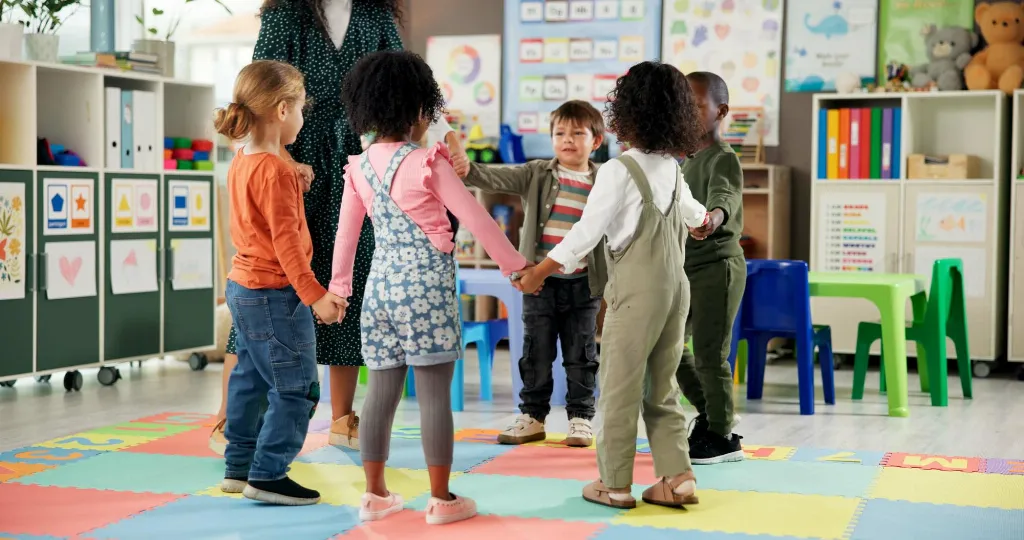
Cooperative games can make social learning active. Children might pass a rhythm around the circle, silently transfer a soft object, or create a group movement pattern in which each child adds one action. Emphasize noticing others, waiting, and adapting—not winning.
Specific feedback strengthens the skill being practiced: “You watched Jordan’s hands and waited for the shaker,” or “You offered another idea when the first plan did not work.” ChildCareEd’s Supporting Social Learning: Creating Classrooms that Care Buy Now $24.00 can help providers develop strategies for community building, open dialogue, and children’s problem-solving.
Which inquiry topics invite science, math, and problem-solving?
Children do not need a formal experiment to engage in scientific thinking. Bring one intriguing item—a pinecone, magnet, shell, ice cube, or fabric sample—and ask children to observe before explaining. “What do you notice?” “What do you wonder?” and “How could we find out?” encourage careful attention, prediction, and evidence-based conversation.
Math can also emerge from authentic group problems rather than daily recitation. Count how many children chose a particular movement, compare the lengths of two ribbons, sort buttons by observable attributes, or determine whether there are enough cups for everyone. Use the language of more, fewer, equal, longer, shorter, beside, and between.
Offer design challenges that require collaboration. For example, ask, “How can we move this ball across the circle without touching it?” Children may propose tubes, scarves, or a sequence of handoffs. The provider documents their ideas with sketches or words and revisits the plan after testing.
These experiences are most powerful when the answer is not predetermined. The teacher’s role is to pose a manageable problem, provide safe materials, and extend thinking with prompts. Follow children’s questions into centers: a discussion about floating can become a water-table investigation; sorting classroom objects can continue in the math area.
How can movement, music, and culture make circle time more meaningful?
Movement is not a reward after “real learning”; it is a pathway to attention, coordination, communication, and self-regulation. Alternate quieter experiences with action. Try animal walks, stretch-and-count, freeze-and-listen, rhythm copying, or a movement story in which children represent verbs such as crawl, glide, reach, and balance.
Music can introduce patterns, memory, phonological awareness, and community. Use call-and-response songs, body percussion, name rhythms, or a child-created soundscape. Invite children and families to contribute songs, greetings, instruments, or movement traditions from home. Explain that classrooms can enjoy music respectfully without treating a culture as a costume or a single “theme.”
Include representation in books, photographs, puppets, and conversation topics. Discuss families, celebrations, occupations, abilities, languages, and community experiences in ways that reflect the children you serve. Ask open questions rather than assuming that one child speaks for an entire culture.
- 🎵 Offer multiple ways to participate: sing, hum, tap, sign, point, watch, or move.
- Provide visual cues and predictable signals for children who benefit from structure.
- Offer seated, standing, and low-stimulation options.
- Use names, words, and pronunciations respectfully and accurately.
ChildCareEd’s Mind’s Medicine: Music in Early Childhood Buy Now $16.00 supports providers in planning developmentally appropriate musical experiences. State requirements vary - check your state licensing agency.
How can providers plan, adapt, and evaluate new circle time topics?
Begin with observation. What are children talking about, building, pretending, or trying to understand? Select one question that connects to their interests and one developmental purpose. Then choose a brief format: a prop conversation, song, story, demonstration, cooperative game, or movement invitation.
For preschoolers, plan short segments and alternate active and quieter moments. A successful group experience might include a two-minute greeting, a three-minute mystery object, a two-minute movement break, and a five-minute story discussion. If attention fades, change the plan. Flexibility is not failure; it is responsive teaching.
Adapt participation before a child struggles. Use picture cards, gestures, communication systems, peer modeling, flexible seating, sensory tools, and reduced language demands. A child watching from nearby may still be learning and may join when the experience feels safe. ChildCareEd’s Inclusive Lessons for Preschoolers Buy Now $16.00 offers practical guidance for designing activities that welcome varied abilities and communication styles.
Evaluate with one observable indicator: Did children use a target word? Wait for a turn? Make a prediction? Follow a movement pattern? Record a short note and use it to plan the next experience. Avoid judging circle time by silence alone; engaged listening can include movement, questions, and productive talk.
Conclusion: What should circle time include beyond the calendar?
Circle time can be a living, responsive part of the curriculum—not a daily obligation to complete. Weather, days of the week, and calendar concepts have a place when they are purposeful, but children also need opportunities to tell stories, investigate materials, solve social problems, move, make music, and ask questions.
- Choose one meaningful question or learning goal.
- Use props, visuals, movement, and conversation to invite participation.
- Connect group discoveries to centers, play, families, and documentation.
- Adapt expectations so every child can participate in a comfortable way.
- End while the group is still successful, and try again tomorrow.
The answer to the central question is simple: circle time should offer children connection, agency, and purposeful exploration beyond routine recitation. Small changes—one mystery object, one cooperative game, or one child-generated question—can transform the tone of the whole day.
Frequently asked questions
Should we eliminate the calendar entirely?
Not necessarily. Keep it when it supports authentic concepts such as planning, counting, sequencing, or anticipating an event. Shorten or vary it when children are disengaged.
What if children do not want to speak?
Offer pointing, gestures, drawing, signing, partner responses, props, or observation. Respect a child’s choice not to share publicly.
How long should circle time last?
Timing depends on age, group size, and activity design. Use short segments, watch children’s cues, and prioritize quality over completing a preset agenda.
How can directors support consistency?
Create a shared planning template with the objective, materials, adaptations, transition plan, and observation prompt. Encourage staff reflection rather than rigid scripting.
How do I connect circle time to assessment?
Observe one specific behavior, such as vocabulary use, turn-taking, prediction, or following a sequence. Record a brief note and use it to adjust future experiences.
- CDA Home Visitor Subject Area 3 Part 3 Birth to 5
- 45 Hour School Age Methods and Materials
- CDA Bridge Bundle: Family Child Care without Portfolio Review
- CDA Bridge Bundle: Infant/Toddler without Portfolio Review
- CDA Bridge Bundle: Preschool without Portfolio Review
- Emergent Learning & Development
- 45-Hour Infant and Toddler Curriculum
- Sensitive Periods in Montessori: Guiding Natural Learning
- Building Early Science Foundations
- Montessori Cultural Activities: Exploring the World Through Play and Learning
- CDA Certification en Español: Recursos y Consejos para Educadores Bilingües
- ❤️ ¿Cómo ayudan los educadores a las familias a acceder a los servicios que necesitan?
- Cuáles Son las Señales de Alerta en el Desarrollo Infantil que Todo Educador Debe Conocer?
- Recursos en Español sobre el Sueño Seguro del Bebé
- ¿Cómo afecta la dopamina a los niños: señales, efectos e influencias diarias?
- Cómo Celebrar el Día Nacional del Kindergarten
- Capacitación Previa al Servicio para Proveedores de Cuidado Infantil en Nevada
- Las Mejores Ideas de Excursiones para Guarderías en Texas
- How can North Dakota programs climb the Bright & Early ND steps before the July 2026 update?
- How do I become an early childhood teacher in DC?
- Canciones, juegos y preguntas de círculo para niños
- What Training Do Beginner Child Care Providers Need?
- How do I run a simple first-week staff onboarding plan for Pennsylvania child care?
- How can Michigan child care programs plan staff schedules and coverage around summer holidays?
- How Can You Prepare Your Classroom for Fall While Prioritizing Safety, Health, and Learning?
- Kindergarten Songs for Circle Time: 15 Sing-and-Move Ideas That Sneak in Learning
- Circle Time Topics Beyond Weather, Days of the Week, and the Calendar
- How Can Child Care Programs Balance Indoor and Outdoor Learning Across the Week?
- Is Your Preschool Day Too Sedentary—and How Can You Tell?
- How Can Teachers Plan Indoor Activities Before Bad Weather Disrupts the Week?
