Turn preschoolers’ fall excitement into purposeful movement, collaboration, and problem-solving with a playful pumpkin delivery challenge. Lesson Planning for Preschoolers  Buy Now $24.00 can help you shape a seasonal game around developmentally appropriate goals, flexible participation, and intentional teaching—so you can build a stronger activity plan while children learn through play.
Why does a pumpkin delivery game offer more than a movement break?
A pretend delivery mission gives children a reason to move with purpose: carry a pumpkin from the “patch” to a destination, follow a route, and respond when something changes. The movement is engaging, but the deeper learning lies in the choices children make along the way. They may decide which path to take, how to carry a prop, or what to do when a route is blocked or a pumpkin is missing.
This kind of open-ended challenge connects physical activity with thinking, language, and social development. Children practice #problem-solving by trying an idea, noticing what happens, and adjusting their plan. They also build #movement skills such as balance, coordination, and body awareness as they walk, step around obstacles, or carry a lightweight object.
A delivery story makes abstract concepts concrete. A child can experience “near,” “far,” “around,” and “between” while navigating a classroom route. Counting deliveries, remembering the next stop, and comparing paths introduce early math and sequencing naturally. As noted in ChildCareEd’s guidance on pretend delivery routes, route play encourages children to plan, compare options, explain decisions, and revise when circumstances change.
- Children get a meaningful reason to move and stay engaged.
- Shared missions invite communication, turn-taking, and teamwork.
- Flexible routes make it easy to adjust the challenge to children’s interests and abilities.
How can you set up a simple pumpkin delivery challenge?
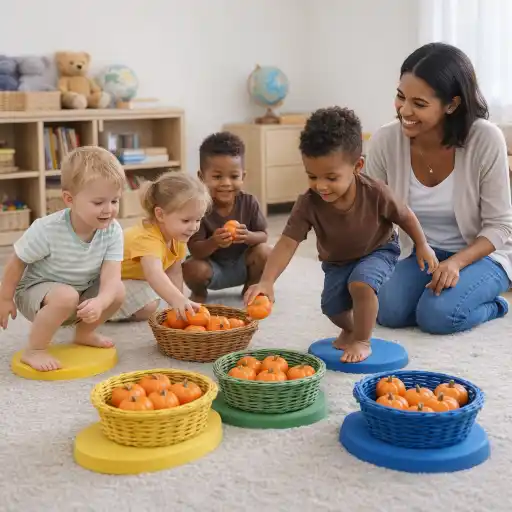
Start with a clear, uncluttered movement area and a short story: “The pumpkin stand has orders to deliver before the market closes!” Use paper or fabric pumpkins, soft balls, or large lightweight play props. Set up two or three destinations with picture signs—perhaps a farm stand, a classroom “bakery,” and a family’s front door. A few floor markers, cones, or painter’s tape can show the route.
Introduce the Pumpkin Delivery Movement Challenge Cards Buy Now $1.50 as prompts to add variation. Children might walk slowly along the route, step around a “puddle,” carry a pumpkin with two hands, or pause to deliver an order card. Keep directions brief and demonstrate each action. The cards can be drawn one at a time, placed at route stations, or offered as choices.
Make the activity collaborative rather than a race. Children can take on roles such as delivery driver, route helper, order checker, or destination greeter, switching roles as the game continues. Use large, safe materials and keep pathways wide enough for children to move comfortably.
- Set out only a few destinations at first; add more when the group is ready.
- Use picture cues and short verbal directions to support understanding.
- Offer a stationary or seated delivery option, such as passing the pumpkin along a table route.
- ✨ Let children help choose destinations or invent a new delivery mission.
What problem-solving challenges can you add to the delivery route?
Introduce one small problem at a time so the game remains playful rather than overwhelming. For instance, a bridge might be “closed,” a delivery card could be missing, or the order might require visiting the garden before the market. Ask children to think through possible solutions instead of supplying one immediately. “What could we try?” and “How will we know if it works?” make room for children’s ideas.
These challenges allow children to experience planning as a process. They can test a route, discover that it does not reach every stop, and revise it. A child who cannot carry the pumpkin and follow a narrow path at once might choose a wider route or ask a partner to help. These are useful examples of adapting a strategy to meet a goal.
Use prompts that encourage explanation, not just correct answers:
- “Which stop should we visit first so we don’t miss an order?”
- “The path is blocked. What other way could we go?”
- “How can we get the pumpkin there without dropping it?”
- “Can you show your partner the route you chose?”
- “What could we change to make the delivery easier?”
Preschoolers often learn through trying, observing, and trying again. Scholastic’s discussion of preschool problem-solving highlights the value of hands-on investigations, open-ended questions, and giving children time to develop their own solutions. Stay nearby to support safety and offer a helpful prompt, while resisting the urge to solve every challenge for them.
How can you adapt the game so every child can participate?
Children approach movement, communication, and pretend play in different ways. Inclusion does not require every child to complete an identical route or action. Keep the core purpose—making a delivery—while offering choices in how children participate. One child might walk a route, another might roll the pumpkin, and another might point to a destination or hand over the order card.
Adapt the distance, pace, materials, and number of steps. Use lightweight, easy-to-grasp objects and high-contrast pictures. If balancing or carrying is difficult, place the pumpkin on a small tray, use a larger soft prop, or let a partner share the delivery. Children who prefer to observe at first can be welcomed as route planners or destination checkers, then join physically when ready.
For children who benefit from additional predictability, show a short visual sequence: choose a card, travel to a stop, deliver, return. Give one direction at a time and allow extra processing time. Accept gestures, home-language responses, signs, and single-word answers as meaningful communication.
- Offer “walk or roll,” “carry or pass,” and “stand or sit” choices.
- Reduce the number of stops or remove an obstacle to simplify the challenge.
- Provide a more complex route, an extra stop, or a child-created rule for children seeking additional challenge.
- Respect individual plans, mobility guidance, and sensory preferences; never turn a movement game into a performance test.
Flexible planning is a key part of developmentally appropriate practice. The ChildCareEd article on fall challenge games likewise recommends varied ways to engage, including moving, pointing, drawing, building, and communicating in a home language.
How can teachers support safety, cooperation, and learning during play?
Before play begins, inspect the route and clear furniture, spills, and small loose objects. Set a manageable boundary, explain a consistent stop signal, and position yourself where you can see the entire activity. Active supervision means watching, listening, interacting, and anticipating possible problems—not simply staying in the room. Use only lightweight props, and make sure the number of children moving at once matches the space and supervision available.
Cooperation grows when children share a goal and have useful roles. Instead of rewarding the fastest delivery, celebrate children who remember an order, help a partner, or find a safe alternate route. If a disagreement arises about whose turn it is or which path to use, pause and invite children to suggest a fair plan. This keeps the focus on shared success rather than elimination or competition.
Observe what children do and say while they play. A brief note can capture important learning: “Ari noticed the route was blocked and suggested going around the blocks,” or “Sam delivered two orders in sequence with a visual reminder.” These observations can inform your next activity plan and help communicate children’s strengths to families.
Common pitfalls are manageable:
- Too many stations can make the route confusing; begin with two or three.
- Long waits reduce active participation; use pairs or small groups.
- Over-directing can limit children’s reasoning; demonstrate once, then step back.
- Competition can discourage some children; make the objective a shared delivery mission.
For activity-planning support, Lesson Planning for Preschoolers Buy Now $24.00 explores lesson components and developmentally appropriate planning. State requirements vary - check your state licensing agency.
How can you extend the game into a complete learning experience?
A pumpkin delivery game can connect movement with math, language, dramatic play, and classroom routines. After a delivery round, count the number of stops or compare routes using “more,” “fewer,” “shorter,” and “longer.” Invite children to create delivery tickets with drawings or marks, match a picture order to a destination, or make a simple class chart showing where the most pumpkins went. You can also connect the pretend mission to a pumpkin-patch or market dramatic-play area.
Revisit the game with one meaningful change. Children could choose a new starting point, deliver a different number of pumpkins, or create a route using blocks and floor markers. Ask them to draw or dictate a map for another group to follow. Returning to the experience gives children an opportunity to build on what they already know rather than starting from scratch every time.
Keep the lesson goal focused and observable. For example: “Children will practice sequencing two or three stops,” or “Children will try a different route when one path is unavailable.” Then notice which prompts, visuals, or adaptations helped each child participate. For further professional learning about integrating purposeful activities into the preschool day, explore the course Early Mathematics Through Play Buy Now $24.00.
- Invite children to describe or draw their route after the game.
- Use delivery orders to practice counting, matching, or remembering a sequence.
- Extend dramatic play with roles such as grower, driver, shopkeeper, and customer.
- Share a brief observation with families that describes a child’s strategy or collaboration.
Conclusion: How can a pumpkin delivery game make fall movement meaningful?
A pumpkin delivery game turns seasonal excitement into purposeful movement and authentic problem-solving. With a clear mission, a simple route, flexible challenge cards, and time to try again, children can practice coordination, sequencing, communication, and cooperation. The goal is not a perfect route or identical performance; it is an inviting experience where children can contribute in ways that work for them.
Start with a few destinations and one playful obstacle. Observe how children plan, adapt, and work together, then use those observations to shape the next round. For a fuller foundation in building intentional, age-appropriate preschool activities, explore Lesson Planning for Preschoolers Buy Now $24.00.
Five ChildCareEd courses to support your practice
- 45 Hour Child Growth and Development
- Turning Behavior Around for Toddlers and Preschoolers
- The ABCs of Behavior: Turning Challenges into Learning Opportunities
- Pediatric RSV First Aid & CPR/AED
- CDA Bridge Bundle: Preschool without Portfolio Review
- Mysteries of Challenging Behavior Solved
- Lesson Planning for Preschoolers
- CDA Infants/Toddlers: Health and Safety
- Texas Director Credential
- Turkey Trot and Tumble: Gross Motor Activities to Keep Little Turkeys Moving this November
- CDA Certification en Español: Recursos y Consejos para Educadores Bilingües
- Actividades de Motricidad Gruesa que Desarrollan el Equilibrio, la Coordinación y la Fuerza
- 10 Ejemplos de Cómo la Cultura Influye en el Desarrollo Infantil
- Capacitación en Salud y Seguridad Preventiva en Línea para Proveedores de Cuidado Infantil
- Actividades de Otoño Fáciles para Preescolares esta Temporada
- Calabazas, hojas y manzanas: actividades de otoño para preescolares
- Celebrando la amistad en el cuidado infantil durante el Día de los Mejores Amigos
- Diversión fresca de verano: actividades del Día Nacional del Helado para niños
- Canciones, juegos y preguntas de círculo para niños
- How Can Everyday Play Help Children Become Flexible Thinkers?
- Bring the Pumpkin Patch Inside: Dramatic Play Ideas for Preschool
- How Can a Pretend Delivery Route Help Children Compare Different Ways to Reach Every Stop?
- How Can Fall Classroom Activities Teach Positive Behavior?
- How Can Fall Literacy Activities Build Early Language and Communication Skills?
- How Can Fall Activities Build Kindergarten Readiness Skills?
- Why Do Some Preschoolers Struggle to Listen and Follow Directions During Group Games?
- How Can You Create a Pumpkin Patch Pretend-Play Experience Without a Field Trip?
- How Can a Pumpkin Delivery Game Turn Fall Movement Into Real Problem-Solving?
- How Can You Extend Fall Dramatic Play into November Without Starting Over?
