What if the pile of jackets, mittens, and hats by the classroom door could spark more than a cleanup? Turn fall lost-and-found items into a playful investigation, and explore Math Foundations in Early Childhood  Buy Now $16.00 for practical ways to weave early math into everyday teaching. This course can strengthen your skills in creating hands-on, math-rich experiences while children match, compare, sort, and explain their ideas.
Why is the lost-and-found a meaningful place to begin?
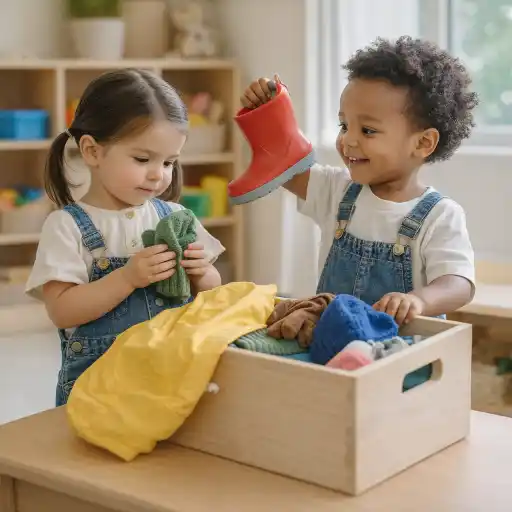
Autumn brings a familiar classroom mystery: a small mountain of hats, scarves, and mittens with no clear owners. Instead of treating the pile only as a housekeeping task, invite children to become detectives. A “Whose hat is this?” question gives preschoolers a real purpose for looking closely, comparing details, and discussing how they know two things might belong together.
The invitation also connects classroom learning to children’s lived experience. Clothing is familiar, seasonal, and linked to routines such as getting dressed and caring for belongings. A child may recognize a pattern, color, logo, or distinctive feature that adults overlook. Their observations deserve to be heard, while privacy and family preferences remain central.
Matching and sorting support early classification: children notice attributes, make a rule, and decide which items fit. Researchers and educators describe classification as a foundation for later mathematical thinking; playful, concrete materials make that thinking visible. Such an activity can also support #belonging when children feel their knowledge and contributions matter.
- Offer a meaningful reason to compare and group objects.
- Build vocabulary through words such as same, different, pair, pattern, and belong.
- Practice cooperation, turn-taking, and care for shared classroom materials.
- Keep the tone curious—not a test of who remembers each child’s belongings.
How can teachers prepare a safe, welcoming detective station?
Start with a quick adult check. Separate items that are wet, soiled, damaged, or unsafe; follow your program’s hygiene procedures before inviting children to handle anything. Remove or set aside belongings that should not be used for group exploration, and avoid sharing personal details or making public guesses about a family. If an item’s owner is uncertain, adults should manage its return discreetly.
Choose a small selection of clean, appropriate items or use photographs and classroom-made picture cards. Keep the station organized with a low tray or basket, a clear surface, and a few visual labels. For children who may mouth objects, avoid small accessories such as detachable buttons or clips. Supervise closely and consider allergies, sensory preferences, mobility, and the child’s ability to handle the materials safely.
Make the purpose visible: “We are noticing clues and thinking about which things might go together.” You can introduce the activity with simple sorting steps Buy Now $0.00 or complement it with matching and sorting practice Buy Now $2.00. These resources can help children explore comparison without turning real belongings into a guessing game.
- Use clean, suitable items or picture representations, and follow program hygiene and supervision practices.
- Offer a few pieces at a time; too many choices can make close observation harder.
- Provide a “not sure yet” space so children can pause rather than force a match.
- 🧺 Invite children to help arrange the station, with adult guidance and accessible materials.
What questions turn matching into early math and language?
The most productive prompts encourage children to describe their clues rather than seek an adult-approved answer. Begin with observation: “What do you notice about this hat?” Invite comparison: “How is it like this scarf? How is it different?” Then ask children to explain a possible connection: “What makes you think these might go together?” Give them time to look and respond in their own way.
Use precise, natural language as you listen. If a child says, “This one has lines,” you might add, “Yes, it has a striped pattern.” Useful words include pair, texture, size, color, label, pattern, category, and match. Children can speak, point, gesture, sign, draw, use a communication device, or share an idea in a home language. The goal is meaningful participation, not a particular verbal response.
Try prompts that keep the investigation open:
- “What clues could help us decide?”
- “Could these two items belong together for another reason?”
- “How might we sort the hats if we are not looking for owners?”
- “What did you notice that changed your mind?”
Children might group hats by color, size, texture, or style, then try a different rule. One object can fit more than one group depending on the question. This flexible thinking supports #reasoning and gives educators a natural opportunity to extend children’s vocabulary and confidence.
How can you adapt the activity for different learners?
Keep the central challenge—observing, comparing, and organizing—while adjusting the amount of material, the way information is presented, and how children can respond. A child who is new to sorting may benefit from two contrasting picture cards and a few familiar objects. Another child may be ready to sort by one feature and then reorganize the set by a second feature.
Use visual supports such as photos, symbols, or labeled baskets. If color is one clue, include another attribute so the task does not depend on color recognition alone. Offer larger items, nonslip trays, adapted tools, or a partner who moves pieces at a child’s direction when these supports make participation easier. Children who prefer not to touch clothing can work with photographs or point from a comfortable distance.
For multilingual learners, welcome clothing words in children’s home languages and invite families to share vocabulary if they wish. Pair spoken directions with gestures, models, and images. Keep the experience strengths-based: the aim is not to make every child complete the same number of matches, but to give each child a genuine opportunity to contribute.
- Start with a small number of familiar items and clear, visible clues.
- Offer multiple ways to communicate a match or sorting rule.
- Provide a quiet space or shorter turn for children who need less stimulation.
- For a challenge, invite children to invent a category or explain an exception.
Children’s sense of identity and connection is supported when adults recognize their perspectives and create opportunities to participate; Head Start’s guidance on identity and belonging offers a useful lens for this kind of responsive practice.
How can staff observe learning and avoid common pitfalls?
Observe the process, not simply whether a child identifies an owner. Notice what features the child attends to, whether they compare two objects, how they describe a possible relationship, and whether they revise a choice after discovering new information. A short, objective note may be more useful than a worksheet: “Sam noticed the two hats had matching stripes and explained the clue,” or “Ari sorted the scarves by texture, then reorganized them by length.”
Use those observations to plan a next step. If a child matched identical pictures, offer objects that share one feature but differ in others. If a child confidently sorts by color, ask whether the group can be reorganized by size or pattern. Preschool math learning is strengthened when teachers connect play, mathematical language, and thoughtful observation; a professional resource on guiding preschool mathematical understanding describes the value of recognizing children’s demonstrated thinking and planning from it.
Common pitfalls are easy to avoid with a little intention:
- Do not pressure children to identify an item’s owner or reveal private family information.
- Do not correct an unexpected grouping before asking what rule the child used.
- Avoid presenting every match as having only one possible explanation.
- Keep the activity hands-on and conversational rather than relying only on a worksheet.
Share observations with families respectfully and only as appropriate under program policy. If the activity connects to required documentation or training, state requirements vary - check your state licensing agency.
Conclusion: How can a fall lost-and-found become a learning invitation?
A fall lost-and-found can become a lively preschool investigation when providers make space for children to observe, compare, sort, and explain. Prepare a safe, manageable selection of materials, use open-ended prompts, make participation accessible, and protect each family’s privacy. The learning is in the children’s thinking—not in correctly guessing who owns every hat.
With a few thoughtful supports, an everyday pile of clothing can nurture early math, language, cooperation, and care for the classroom community. To build a stronger foundation for turning routines and play into meaningful math experiences, explore Math Foundations in Early Childhood Buy Now $16.00. You can also feature the Sort It! Two-Category Sorting Poster and Steps Buy Now $0.00, Woodland Camouflage Activity Pack Buy Now $2.00, Early Mathematics Through Play Buy Now $24.00, and No Such Thing as Boring Math Buy Now $24.00 as additional ways to support playful matching and sorting in your program.
- 45 Hour Child Growth and Development
- Many Colors, One Canvas: MD ECE Conference
- Engaging Families During a Pandemic
- Basic Health & Safety and Breastfeeding Awareness
- The ABCs of Behavior: Turning Challenges into Learning Opportunities
- Math Foundations in Early Childhood
- Texas Director Credential
- Spaces that Support Discovery
- Requisitos Para Ser Maestra Principal En Un Daycare: Lo Que Necesitas Para Empezar
- Cómo ser director de cuidado infantil en Maryland
- Proporciones de Cuidado Infantil y Tamaños de Grupo por Edad en Virginia (Guía Rápida para Centros y Hogares)
- Actividades de Otoño Fáciles para Preescolares esta Temporada
- Lista para Guardería en Casa en Texas: Cómo Iniciar una Guardería en el Hogar
- Cómo Ser Maestra de Preescolar en Illinois
- Cómo Ser Maestra de Preescolar en Wisconsin
- Cómo Ser Maestra de Preescolar en California
- Cómo Ser Maestra de Preescolar en Maryland
- Canciones, juegos y preguntas de círculo para niños
- Baby’s First Fall: Simple Ways to Explore the Season Through Play
- Too Wiggly to Sit? Fall Movement Activities Toddlers Will Love
- Crunch, Stomp, Scoop! Fall Activities Toddlers Can’t Resist
- Go on a Fall Hunt! Outdoor Learning Challenges for Preschoolers
- Can You Build a Leaf Bridge? Fall STEM Challenges for Pre-K
- Fall Detectives: 10 Questions Pre-K Kids Can Investigate This Season
- How Can Fall Art Leave Room for Children’s Ideas Beyond Matching Pumpkins?
- How Can Fall Sorting Mats Show Children That More Than One Answer Can Be Right?
- How Can Leaf Piles Become Preschoolers’ Next Great Story Adventure?
- How Can You Refresh Fall Learning Stations Without Buying New Materials?
