Introducing Japanese culture to young children can broaden their perspectives, build empathy, and support learning across multiple areas of development. This guide gives child care providers and directors practical, research-informed strategies that are classroom-ready, family-centered, culturally respectful, and developmentally appropriate. Readers will find step-by-step activity ideas, guidance for selecting safe materials, suggestions for inviting family and community voices, and vetted resources that help programs move beyond stereotypes or one-time celebrations. Educators can deepen this work through ChildCareEd’s self-paced online course From Play to Planning: Building Culturally Competent, Child-Centered Curriculum  Buy Now $55.00, which explores multiculturalism, culturally responsive curriculum planning, inclusive materials, and respect for children’s cultural identities. The online course Creating Environments that Nurture Growth and Community Buy Now $55.00 can also help providers create welcoming spaces that encourage belonging, meaningful relationships, and community connection. State requirements vary, so always check with your state licensing agency.
How can I weave Japanese culture into everyday classroom routines?
- 👋 Teach simple greetings and routines: add Konnichiwa or Ohayō as part of arrival songs or circle time and pair the phrase with gestures. Use songs and child-friendly music—many classic children’s tunes and dōyō are ideal; see examples in this overview of Japanese children’s songs for age-appropriate pieces.
- 🍱 Include a food culture moment: discuss school lunches and balanced meals via the Japanese kyūshoku model to talk about nutrition and community eating; a great primer is at Kids Web Japan and nutrition context at Kikkoman.
- 🎨 Make teaching visual: map Japan during geography time and display simple images of everyday life; Columbia University’s Asia for Educators collection offers elementary resources and images.
- 📚 Read and reflect: choose authentic picture books or Japanese-American children’s stories, and invite children to compare routines with their own.
Practical tip: embed one short Japanese language or cultural moment into daily schedules so children experience continuity and context rather than a one-off event. This approach aligns with multicultural curriculum strategies discussed at ChildCareEd (#cultures).
What hands-on #activities are developmentally appropriate and safe for young children?
- 🌸 Cherry blossom art: try fingertip stamping or straw-blown ink branches for a low-risk painting activity; lesson ideas are practical in this cherry blossom activity.
- 📝 Simple kana practice & haiku: offer large-format hiragana tracing sheets and short haiku templates (1-3 lines) for emergent writers — encourage expression rather than perfect form; see child-friendly language resources at Asia for Educators.
- 🧩 Sensory & manipulative stations:
- 🔹 Sensory tub with rice and chopstick practice (fine motor + culture). Inspiration: Independent Sensory Activities.
- 🔹 Wooden toys and stacking blocks to honor traditional materials; see examples of Japanese wooden toys and how they support imaginative play at From Japan Blog.
- ✂️ Origami & paper folding: use pre-cut, larger paper for toddlers and scaffold folds for preschoolers. Simple cranes and boats connect to storytelling; find family-friendly origami ideas at Kids World Travel Guide and at family blogs like the piri-piri lexicon.
- 🍱 Role play and dramatic play: add a wooden sushi set or market stall props for cooperative play (ensure pieces are not choking hazards). These materials relate to everyday Japanese life without stereotyping.
Safety note: supervise art with small parts, choose non-toxic materials, and adapt each activity for your children's ages. For more on turning household items into learning tools (Montessori-style), see Montessori Magic.
How do I teach respectfully and avoid common pitfalls?
- ✅ Center real voices: whenever possible, invite caregivers or community members to share stories, songs, or demonstrations. Family involvement is powerful—ChildCareEd emphasizes family and community partnerships in multicultural programming (Multicultural Games and Activities).
- ⚠️ Common mistakes and how to avoid them:
- 🔸 Mistake: presenting culture as a set of static “props.” Fix: frame activities as one perspective among many, show contemporary and historical views.
- 🔸 Mistake: using food or clothing only as spectacle. Fix: pair tastes or costumes with stories and context (why items matter and how families use them).
- 🔸 Mistake: relying on stereotypes. Fix: use primary resources, real-life images, and first-person accounts; avoid caricatures.
- 📣 Reflective practice: ask children questions like “How is this like your home?” and document responses to show growth in cultural awareness. This supports inclusive identity development as discussed in ChildCareEd’s work on culture and development (How Can Culture Affect A Child’s Development?).
- 📑 Policy & ethics: maintain accurate records of family consent for cultural activities that involve food, clothing, or religious elements; and remember state requirements vary - check your state licensing agency.
What festivals and calendar events are child-friendly to celebrate, and how?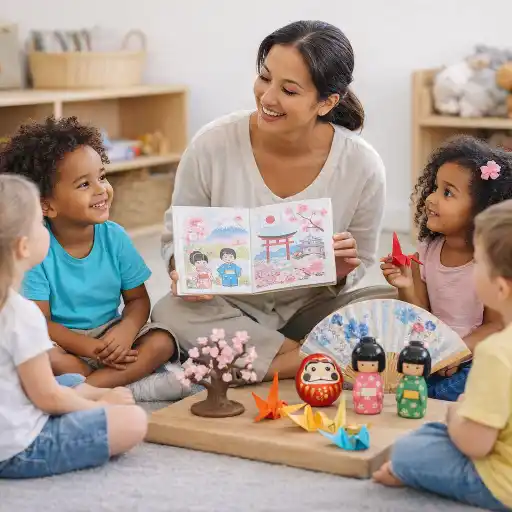
Introducing festivals provides rhythm and seasonal learning. Choose tactile, classroom-sized celebrations that focus on process rather than performance.
- 🌸 Hanami (Cherry Blossom): spring art, paper petal collages, and observational walks to notice changes in trees. Use the cherry blossom motif to teach seasons and sensory art—see hanami resources in the Asia for Educators collection.
- 🎎 Hina Matsuri (Girl’s Day): simple doll displays, paper crafts, and stories about family traditions. Child-size displays allow discussion of family variation; lesson ideas are listed among festival teaching resources like Japanese Teaching Ideas.
- 👹 Setsubun (Bean-throwing ritual): craft oni masks, talk about symbolic “driving out” of unwelcome things (use soft beans or paper balls indoors for safety). Boston Children’s Museum offers child-appropriate plans linked from many festival guides.
- 🎏 Kodomo no Hi (Children’s Day / Koinobori): make carp kites and discuss wishes for health and growth; lesson plans and craft templates are widely available (see Asia for Educators).
- 🕯️ Obon & seasonal remembrance: keep this reflective and low-key—focus on lantern-making and remembering family stories rather than religious teaching, and invite families who observe Obon to opt in.
For overviews of many Japanese festivals, the travel-oriented guide at Japan Guide - Matsuri is a clear reference; adapt activities to be inclusive and age-appropriate.
How does exploring Japanese culture support child development and family engagement?
Exploring another culture is not just “fun” — it tangibly supports cognitive, social-emotional, and family-engagement outcomes:
- Developmental gains:
- 🔹 Language: multilingual exposure supports emergent literacy and phonological awareness (even simple greetings help oral language development).
- 🔹 Motor and sensory: chopstick practice, origami folds, and wooden toy play refine fine-motor coordination and bilateral integration.
- 🔹 Executive function & creativity: music, dance, and role-play support self-regulation and flexible thinking.
- Family engagement & identity: inviting families to share traditions strengthens relationships and is linked to better learning outcomes—research on parental involvement in Japan shows how parental aspirations and school–family communication shape children’s educational experiences (Holloway et al. - parental involvement in Japan).
- Health & nutrition learning: discussing Washoku and school-lunch practices (kyūshoku) opens conversations about balanced meals and community responsibility around food (Kids Web Japan, Kikkoman).
Program-level idea: create a short, visible unit on Japan that includes 1) a daily morning greeting in Japanese, 2) two hands-on centers (art + sensory), and 3) a family-sharing event. Document children’s responses and display work to show authentic learning.
FAQ — quick answers for busy providers
- Q: How long should a cultural unit last? A: 1–3 weeks of light integration (daily greetings + 2–3 thematic centers) keeps interest high and makes the learning manageable.
- Q: Are there allergy or religious concerns with food activities? A: Yes—always get family consent and plan alternatives. State requirements vary - check your state licensing agency.
- Q: How do I assess cultural learning? A: Use observational notes: children’s vocabulary growth, questions asked, and participation in centers are good indicators.
- Q: Can I invite families to contribute without putting pressure on them? A: Offer multiple low-stakes ways to participate (photos, recipes, short videos, or classroom visits) and respect privacy choices.
- Q: Where can I find accurate teaching materials? A: Start with museum and education sites (e.g., Asia for Educators), national resources (e.g., Kids Web Japan), and vetted childcare professional content such as ChildCareEd.
Conclusion
Exploring Japanese culture with young children can be joyful, educational, and deeply respectful when planned intentionally. Prioritize everyday routines, hands-on centers, family partnerships, and reflective practice. Keep materials safe, age-appropriate, and always contextualized—this avoids tokenism and supports sustained learning. For curriculum planning, consider short units that scaffold daily exposure rather than single events. Your work in creating culturally responsive programs plants seeds for empathy, curiosity, and lifelong learning in children and families.
Why it matters: small, repeated moments make cultural learning visible and routine. A consistent approach helps your #preschoolers develop familiarity without exoticizing a culture. Hands-on learning fosters language, fine motor skills, and social interaction. Choose materials that are non-toxic, age-appropriate, and supervised. Here are classroom-ready invitations to learn: Why it matters: respectful representation prevents tokenism and supports genuine intercultural understanding.
- 45 Hour Child Growth and Development
- Roots & Resilience: Understanding What Shapes a Child
- 45 Hour Preschool Methods and Materials
- Bienvenido! Welcoming All Families
- Texas Director Credential
- Building Bridges for Dual Language Learners
- Montessori Cultural Activities: Exploring the World Through Play and Learning
- Engaging Families for Child Success
- Bridging Cultures: Family Communication & Collaboration
- Tiny Tots, Big Learning: Crafting Curriculums for the Littlest Learners!
- CDA Certification en Español: Recursos y Consejos para Educadores Bilingües
- 🔍 ¿Qué ves cuando observas a un niño aprender?
- 🪁¿Cómo puede el juego apoyar de manera poderosa a los niños con autismo?🧩
- 💛🧩 ¿Cómo puedo hacer que mi enseñanza sea inclusiva para los niños con autismo?
- 🌎 ¿Cómo apoyo a las familias diversas mientras honro su cultura y valores? 💜
- 🤯 ¿Por qué este niño está teniendo un comportamiento difícil de repente?
- Recursos en Español sobre el Sueño Seguro del Bebé
- 10 Ejemplos de Cómo la Cultura Influye en el Desarrollo Infantil
- Proporciones de Cuidado Infantil y Tamaños de Grupo por Edad en Maryland (Guía Rápida para Centros y Hogares)
- Proporciones de Cuidado Infantil y Tamaños de Grupo por Edad en Nueva Jersey (Guía Rápida para Centros y Hogares)
- Proporciones de Cuidado Infantil y Tamaños de Grupo por Edad en Virginia (Guía Rápida para Centros y Hogares)
- Cómo Celebrar el Día Nacional del Kindergarten
- Lista para Guardería en Casa en Illinois: Cómo Iniciar una Guardería en el Hogar
- Apoyo en Preescolar para Retrasos del Habla: Estrategias Simples que Ayudan
- Las Mejores Ideas de Excursiones para Guarderías en Texas
- Celebrando la amistad en el cuidado infantil durante el Día de los Mejores Amigos
- Canciones, juegos y preguntas de círculo para niños
- How can childcare programs meaningfully explore Japanese culture with young children?
