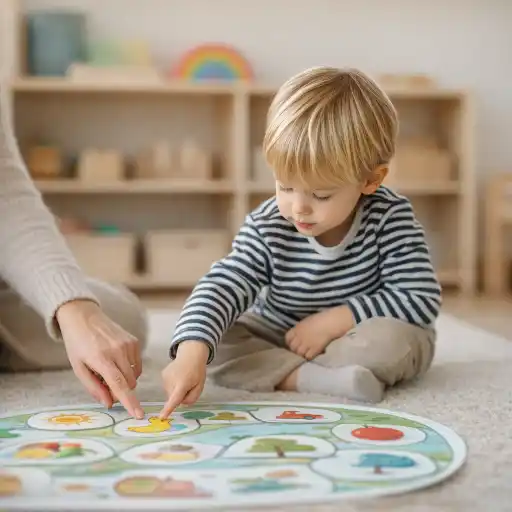
A child looks toward the picture you point to—but what guided their attention: the image, your gesture, your words, or the combination? Learning to distinguish these cues can sharpen your classroom observations and help you plan more responsive interactions. Explore Observing & Assessing in Child Care  Buy Now $16.00 to build practical skills in documenting children’s growth and using observations to shape learning experiences.
Why does it matter which cue the child follows?
In a busy classroom, an adult points to a picture and says, “Look at the puppy!” A child turns toward the page. It is tempting to record that the child followed the point, understood the word, or shared attention. Yet several cues arrived at once: the adult’s finger, voice, gaze, and the colorful picture. A careful observation asks what the child actually responded to, rather than treating the moment as proof of a single skill.
This distinction matters because visual attention, gesture-following, receptive language, and joint attention are related but not identical. Studies of infants show that attention-following develops gradually and that results can differ depending on how researchers define and test the behavior. Dynamic pointing may prompt a shift of visual attention in very young infants, while more complex tasks ask a child to identify a specific target among alternatives. Development also varies across children and contexts.
Separating cues helps educators avoid overinterpreting one moment. It can reveal whether a picture is accessible, whether a spoken direction helps, or whether a child is beginning to use another person’s gesture as meaningful information. These details support thoughtful teaching—not labels or diagnoses. Purposeful observation can guide adjustments to materials and interactions, as NAEYC’s guidance on using observation to guide teaching emphasizes.
What is the difference between following a picture and following a point?
A picture is a visual target: a photograph, drawing, symbol, or object in a book. A pointing finger is an adult gesture that indicates a location or referent. In an everyday interaction, children may respond to either one—or to other signals delivered at the same time. A child who reaches for a bright picture may be attracted to its color; a child who turns toward the adult’s hand may be tracking its movement without yet locating the intended item.
Researchers use different definitions of attention-following. Some measure whether a child shifts eyes in the same direction as a moving face or hand. Others require the child to look toward a particular target indicated by another person. These are not interchangeable tasks. The research on the gradual emergence of gaze- and point-following in infancy highlights how developmental conclusions depend partly on the cue, setup, and response being measured.
In child care, the goal is not to reproduce a laboratory test. It is to notice what supports an individual child’s participation in natural routines. Try a brief, low-pressure comparison:
- Place two familiar pictures at a comfortable distance and make sure both are easy to see.
- On one opportunity, name a picture without pointing; on another, point without naming it.
- Observe the child’s first look, reach, vocalization, or other response before adding another cue.
- Repeat at a different time or in another familiar activity rather than drawing conclusions from one trial.
Keep the interaction playful. Do not withhold a desired object or make the child perform on demand. The aim is to understand how the child communicates and attends—not to test compliance.
How can educators observe the cues without leading the child?
When adults point, speak, lean, look toward a target, and repeat directions all at once, it becomes difficult to know which cue influenced the child. A useful observation reduces unnecessary cueing while preserving a warm, natural exchange. First decide on a small question: “Does the child look toward the named picture when I do not point?” or “Does the child notice the point when I pause before naming the object?”
Record what can be seen and heard, including the context. For example: “During book time, the educator pointed to a red ball and said, ‘Where is the ball?’ Noor looked at the educator’s hand, then touched the ball picture after the educator repeated the word.” This is more informative than “Noor understands pointing,” because it distinguishes the sequence without claiming what it means.
Try the following practical steps:
- Use a familiar book, photo board, or play scene that interests the child.
- Offer one cue at a time when practical: picture, gesture, or spoken label.
- Pause long enough for the child to process and respond; avoid immediately repeating or adding prompts.
- Note whether the child looks, points, reaches, moves closer, vocalizes, or responds in another way.
- Observe across different routines, adults, and materials to see whether a pattern emerges.
Be attentive to your own position. If you point close to the child’s face or block the picture with your hand, the setup may change what the child can see. A neutral, comfortable arrangement and an unhurried pace make observations easier to interpret. The Head Start approach to observing to understand children’s goals and intentions encourages educators to watch, ask what a behavior might communicate, and adapt support.
How do pictures, words, gestures, and context work together?
Children make sense of communication through more than one channel. A picture can make a reference concrete; an adult’s point can direct attention; spoken language can label or describe the object; and shared interest can turn the moment into a joint-attention exchange. These cues may reinforce one another, but their combination can also make it difficult to identify what helped most.
That is why ordinary classroom interactions are valuable for observation. During story time, an educator might point to a boat, look toward the child, and say, “I see a boat on the water.” The child may look at the picture, imitate the adult’s point, make a sound, or turn to the adult. Each response offers information. The Victorian Government’s teaching demonstration on gesture and joint attention illustrates how educators can model eye gaze, gestures, and language, then respond to children’s verbal and nonverbal communication.
Use the child’s interests to create natural opportunities:
- During a shared book, pause beside a picture the child has already noticed.
- In play, point to a familiar toy and describe what is happening without demanding a response.
- Offer meaningful photos or simple visuals for routines, choices, and transitions.
- Follow the child’s own gaze or gesture, then add a short, relevant comment.
Visual supports can clarify expectations and make information more accessible, particularly when verbal instructions alone are difficult to understand. Head Start’s resource on visual supports describes ways pictures and other visuals can support children’s engagement across activities. These supports should complement responsive relationships, not replace interaction or be treated as a one-size-fits-all solution.
How can observation notes be objective and useful?
Good documentation captures an event before interpreting it. Write what the child did, what the adult offered, what happened next, and the relevant setting. Avoid turning a brief response into a broad conclusion such as “doesn’t understand pictures” or “always follows directions.” A single moment is a snapshot; repeated observations across contexts provide a stronger basis for planning.
The NAEYC guidance on observing, documenting, and assessing children’s development and learning stresses that assessment should be ongoing, purposeful, and responsive to children’s development, language, culture, and experiences. That principle is especially relevant when watching attention and communication: a child may respond through movement, gesture, home-language words, signs, or a period of looking before acting.
A simple visual-cue observation sheet can include:
- Date, time, activity, materials, and people present.
- The adult cue: picture, point, words, gaze, or a combination.
- The child’s observable response and its timing, using direct descriptions.
- Any environmental or contextual factors, such as distance, noise, or familiarity.
- A separate reflection: what might this suggest, and what should we observe next?
For example, record “looked at the adult’s hand, then turned toward the book’s animal picture” rather than “understood the gesture.” Consider whether lighting, visual access, hearing, language familiarity, fatigue, interest, or the adult’s timing might have influenced the moment. Discuss patterns with colleagues and families respectfully, recognizing that their knowledge adds context. Observation can inform responsive teaching, but it is not a diagnosis or a substitute for formal screening or evaluation.
What common pitfalls should providers avoid?
A common pitfall is adding more prompts as soon as a child hesitates. Repeating the child’s name, pointing more emphatically, moving the picture closer, and asking the question again may help the child respond, but it makes the original cue hard to identify. If the child does not respond, pause and consider whether the child needs more time, a clearer visual, a different position, or simply a different activity.
Another mistake is treating one response as evidence of a stable ability or concern. Attention varies with interest, energy, sensory conditions, familiarity, and the relationship between child and adult. Developmental skills also emerge unevenly. The CDC’s 30-month developmental milestones include naming pictures in a book when an adult points and asks, but milestone information is a monitoring resource—not a pass/fail test or diagnosis. If a concern persists, share specific observations with the family and follow program procedures for discussing developmental screening with appropriate professionals.
- Do not equate looking in the same direction with understanding the adult’s intention.
- Do not assume that a child who misses a point cannot learn from pictures or language.
- Do not compare children without considering age, communication style, culture, and context.
- Do not let documentation interfere with active supervision or a responsive interaction.
- 🌱 Notice strengths too: interest, persistence, a self-initiated point, or an attempt to share attention.
When observations raise questions, gather information over time and partner with families rather than applying a label. State requirements vary - check your state licensing agency.
Conclusion: How can we tell what guided the child’s attention?
We cannot reliably tell from one glance whether a child followed a picture, a pointing finger, spoken language, or the combined interaction. The most useful approach is to observe deliberately: offer manageable opportunities, separate cues when appropriate, allow time to respond, and document the child’s observable actions without overclaiming what they mean.
Use what you learn to make the next interaction more welcoming and accessible. A clear picture, an unhurried point, a brief description, or a child-selected book may help a child join shared attention in their own way. Revisit the question across routines and conversations, and use patterns to inform teaching and family partnership—not to label a child. A thoughtful observation sheet can help providers notice #pictures, #gestures, #attention, #communication, and #observation as connected parts of everyday learning.
For deeper professional learning, these English-language ChildCareEd courses can extend your practice:
- Observing & Assessing in Child Care Buy Now $16.00 — practical foundations for observation, documentation, and assessment.
- Tracking Progress, Shaping Futures: Observation & Assessment Skills Buy Now $55.00 — explore developmentally appropriate observation methods and how to use evidence for goals.
- Assessing through Observation Buy Now $35.00 — learn about observation strategies and assessment methods.
- Preschool Assessments & Observations Buy Now $24.00 — focus on objective observation and individual learning needs in preschool.
- Language Development in Early Childhood Buy Now $16.00 — strengthen knowledge of verbal and nonverbal communication development.
- 45 Hour Child Growth and Development
- 45 Hour Preschool Methods and Materials
- CDA Family Child Care Credential with Portfolio Review
- CDA Bridge Bundle: Preschool
- 45 Hour School Age Methods and Materials
- CDA Bridge Bundle: Family Child Care
- CDA Bridge Bundle: Infant/Toddler
- Texas Director Credential
- Every Moment Matters: Schedules and Transitions
- CDA Certification en Español: Recursos y Consejos para Educadores Bilingües
- Requisitos Para Ser Maestra Principal En Un Daycare: Lo Que Necesitas Para Empezar
- ¿Cómo solicito la licencia para una guardería en California?
- Regulaciones de Licenciamiento de Cuidado Infantil en California para Centros y Hogares de Cuidado Infantil Familiar
- Cómo Ser Maestra de Preescolar en Illinois
- Kindergarten Songs for Circle Time: 15 Sing-and-Move Ideas That Sneak in Learning
- How Can Child Care Providers Support Language Development in Young Children?
- How Do Clip Cards Build Fine Motor Strength and Focus?
- How Can Recipe Sequences Build Comprehension and Oral Language in Preschool?
- What Should Effective Beginning-Sound Practice Include?
- How Can You Increase Maze Difficulty Without Frustrating Young Learners?
- How Can Providers Connect Letter Formation, Sound, and Vocabulary in Phonics Instruction?
- How Can Child Care Providers Move Beyond Shape Names to Attributes and Comparisons?
- How Can Tracing and Painting Build Multisensory Prewriting Skills?
- How Can Spring-Themed Pencil-Control Activities Support Preschoolers’ Pre-Writing Skills?
- How Can Reading Games Build Wildlife Vocabulary in Early Childhood?
- How Can Valentine’s Day Problem-Solving Activities Help Preschoolers Learn?
- How Can You Teach a New Word So Children Use It Beyond the Activity?
- Why Can a Child Match a Shape but Struggle to Rebuild It with Pieces?
- Is the Child Following the Picture or Your Pointing Finger?
