When children can identify, locate, and return classroom supplies, everyday routines become opportunities to build confidence, participation, and independence. ChildCareEd’s A Great Place for Education Includes All ONLINE  Buy Now $24.00 offers relevant learning on inclusion and classroom supports; explore the course to strengthen your practical understanding of how to make materials more accessible for children with diverse needs. Keep reading for classroom-ready strategies you can begin adapting today.
Why does finding classroom supplies matter for children’s independence?
Finding a supply is a small task with a meaningful chain of skills behind it: a child notices what is needed, identifies the item, navigates to its location, retrieves it safely, uses it, and returns it. Repeated opportunities to do these steps support problem-solving, memory, language, motor planning, and a sense of responsibility. They also reduce unnecessary waiting and help children enter play or learning activities with more agency.
When a child cannot find an item, the difficulty may not reflect unwillingness or ability. The container may be hard to open, the label unclear, the shelf unreachable, or the storage location inconsistent. Treat confusion as useful information about the environment and teaching process. NAEYC’s guidance on individuality and inclusive practices emphasizes planning for children’s varied strengths, experiences, and needs so every child can participate and belong.
Clear organization benefits the whole group. Predictable locations make cleanup more manageable, give children concrete language for materials and categories, and invite peers to help one another. The goal is not to expect every child to work without support; it is to create a classroom where support, practice, and growing independence can coexist.
- Think of access as part of participation, not an extra task for one child.
- Notice whether children can find supplies during authentic play and routines.
- Build from what children already recognize, enjoy, and communicate.
How can you organize supplies so children can recognize and reach them?
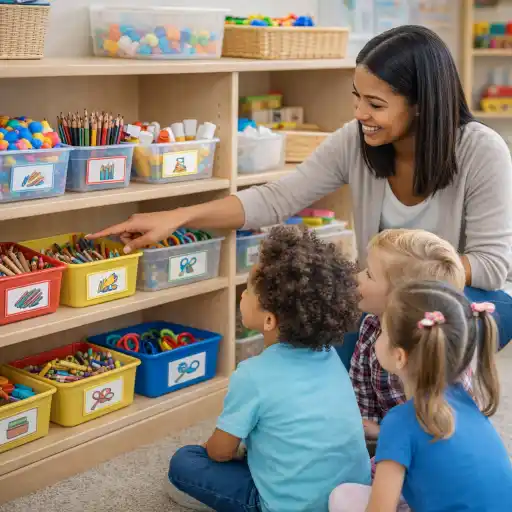
Start with the physical “home” for each frequently used material. Group items by purpose or learning area, store them close to where they are used, and keep locations consistent. Low, stable shelves and open containers let children see choices and reach what is appropriate for them. Shallow baskets can make contents easier to notice than deep, crowded bins.
Labels can connect a visual or tactile cue with an item’s name and storage place. Use a clear photograph of the actual contents when possible, paired with a short word. Keep the label close to the matching bin or shelf, at a height children can see or explore. A child who benefits from other access formats may use high-contrast print, an object cue, a tactile marker, braille, or spoken description. Invite family members and specialists to share what formats are familiar and useful to the child.
- Choose a simple, consistent picture-and-word system.
- Use distinct tactile cues when appropriate, and check that the child can notice and tell them apart.
- Keep pathways clear and storage secure; place heavy or unsafe items out of children’s reach.
- ✨ Review labels and locations after rotating materials or changing the room arrangement.
Offer a manageable selection rather than filling every shelf. A focused display makes important supplies easier to distinguish and gives children room to practice choosing. Make sure materials remain safe, age-appropriate, and accessible within your supervision plan.
How can educators explicitly teach children to identify and locate materials?
A label is a helpful cue, but children learn what it means through interaction. Introduce a supply during the activity where it is used. Name it, show how it matches the picture or symbol on its container, and model how to retrieve and return it. For example: “These are the paintbrushes. Let’s match them to the brush picture, then carry the cup to the art table.” Use simple, concrete language and allow time for children to look, listen, touch, point, or respond in their preferred way.
Teach one or two steps at a time. First, invite the child to identify a familiar object. Next, help them find its storage place. Later, practice returning it after use. A calm, repeated routine is more supportive than asking a child to complete the whole sequence during a rushed transition. The Back-to-School Sorting: Belongs at School or Not? Buy Now $1.49 resource offers a playful sorting activity with school-related and silly non-school items. Use it as a conversation starter: children can name, compare, and sort familiar objects, then connect those categories to where classroom supplies are stored.
- Model your thinking aloud: “I need the glue, so I’ll look for the picture on the art shelf.”
- Invite children to match, point, retrieve, or return materials without requiring a spoken answer.
- Give specific feedback: “You checked the photo and found the marker basket.”
- Let children help make or update labels with drawings, photographs, or dictated words.
Keep the experience playful and authentic. Children may first recognize a bin by its photograph, color, place, or texture before understanding its printed word. Each useful strategy is a foundation for more independent participation.
How can inclusive supports help every child use classroom supplies?
Inclusive organization begins by asking what makes materials easy or difficult for individual children to access. Consider vision, mobility, motor skills, sensory preferences, communication, language, and developmental experience. A child may need a larger picture, high contrast, a container that opens easily, extra processing time, an object cue, or a brief spoken description. These adjustments should be guided by observation and, when appropriate, collaboration with families and qualified specialists.
Offer multiple ways to recognize and request supplies. Children may use words, gestures, pictures, communication devices, home languages, or a familiar object. Pairing labels with clear spoken names and real materials can reinforce meaning without insisting that every child respond in the same way. Keep commonly used items within reach whenever safe and appropriate, and preserve a clear route between centers and storage.
Predictability can matter as much as the label itself. Keep the shelf and its contents in their established locations. If a change is needed, let children know, show them the new arrangement, and offer time to explore it. NAEYC’s inclusion resources describe inclusion as a planned, collaborative practice; accessible materials are one practical way to support access and participation in the shared classroom community.
- Ask before providing physical assistance; use the least intrusive prompt that helps.
- Offer a choice of two or three useful supplies when too many options feel overwhelming.
- Coordinate strategies among classroom staff so cues and expectations stay consistent.
- Keep individual supports respectful and integrated into shared routines whenever possible.
How can you build supply-finding into play, cleanup, and daily routines?
Children are more likely to use an organization system when it has a clear purpose in their day. During art, invite a child to find a brush by checking the photo label. In blocks, ask where the vehicles belong before beginning a new build. During cleanup, turn matching supplies to their pictured “homes” into a shared job rather than a test. Predictable routines allow children to rehearse the same skills in meaningful settings; NAEYC’s daily routines and transitions resources provide additional context for making classroom sequences supportive.
Use concise prompts that point children toward a strategy: “Where could we look?” “What picture matches this?” or “What do we need for painting?” Pause before stepping in so children have time to act. If they need help, model the next step, then give them a chance to continue. Adult support is still essential for safety, emotional reassurance, and adapting the task; independence is not the same as being left alone.
Observe the routine and adjust the system when it is not working. Are bins too full? Are several kinds of materials mixed together? Are labels difficult to see or symbols too similar? Are children being asked to find items before they have had a chance to practice? Addressing the setup can be more effective than repeating directions or correcting children.
- Start with one high-use area, such as art supplies or books, and teach that system first.
- Give a transition warning when cleanup begins and assign manageable helper roles.
- After play, invite children to return supplies and check that the area is ready for the next group.
- Share useful strategies among staff and families, while respecting each child’s preferences.
Conclusion: What is the first step toward helping children find supplies?
To help children recognize and find classroom supplies, make the storage system visible, predictable, reachable, and responsive to individual needs. Pair materials with clear cues, teach children how to use those cues in real activities, and offer repeated opportunities to retrieve and return items. These everyday experiences strengthen language, problem-solving, participation, and confidence.
Begin with one shelf or center. Choose a few frequently used supplies, place them in consistent homes, add appropriate picture, word, or tactile cues, and model the routine. Then watch what children do: which cues work, where they pause, and what support helps them participate. Refine the environment rather than interpreting every struggle as a child’s failure. State requirements vary - check your state licensing agency when changes involve safety, access, or classroom setup. A thoughtful system helps answer the central question: how can children recognize and find supplies? By designing for access and teaching the steps with patience, providers make independence a shared, achievable part of classroom life.
Additional ChildCareEd courses for professional learning
- Inclusive Lessons for Preschoolers Buy Now $16.00 — explore ways to adapt activities and materials so more children can participate.
- Building Equity: Inclusionary Practices in Preschool Buy Now $10.00 — develop practical inclusive approaches for preschool settings.
- Classroom Setup for Child Care Buy Now $24.00 — consider how room arrangement can support safe, welcoming participation.
- Moving About the Classroom: Effective Transitions for Everyday
- CDA Home Visitor Subject Area 3 Part 3 Birth to 5
- Teacher-Child Interactions for Stronger CLASS® Outcomes
- CDA Home Visitor Subject Area 2 Part 3 Birth to 5
- Pediatric RSV First Aid & CPR/AED
- CDA Bridge Bundle: Family Child Care without Portfolio Review
- CDA Bridge Bundle: Infant/Toddler without Portfolio Review
- Sensitive Periods in Montessori: Guiding Natural Learning
- Texas Director Credential
- A Great Place for Education Includes All ONLINE
- First Aid and CPR
- First Aid and CPR
- CDA Certification en Español: Recursos y Consejos para Educadores Bilingües
- Celebrating Teachers
- 💛🧩 ¿Cómo puedo hacer que mi enseñanza sea inclusiva para los niños con autismo?
- Recursos en Español sobre el Sueño Seguro del Bebé
- 10 Ejemplos de Cómo la Cultura Influye en el Desarrollo Infantil
- Proporciones de Cuidado Infantil y Tamaños de Grupo por Edad en Maryland (Guía Rápida para Centros y Hogares)
- Proporciones de Cuidado Infantil y Tamaños de Grupo por Edad en Nueva Jersey (Guía Rápida para Centros y Hogares)
- Proporciones de Cuidado Infantil y Tamaños de Grupo por Edad en Virginia (Guía Rápida para Centros y Hogares)
- Retraso del Habla en la Guardería: Cómo Pueden Ayudar los Proveedores
- Cómo Trabajar en el Cuidado Infantil en Carolina del Norte: Requisitos y Pasos
- Capacitación CDA gratuita en Illinois
- Celebrando la amistad en el cuidado infantil durante el Día de los Mejores Amigos
- Canciones, juegos y preguntas de círculo para niños
- Child Care Administration Course: Are You Ready to Manage Adults, Not Just Classrooms?
- Pediatric First Aid for Teachers: Blended or In-Person—Which Should You Choose?
- ¿Todos los niños deben participar en el tiempo de círculo?
- How Can Infant Care Routines Become Everyday Learning Opportunities?
- How Can You Help Children Recognize and Find Classroom Supplies?
