A picture label can do more than show where the blocks belong—it can spark a conversation about what a child notices, imagines, and knows. Extend that same approach to the Community Helpers at Work Buy Now $1.49 matching activity by inviting children to talk about the people, vehicles, and workplaces pictured and connect them to experiences in their own lives. Listening to their ideas and following up on their comments can turn a simple picture into a shared conversation. For more ways to support these exchanges, explore ChildCareEd’s Language Development in Early Childhood  Buy Now $16.00, which offers strategies for encouraging verbal and nonverbal communication in your classroom.
Why can a simple picture label invite meaningful talk?
Preschoolers encounter picture labels as concrete signs: a photograph of a paintbrush beside the word “brush,” or an image of a book on a library basket. These pairings give children a visible point of reference. When an educator notices the child looking, pointing, or reaching toward the label and responds with interest, an organizing cue can become a shared moment of attention.
Back-and-forth conversation supports more than vocabulary. It gives children opportunities to express ideas, practice listening, connect concepts, and build relationships with adults and peers. A label’s image can also help children participate when they are still developing spoken language, communicating through gestures, signs, or other supports.
Labels are most useful when they connect to real classroom purposes. A child may recognize a picture of a mixing bowl, find it in the kitchen play area, and begin explaining what they plan to make. The printed word becomes meaningful because it is linked to an object, an action, and a child’s own intention. As NAEYC’s guidance on conversations with children emphasizes, children’s work and classroom materials can give educators authentic openings for discussion.
- Use the child’s attention as your cue rather than interrupting play to deliver a lesson.
- Link the picture, printed word, real object, and child’s current activity.
- Recognize that a glance, point, gesture, sign, or spoken word can all begin an exchange.
How can educators move from naming to a genuine exchange?
A label can prompt more than “What is this?” Start with a comment or an open invitation that makes room for the child’s thinking. For example, point to a picture of a basket of pretend fruit and say, “I see apples and oranges here. What might you make with them?” The child might answer with a word, a phrase, a gesture, or a story. Each response offers a path for the next turn.
Try this simple rhythm: notice, invite, listen, and extend. First, notice what the child is looking at or doing. Then offer one accessible prompt, pause long enough for a response, and listen without rushing to fill the silence. Finally, respond to the child’s meaning and add a useful detail.
- Notice: “You found the picture of the cars.”
- Invite: “Where do you think the cars could go?”
- Listen: Give the child time to speak, point, sign, or act.
- Extend: “You’re making a road for the blue car to drive under the bridge.”
Open-ended prompts such as “Tell me about it,” “What else do you notice?” and “How did you decide?” can encourage richer responses, as the NAEYC resource on open-ended questions illustrates. Keep questions conversational, not rapid-fire. One thoughtful prompt followed by attentive listening is usually more inviting than a string of questions.
What kinds of prompts help preschoolers think and talk?
Choose prompts that fit the child’s language, interest, and the moment. Some children are ready to explain or imagine; others may benefit from a concrete choice or a prompt that asks them to name what they see. Different question types all have value. Remembering and describing can provide a helpful foundation for predicting, comparing, explaining, and creating.
With a label showing a garden trowel, for instance, begin with “What do you see?” If the child names the tool, you might ask, “What could we use it for?” Later, after the child has tried it in the garden or sensory area, invite reflection: “What changed when you moved the soil?” This progression links words to experience without expecting every child to respond at the same level or in the same way.
- Name and notice: “What do you see in this picture?”
- Describe: “Tell me about the materials in this basket.”
- Connect: “Where have you seen something like this before?”
- Predict: “What might happen if we use the bigger block?”
- Imagine: “What else could this box become in your play?”
Use prompts as invitations, not tests. If a child does not answer, model a response, offer a choice, or simply describe what is happening. An educator might say, “I see a round red ball. You’re rolling it to Mateo.” This provides useful language while leaving the child free to join in. The range of question types described in NAEYC’s conversation guidance can help teachers vary prompts and follow children’s ideas.
How can educators expand a child’s response without taking over?
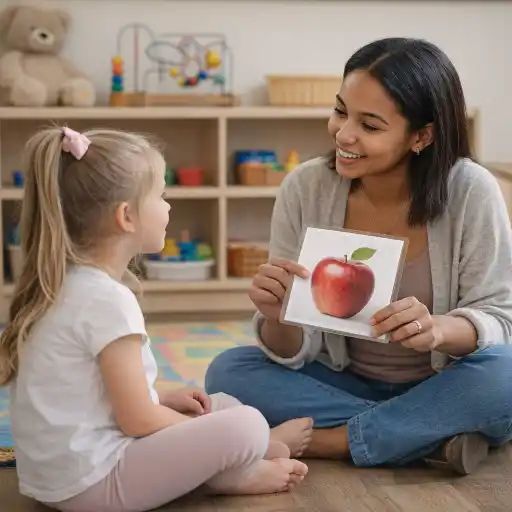
When a child responds, build on the idea rather than correcting or replacing it. If a child points to the photo and says “dog,” an educator might reply, “Yes, a small brown dog. It’s sitting beside the bed.” This expansion affirms the child’s contribution and models a fuller phrase. If the child says “dog sleeping,” the educator can respond, “The dog is sleeping on its soft blanket.”
Then give the child another chance to contribute. A follow-up such as “What do you think the dog will do when it wakes up?” encourages another conversational turn. The adult is not trying to elicit a particular answer; the purpose is to sustain an exchange around something meaningful to the child.
Rich conversation includes adult language, child talk, and meaningful feedback. Research summarized in Let Children Talk: Strategies to Foster Early Language and Vocabulary Development through Conversation highlights modeling rich language, open-ended prompts, and responsive feedback as useful components of extended exchanges.
- Repeat the child’s key word or idea, then add a relevant descriptor, action, or relationship.
- Respond to the meaning, even when the child’s speech is still emerging or difficult to understand.
- Pause after your response so the child has space to continue, change direction, or simply return to play.
- Accept speech, gesture, signs, home-language words, and communication devices as meaningful contributions.
A useful rule of thumb is to add just enough language to enrich the moment, not so much that the adult takes over. Keep the exchange collaborative and enjoyable.
How can labels support multilingual children and different communication styles?
Picture labels can make classroom information more accessible, but they should reflect the children who use the room. When appropriate, pair the picture and English word with a home-language word, and ask families for help with familiar terms and accurate pronunciations. A child may identify the object in one language, combine languages, point, or use a communication system; each mode can contribute to the conversation.
Labels also provide a natural chance to hear and use words across routines. If a child points to a labeled cup at snack, an educator can name it, connect it to the child’s action, and wait: “You found the cup. Would you like the blue cup or the green one?” Visuals, objects, and gestures support understanding while allowing the child to participate in a way that feels comfortable. Head Start’s guidance on engaging children in conversations recommends honoring children’s home languages and individual communication needs.
- Ask families which words, images, or objects feel familiar and meaningful to their child.
- Use real photographs or clear illustrations that children can match to classroom materials.
- Allow additional response time and offer choices when open prompts feel too demanding.
- For children who use augmentative or alternative communication, include accessible symbols and communication tools in daily interactions.
Research on classroom labels in dual-language settings describes opportunities to connect spoken and written language across languages when words are used purposefully throughout the day (Classroom Labels That Young Children Can Use). The intention is not to make every label a bilingual lesson; it is to help children see that their language and knowledge belong in the classroom.
How can teams make picture-label conversations part of the day?
Conversation does not require a separate activity or a perfectly quiet classroom. Educators can weave brief exchanges into arrival, center play, cleanup, snack, and transitions. Choose a few labels children use often, place them at a child’s eye level, and make sure images accurately represent the materials. Then look for natural moments when a child pauses, points, chooses, or starts using an item.
Teams can support consistency by agreeing on a few shared practices: follow children’s attention, use comments as well as questions, allow wait time, and extend a child’s idea without demanding repetition. Directors can model these interactions during classroom visits and encourage staff to share examples that felt successful. Small, steady changes fit into busy routines more easily than a new scripted lesson.
- At arrival: “Your picture is on this cubby. What did you bring in your backpack today?”
- During block play: “The blocks have their own picture. What are you building with them?”
- At cleanup: “You matched the puzzle to its picture. Where should the animals go?”
- At snack: “You chose the cup label. What would you like to pour into it?”
Watch for signs of engagement—not just spoken answers. A child may point, bring an object to you, add an idea to the play, or return to the label later. Avoid common pitfalls such as turning each label into a quiz, expecting children to answer immediately, or correcting every word. If adapting the classroom environment or formal practices, state requirements vary - check your state licensing agency.
Conclusion: How does a picture label become a real conversation?
A picture label becomes a real conversation when an educator uses it to notice what matters to a child, invite a contribution, listen responsively, and build on the child’s meaning. The label offers a shared focus; the relationship and back-and-forth exchange make the moment valuable.
Start small: choose one familiar label, connect it to a real object or activity, ask one inviting question or make an observation, and give the child time. Expand a response naturally, welcome different communication modes and languages, and let the conversation end when the child is ready. Repeated across ordinary classroom routines, these brief moments can make print meaningful and help preschoolers feel that their ideas are worth hearing.
Explore five relevant ChildCareEd courses
- Language Development in Early Childhood Buy Now $16.00 — strategies for supporting verbal and nonverbal communication.
- Classroom Tools for Emergent Literacy Buy Now $16.00 — includes labeling and other emergent literacy practices.
- Building Vocabulary Buy Now $16.00 — approaches to strengthening young children’s word knowledge.
- Building Bridges for Dual Language Learners Buy Now $16.00 — practical support for multilingual children and family partnerships.
- Reading Aloud and Storytelling Buy Now $16.00 — interactive language and literacy strategies for shared stories.
- Lesson Planning for Preschoolers
- Teacher-Child Interactions for Stronger CLASS® Outcomes
- CDA Preschool Credential with Portfolio Review
- From Tantrums to Triumphs: Equipping Preschoolers with Self-Regulation Skills
- CDA Bridge Bundle: Preschool
- Baby Steps to Milestones
- CDA Bridge Bundle: Family Child Care without Portfolio Review
- CDA Bridge Bundle: Infant/Toddler without Portfolio Review
- CDA Bridge Bundle: Preschool without Portfolio Review
- Texas Director Credential
- CDA Certification en Español: Recursos y Consejos para Educadores Bilingües
- 💛🧩 ¿Cómo puedo hacer que mi enseñanza sea inclusiva para los niños con autismo?
- CDA GRATIS
- Cómo Abrir Una Quardería En Casa Sin Dinero?
- Requisitos Para Ser Maestra Principal En Un Daycare: Lo Que Necesitas Para Empezar
- Proceso CDA: Entrenamiento, Portafolio, Examen y Visita de Verificació
- ¿Qué preguntas aparecen en el examen CDA para preescolar?
- Cómo Crear Tu Portafolio CDA Paso a Paso
- Proporciones de Cuidado Infantil y Tamaños de Grupo por Edad en Nueva Jersey (Guía Rápida para Centros y Hogares)
- Proporciones de Cuidado Infantil y Tamaños de Grupo por Edad en Virginia (Guía Rápida para Centros y Hogares)
- Lista para Guardería en Casa en Texas: Cómo Iniciar una Guardería en el Hogar
- Cómo Ser Maestra de Preescolar en Illinois
- Cómo Ser Maestra de Preescolar en Wisconsin
- Cómo Ser Maestra de Preescolar en California
- Cómo Ser Maestra de Preescolar en Maryland
- Cómo Ser Maestra de Preescolar en Virginia
- Celebrando la amistad en el cuidado infantil durante el Día de los Mejores Amigos
- Canciones, juegos y preguntas de círculo para niños
- How Can Transportation Word Searches Build Vocabulary and Spelling Skills?
- How Can a Picture Label Become a Real Conversation with a Preschooler?
