When a child can reliably locate a favorite book, art supply, or cubby, the classroom becomes easier to navigate—and independence grows through everyday practice. Consistent tactile landmarks can make materials more discoverable for children who are blind or have low vision, while also strengthening predictable routines for the whole group. For a deeper look at inclusive classroom access and provider responsibilities, explore ChildCareEd’s Access for All: Inclusion and the ADA Buy Now $25.00 course; it offers relevant professional learning on accommodations, accessibility, and inclusive environments.
Why do tactile landmarks matter for children’s independence?
A tactile landmark is a stable, touch-identifiable cue that helps a child recognize a place or find a route. It might be a textured marker on a shelf edge, a distinct symbol on a bin, or a recognizable surface beside a center entrance. When these cues stay in the same places and mean the same things, children have more opportunity to locate materials without waiting for an adult to guide them.
For young children who are blind or have low vision, classroom access involves more than placing objects within reach. Children need opportunities to learn the room’s layout, understand where materials belong, and participate in routines alongside peers. Stable furnishings, clear paths, and tactile labels can support spatial learning and self-help skills. Environmental adaptation guidance emphasizes maintaining consistent furniture locations and using tactile markers on routes, furniture, and activity areas; see environmental adaptations for preschool classrooms.
Landmarks can also benefit classmates. A consistent marker paired with a spoken name, picture, or print label gives children more than one way to recognize a location. This reflects inclusive planning: offer useful access points without separating a child from shared materials and play. The goal is not to make the environment complicated, but to make its organization clear and dependable.
How should providers choose useful tactile landmarks?
Begin with the child and the routines—not with a particular texture or product. A tactile cue is useful only if the child can notice, distinguish, and understand it. Ask the family and relevant specialists what textures or symbols the child already recognizes, and observe how the child explores objects. The child’s preferences and responses should guide decisions; a cue that feels uncomfortable or is difficult to distinguish needs a different approach.
Select a small, consistent set of landmarks. For example, a ridged marker might identify the art-material shelf, while a smooth raised shape identifies the book area. Keep the cues distinct in shape, texture, and placement. Pair a tactile landmark with other accessible information as appropriate—such as large-print text, braille, a familiar object cue, a spoken label, or a high-contrast marker—because children vary in how they access information.
- Use sturdy, securely attached materials that can withstand daily handling.
- Place cues at a height and location the child can reach and explore safely.
- Keep a landmark directly connected to the location or material it identifies.
- Use a limited, memorable system rather than introducing many similar textures.
- Check that cues do not create sharp edges, choking hazards, or obstacles on pathways.
🧭 Invite the child to explore each cue with time and choice; describe what the landmark means, then let the child investigate rather than moving their hands for them. Tactile materials are most meaningful when educators help children connect the cue to a real place, object, and purpose.
How can a landmark system work across the classroom?
Think of landmarks as a classroom-wide system, not isolated labels. Start by mapping the child’s common routes: arrival to cubby, cubby to play centers, centers to handwashing, and table to materials storage. Keep furniture and shelves in consistent locations whenever possible, leave pathways clear, and establish cues at meaningful decision points. If the room must change, explain the change and provide time to explore the new arrangement.
For materials, make the storage location part of the cue. A tactile symbol on a bin is only helpful if the bin is always returned to its designated place and its contents are consistently organized. Consider one clear identifier per shelf or container, and teach the child how to put materials back. This can support participation in clean-up, not simply retrieval.
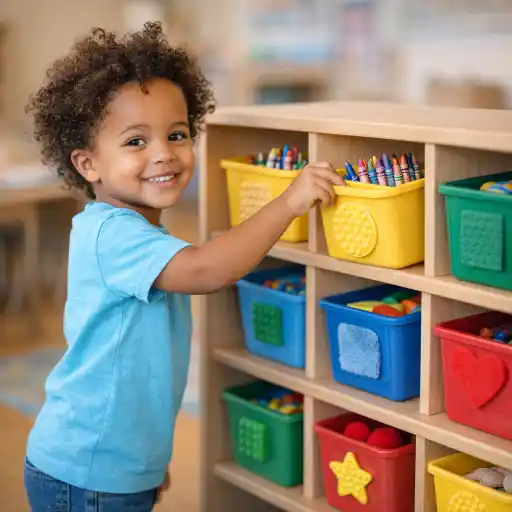
Consistency among adults is essential. Agree on what each cue means, how staff will describe it, and how materials will be returned after use. Document the system in a brief classroom plan that substitutes and support staff can follow. Accessible classroom design guidance likewise recommends consistent material locations, accessible labeling, clear travel paths, and reorientation when arrangements change; see classroom design tips for students who are blind or visually impaired.
Pairing tactile cues with spoken descriptions, real objects, and accessible print can reinforce meaning. For instance, a child might feel the textured marker on the block shelf, hear the center named, and explore a familiar block. Multiple ways to identify a place make the system more usable and support shared participation.
How can educators teach children to use the landmarks?
Teach landmarks during calm, meaningful routines rather than introducing them only when a child is expected to find something quickly. Begin by exploring a real material or location, then connect it to its tactile cue. Use consistent, concrete language: “The raised circle is on the puzzle shelf,” or “Follow the textured edge to the book basket.” Allow processing time and repeated opportunities across ordinary play and care routines.
Respect the child’s control and communication. Offer an invitation to explore, ask before providing physical assistance, and notice whether the child reaches toward, avoids, or returns to a cue. If assistance is needed, hand-under-hand support can allow a child to observe and participate while remaining in control. Guidance on prompts recommends using the least intrusive support necessary, respecting the child’s response, and fading prompts to encourage self-initiation; see cues and prompts for students with visual impairments.
- Introduce one landmark at a time, linking it to a familiar activity.
- Model exploration and narrate the landmark’s location and meaning.
- Invite the child to locate the cue and retrieve or return the material.
- Use the same cue and wording across staff and routines.
- Gradually reduce reminders as the child shows understanding and confidence.
Make the experience social when it fits naturally: peers can help return materials, describe what they notice, and join the activity. The aim is authentic access and participation, not a test of whether a child can navigate quickly. Observe what supports success and adjust the teaching pace accordingly.
How can providers evaluate and improve the system?
Assessment is practical and ongoing: watch what the child can locate, how much prompting is needed, and whether the cue is meaningful in real classroom use. A child might recognize a tactile marker but still need support understanding which shelf it identifies. Another child may find materials independently but struggle when bins are moved. These observations help staff improve the environment without assuming that a child is incapable.
Check the system with the child, family, and relevant specialists. Ask whether the textures remain distinguishable, whether placement is comfortable, and whether the same strategies work across home and school routines. If the child has an individualized plan or receives specialist services, coordinate classroom practices with those supports and follow applicable recommendations.
Common pitfalls are often small but consequential:
- Changing locations casually: Return materials to their assigned places and reorient the child when a change is necessary.
- Using cues that feel alike: Choose clearly distinct markers and check that the child can tell them apart.
- Relying on an adult to guide every trip: Allow time for independent exploration while maintaining appropriate supervision.
- Adding too many labels: Keep the system simple and tied to useful routines.
- Assuming one method suits every child: Adapt cues to the child’s sensory access, preferences, and communication.
State requirements vary - check your state licensing agency. For legal and program-level questions about inclusion, providers should also consult applicable guidance and make individualized decisions rather than relying on assumptions. The U.S. Department of Justice explains that child care providers must consider children’s individual needs and reasonable modifications under the ADA; see Equal Access to Child Care.
Conclusion: What should a provider do first?
Consistent tactile landmarks help children connect a sensory cue with a place, a material, and a classroom routine. To begin, identify one high-value location, select a distinct and comfortable tactile marker with input from the child and family, and keep the marker and materials in the same place. Teach the cue through real exploration, consistent language, and repeated opportunities to participate.
Then observe and refine: Does the child find the location more readily? Can they retrieve and return materials? Are pathways clear, cues distinct, and staff practices aligned? Treat the answers as information for improving access, not as a measure of a child’s worth or potential. A predictable, thoughtfully organized environment supports greater independence and belonging—and benefits classmates who also thrive when materials are easy to identify and return.
For further professional learning on accessibility and inclusive practice, consider Access for All: Inclusion and the ADA Buy Now $25.00. The course offers a broader learning experience about provider responsibilities, accommodations, and inclusive environments. Related ChildCareEd learning options include Inclusive Lessons for Preschoolers  Buy Now $16.00, Classroom Setup for Child Care Buy Now $24.00, Special Needs: From Referral to Inclusion Buy Now $24.00, and Using Toys to Support Learning Buy Now $16.00. Review course details and your local professional-development requirements before enrolling.
- Teacher-Child Interactions for Stronger CLASS® Outcomes
- CDA Bridge Bundle: Preschool
- Pediatric RSV First Aid & CPR/AED
- 45 Hour School Age Methods and Materials
- CDA Bridge Bundle: Family Child Care
- Art from the Heart for Preschoolers: Open Ended Art Projects that Build Self-Esteem
- Emergent Learning & Development
- 45-Hour Infant and Toddler Curriculum
- CDA Certification en Español: Recursos y Consejos para Educadores Bilingües
- 💛🧩 ¿Cómo puedo hacer que mi enseñanza sea inclusiva para los niños con autismo?
- 😫🧸 ¿Qué hacer cuando un bebé no quiere dormir la siesta en el aula?
- 👶 ¿Cuáles son las proporciones y grupos requeridos en Dakota del Norte? 🏫
- ¿Cómo explicar los colores a un niño ciego? Actividades con tacto, sonido y emociones
- Recursos en Español sobre el Sueño Seguro del Bebé
- 10 Ejemplos de Cómo la Cultura Influye en el Desarrollo Infantil
- Proporciones de Cuidado Infantil y Tamaños de Grupo por Edad en Maryland (Guía Rápida para Centros y Hogares)
- Proporciones de Cuidado Infantil y Tamaños de Grupo por Edad en Nueva Jersey (Guía Rápida para Centros y Hogares)
- Proporciones de Cuidado Infantil y Tamaños de Grupo por Edad en Virginia (Guía Rápida para Centros y Hogares)
- Apoyo en Preescolar para Retrasos del Habla: Estrategias Simples que Ayudan
- Retraso del Habla en la Guardería: Cómo Pueden Ayudar los Proveedores
- Cómo Trabajar en el Cuidado Infantil en Carolina del Norte: Requisitos y Pasos
- Cómo Ser Maestra de Preescolar en Maryland
- Capacitación CDA gratuita en Illinois
- Celebrando la amistad en el cuidado infantil durante el Día de los Mejores Amigos
- Canciones, juegos y preguntas de círculo para niños
- Cómo simplificar la capacitación para sus empleados de daycare
- National Massachusetts Day for Kids: Explore the Bay State Through Play
- How Can Consistent Tactile Landmarks Help Children Find Classroom Materials?
