A child may recognize a familiar toy at a glance—until it is shown in a different color, turned around, or reduced to a simple outline. Understanding how children identify objects when visual clues change can help you plan more supportive play and respond thoughtfully to what you observe. The Observing & Assessing in Child Care  Buy Now $16.00 course offers practical learning in documenting children’s development, while Playful Learning: Infant & Toddler Activities Buy Now $25.00 can help you shape age-appropriate experiences that build on children’s exploration. Read on for ways to make these everyday moments meaningful without turning them into tests.
Why can an object look unfamiliar when its color or details change?
Recognizing an object is not simply a matter of seeing it. Children use visual information—such as shape, color, size, texture, and distinctive features—along with memory, attention, experience, and the setting in which the object appears. When a familiar red ball appears in blue, or a detailed toy is represented by a plain silhouette, some of the clues a child has relied on may no longer be available.
Young children may also focus strongly on one noticeable feature. A child who has learned to identify a particular cup by its bright color might hesitate when the cup is shown in a photograph with different lighting or against a new background. That pause can reflect a changing task, not a lack of understanding. Research into children’s picture understanding likewise shows that interpreting an image as a representation of a real object involves more than noticing what it looks like.
Visual perception also continues to develop beyond the preschool years. A study summarized by Medical Xpress reports that some aspects of visual processing, including how children prioritize global shape information, develop into later childhood. These findings remind providers not to assume that every child will interpret a changed image in the same way or on the same timeline.
- Notice which clues the child seems to use: outline, color, size, texture, or familiar context.
- Remember that a response may depend on the image, the prompt, attention, and familiarity—not just object knowledge.
What visual skills are involved in recognizing objects?
Object recognition draws on several connected abilities. Visual discrimination helps a child notice similarities and differences, while visual memory helps them compare what they see now with what they have encountered before. Visual form constancy is the ability to recognize a form even when it changes in size, color, or orientation. Children also use attention to select relevant information and ignore distractions in the background.
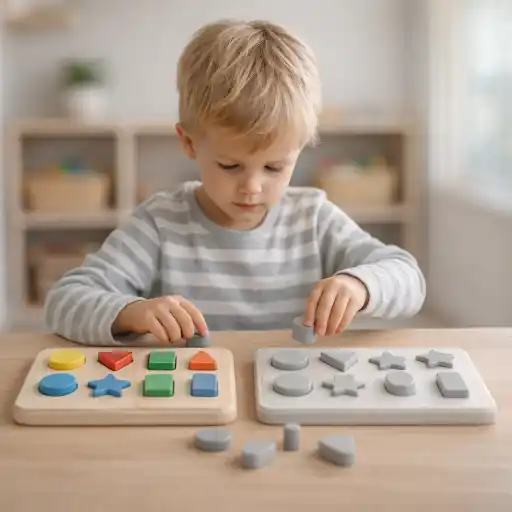
These abilities work together, and an activity may ask for more than one at once. For example, matching a small black outline of a familiar animal to a colorful toy requires the child to understand that different-looking representations can refer to the same thing. Matching a photograph of a cup to the real cup adds the challenge of connecting a flat image with a three-dimensional object. The child may understand the cup perfectly in everyday routines and still need support with this symbolic connection.
Skills do not necessarily appear all at once or in a fixed sequence. A child might recognize an object when it is turned but not when its color changes, or match two photographs but not a photo to a real object. Treat these patterns as useful information for planning the next opportunity rather than as a score.
- Discrimination: noticing which features are alike or different.
- Memory: recalling an object or image seen earlier.
- Form constancy: recognizing a familiar form despite visual changes.
- Symbolic understanding: connecting an image or model with the real-world object it represents.
How can providers explore recognition through playful activities?
Start with familiar, safe objects that matter to the child: a favorite block, classroom cup, large toy animal, or familiar piece of clothing. Let the child handle and explore the real item first. Then introduce one change at a time. You might show the same object from another angle, pair it with a clear photograph, or offer a simple outline after the child is comfortable with the photo. This gradual progression keeps the task understandable and makes it easier to see which supports help.
Keep the activity playful and brief. Instead of quizzing, describe what you notice: “This picture has the same round top as your cup,” or “The toy is turned, but I can still see its wheels.” Give the child time to look, turn, point, reach, or compare. Children can show recognition without saying the object’s name; gestures, gaze shifts, matching, and bringing the real object to an image can all be meaningful responses.
- Begin with identical real objects or matching clear photographs.
- Connect one real object to one photograph, using a familiar angle and uncluttered background.
- Gradually vary a single feature—such as color, size, or orientation—when the child is engaged.
- 🧸 Let the child choose a familiar object and lead the comparison; follow their interest rather than insisting on a correct answer.
- Use objects from classroom routines, books, and play so the idea appears in meaningful contexts.
Adjust materials to support access. Use large images, strong contrast, good lighting, and a small number of choices. Do not rely on color alone; pair it with shape, outline, texture, or a spoken label. Close supervision and age-appropriate materials are especially important when small objects are present.
What should educators observe and document?
Observe the conditions around the child’s response, not just whether a match was made. Record the object and image used, the prompt, the number of choices, the setting, and what the child did or communicated. A useful note might read: “During free play, Eli picked up the familiar green truck. When shown a black outline of a truck among two cards, he looked at both, then returned to the toy.” This describes what happened without deciding what Eli did or did not understand.
Look for patterns across several moments. Does the child recognize the item when the image is larger? Does adding a spoken label or a real object help? Are photographs easier than drawings? Does recognition appear when the child can point rather than name? Consider fatigue, distraction, interest, language access, and the visual complexity of the materials before drawing conclusions.
Use observation to decide what to try next. If the child is successful with identical photos, you might later introduce a photo from a slightly different angle. If that is difficult, return to the familiar image or reduce the choices. The goal is to make learning responsive—not to push the child through a predetermined sequence. The ChildCareEd resource on connecting real objects with photographs offers additional ideas for using these observations to guide practice.
- Write down what you saw and heard, rather than labels such as “doesn’t know it.”
- Note which adjustments supported engagement and which made the activity harder.
- Share objective examples with families and invite their perspective; follow program procedures if a concern persists.
How can providers avoid common pitfalls and support every learner?
A mismatch is not automatically evidence that a child does not recognize an object. The task may be asking the child to interpret a photograph, tolerate a new visual arrangement, remember a detail, and follow a verbal direction all at once. Simplifying the task can reveal more about the child’s current understanding than repeating the same prompt.
Avoid presenting the activity as a speed test or correcting every response immediately. Repeated questioning can make play feel like an evaluation and may draw attention away from the object itself. Offer a calm model, wait, and allow the child to explore. Also avoid using visually busy pictures, unfamiliar objects, or too many choices at the beginning. Add difficulty gradually, changing one feature at a time.
Inclusion means preserving the learning idea while offering different ways to access it. A child may point, use eye gaze, gesture, speak in a home language, use a communication system, or work with a partner. Children with visual differences may benefit from larger images, tactile features, high contrast, or better lighting. If you have an ongoing developmental concern, document specific examples and follow your program’s process for family communication and referral. Providers observe and share information; they do not diagnose. State requirements vary - check your state licensing agency.
- Keep the experience collaborative and low-pressure; value careful looking and exploration.
- Adapt the size, contrast, number of choices, response method, or amount of adult support.
- Do not infer a child’s overall ability from a single activity or one difficult moment.
Conclusion: Can children recognize objects when color and details disappear?
Yes, children can learn to recognize objects across changes in color, detail, size, and viewpoint, but how they respond depends on developing visual, memory, attention, and symbolic skills as well as the familiarity and complexity of the task. A pause or mismatch can be an informative moment—not a verdict about what a child knows.
For providers, the practical approach is to begin with familiar objects, introduce visual changes gradually, offer accessible ways to respond, and document what happens without judgment. Use those observations to plan the next playful opportunity and to partner with families when useful. These small, thoughtful experiences help children notice relationships and build confidence as they make sense of the world around them.
For additional professional learning, explore these English-language ChildCareEd courses:
- Observing & Assessing in Child Care Buy Now $16.00
- Playful Learning: Infant & Toddler Activities Buy Now $25.00
- Tracking Progress, Shaping Futures: Observation & Assessment Skills Buy Now $55.00
- Recognize, Respond, Respect: Supporting Diverse Learners Buy Now $55.00
- The Best Promotion is Play Buy Now $35.00
- Creating the Natural Outdoor Classroom
- CDA Home Visitor Subject Area 3 Part 3 Birth to 5
- Power of Art: Bldg Self-Esteem & Positive Behavior for ALL Abilities
- CDA Bridge Bundle: Preschool
- CDA Bridge Bundle: Family Child Care
- CDA Bridge Bundle: Family Child Care without Portfolio Review
- CDA Bridge Bundle: Infant/Toddler without Portfolio Review
- CDA Bridge Bundle: Preschool without Portfolio Review
- CDA Bridge Bundle: Infant/Toddler
- Texas Director Credential
- CDA Certification en Español: Recursos y Consejos para Educadores Bilingües
- Recursos en Español sobre el Sueño Seguro del Bebé
- Proporciones de Cuidado Infantil y Tamaños de Grupo por Edad en Virginia (Guía Rápida para Centros y Hogares)
- Por Qué la Supervisión Activa Es Clave para la Seguridad en el Cuidado Infantil
- Retraso del Habla en la Guardería: Cómo Pueden Ayudar los Proveedores
- Cómo simplificar la capacitación para sus empleados de daycare
- Toddler Classroom Management Strategies for the 5 Hardest Parts of the Day
- How Can Fun Bingo Games Teach Colors, Shapes, and Animals to Preschoolers?
- Beyond “How Are You?” Circle Time Questions Kids Actually Want to Answer
- How Can Child Care Providers Introduce Even and Odd Numbers Through Visual Patterns?
- How Do Memory and Matching Games Support Visual Discrimination?
- How Can Repetitive Early Readers Help Children Learn Color Words?
- How Do Color-Word Activities Support Reading Automaticity?
- When Does a Classroom Picture Mean Something Different to a Child?
- Why Might a Child Recognize a Real Object but Not Its Photograph?
- What Does Allergy Refresher Training Need to Cover Beyond a Food List?
- Where Does an Object Belong When It Fits Both Sorting Groups?
- What Happens to a Fallen Leaf? How Can Preschoolers Investigate Decomposition?
- How Can a Halloween Staff Debrief Improve Your Child Care Program?
- Can Children Recognize an Object When Its Color and Details Disappear?
