When a child studies a picture, turns it around in their mind, and chooses the silhouette that fits, a quiet game becomes active learning. Try the DAP for Preschool  Buy Now $24.00 course to strengthen your understanding of developmentally appropriate teaching and apply it to playful activities like shadow matching. For practical ideas on turning children’s observations into rich conversations, explore Building Vocabulary Buy Now $16.00 as a helpful next step.
Why does shadow matching deserve a place in preschool play?
Picture-to-shadow matching asks children to do more than recognize a familiar object. They must focus on its outline, decide which features matter, compare possible silhouettes, and make a choice. That sequence supports visual discrimination—the ability to notice similarities and differences in visual information—and creates a natural opportunity to practice persistence and reasoning.
The activity is also easy to make meaningful. Autumn leaves, acorns, pumpkins, or classroom objects connect the game to children’s everyday experiences. A familiar theme can invite conversation and keep children engaged without turning the activity into a formal test. Matching and memory games similarly encourage children to attend, compare, remember, and describe what they see, as discussed in ChildCareEd’s article on memory and matching games.
For providers, the key is to look beyond whether a child gets the answer right. Notice the strategies: Does the child scan each option? Turn the picture or point to a feature? Try again after an imperfect match? Those actions reveal learning in progress and help you choose a supportive next step.
- Children practice noticing outlines, orientation, and shape.
- They learn to compare choices and persist through uncertainty.
- Providers gain a low-preparation way to observe thinking and language.
How does matching a picture to its silhouette build visual discrimination?
A silhouette removes color, texture, and many interior details. Children therefore need to attend to the outer contour and to the spatial arrangement of distinctive parts: a leaf’s points, a pumpkin’s stem, or an acorn’s cap. Comparing these features supports careful visual analysis rather than quick guessing. This is a useful foundation for noticing shapes and patterns in other settings; it is not a promise of a particular academic outcome.
Start with clear, familiar images and just a few shadow choices. For toddlers and younger preschoolers, identical or notably different outlines reduce unnecessary demands. As children become comfortable, add choices with closer shapes, rotate some silhouettes, or include items that share a broad outline but differ in a key feature. Change one aspect of difficulty at a time so that children can concentrate on the skill you intend to support.
Shape exploration fits naturally into early mathematics. The NAEYC discussion of discovering shapes and space in preschool highlights comparing shapes in different sizes and orientations and using spatial language in everyday activities. Shadow matching offers a concrete, playful moment to do this: “This one has a narrow tip,” or “The stem points to the side.”
- Use uncluttered pictures with recognizable outlines.
- Invite children to scan all options before choosing.
- Ask what feature helped them decide, rather than supplying the answer immediately.
How can the game strengthen attention and early problem-solving?
Matching a picture to a silhouette requires children to hold a goal in mind, focus on relevant details, compare alternatives, and revise a choice when it does not fit. These actions provide practice in attention and early problem-solving. The learning lies not only in the correct pairing but in the process: looking again, noticing a mismatch, and trying a different possibility.
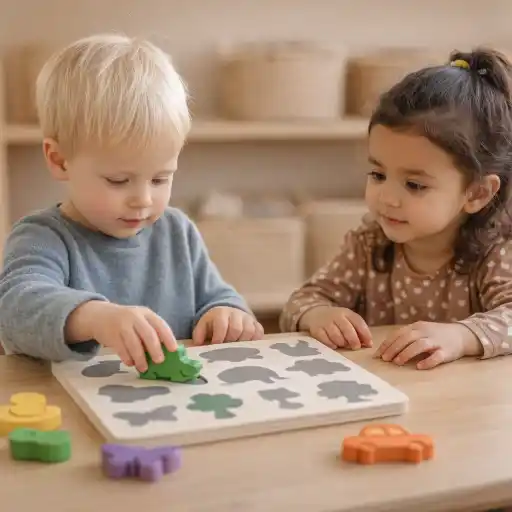
Providers can make that process visible by thinking aloud. For example: “I see two shadows with a rounded bottom. I’ll check the top—this one has a point, like the leaf.” Then pause and let children take the lead. Open-ended prompts such as “What do you notice?” and “Which part are you comparing?” encourage children to explain or demonstrate their reasoning. A response may be spoken, pointed to, signed, or shown by moving a card.
Keep the challenge manageable. A crowded page or many similar choices can overwhelm a child’s attention, while too few choices may offer little opportunity to compare. Short rounds, a small set of cards, and unhurried turns support productive effort. Celebrate strategies and persistence, not speed; the goal is thoughtful participation, not winning.
- Begin with a few options and add more only when children are ready.
- Give children time to look, compare, and change their minds.
- 🧩 Invite partners to solve the matching challenge together and share what they noticed.
How can providers use descriptive language during shadow matching?
Silhouettes prompt children to describe what they see, even when they do not yet know the object’s name. Educators can model useful words such as outline, pointed, curved, wide, narrow, same, and different. For autumn materials, children might talk about a leaf’s jagged edge, a pumpkin’s round shape, or an acorn’s small cap. Such exchanges make vocabulary part of purposeful play rather than a separate drill.
Use prompts that invite observation and explanation: “What makes this shadow look like the leaf?” “Which one has a longer stem?” or “How are these outlines alike?” Avoid requiring a lengthy verbal answer. A child can point to the matching edge or demonstrate the comparison, while the educator supplies a clear label and expands gently: “You pointed to the sharp tip. That pointed edge helped you find the match.”
Welcome home-language words and gestures. When children hear ideas expressed in familiar languages as well as new vocabulary, they can participate meaningfully while building connections across languages. The NAEYC resource on shapes and space recommends weaving mathematical words into everyday interactions and children’s home languages. Providers can also extend the conversation by inviting children to describe a real leaf before matching it to a printed silhouette.
- Model one or two precise describing words at a time.
- Accept pointing, signing, drawing, and home-language responses.
- Connect picture features to objects children can examine in the room or outdoors.
How can you adapt the activity for different ages and learners?
Adapt the materials and response method while keeping the central goal—comparing shapes—in view. For a younger child, offer two large, high-contrast choices and let them point or place a picture. Older preschoolers may be ready to compare several similar silhouettes, match a real object to a shadow, or explain which details distinguish two options. These are flexible starting points, not age-based rules; observe each child’s interest, experience, and comfort.
Accessibility matters. Use large cards, uncluttered backgrounds, adequate lighting, and stable surfaces when helpful. Do not make color the only clue, since the intended task is shape comparison. Children who have motor differences can indicate a choice by pointing, eye gaze, or working with a partner. Children developing more than one language may benefit from familiar images, gestures, and home-language labels.
Observe without turning play into a screening tool. Briefly note whether a child scans choices, notices a distinctive feature, persists, or uses descriptive words. If a child finds the task difficult, reduce the number of choices or present one match at a time; a challenge may reflect memory, language, motor access, or visual complexity rather than a lack of understanding. If concerns about a child’s vision or development persist, share objective observations with the family and follow program procedures.
- Offer choices for how to participate: point, place, describe, draw, or partner.
- Increase complexity gradually and adjust one feature at a time.
- State requirements vary - check your state licensing agency when reviewing applicable program or professional-development expectations.
How can educators make an autumn shadow activity purposeful?
Set up a small, calm invitation with a few autumn picture cards and matching silhouettes. Begin by showing one example and naming what you are looking at: “I’m comparing the outline of this leaf.” Then invite children to take turns choosing a picture, scanning the shadows, and explaining or showing their match. Keep the interaction relaxed; children can watch first, work with an adult, or return to the activity later.
Extend the game into the classroom and outdoors. Collect safe, familiar leaves and compare their shapes with picture cards. Invite children to sort the leaves by broad features, make a simple leaf rubbing, or draw a silhouette they would like a friend to match. These follow-ups connect visual comparison with early geometry, observation, and creativity. ChildCareEd’s overview of visual matching in preschool also emphasizes the value of adapting materials and inviting children to explain their thinking.
Avoid common pitfalls: too many cards, visually busy designs, rushed turns, and praise focused only on correct answers. Instead, recognize careful looking: “You checked the shape of the stem before deciding.” If frustration rises, simplify the set, offer a break, or match together. The game works best when children feel safe to wonder, try, and revise.
Conclusion: What do children learn when they match shadows?
Matching pictures to silhouettes is more than a simple preschool game because it invites children to notice visual details, sustain attention, compare possibilities, use descriptive language, and test early solutions. The autumn theme can make these ideas tangible and inviting, while thoughtful adult interaction helps children put their observations into words and build confidence in their strategies.
Start with a small, accessible set; model careful looking; and adjust the challenge to the children in front of you. Observe how each child approaches the match, welcome different ways of communicating, and connect the game to real objects and experiences. In doing so, providers make shadow matching a purposeful, flexible learning experience—one that supports curiosity and gives educators useful insight into children’s thinking.
- 45 Hour Child Growth and Development
- Turning Behavior Around for Toddlers and Preschoolers
- CDA Preschool Credential
- CDA Preschool Credential with Portfolio Review
- 45 Hour Preschool Methods and Materials
- What Makes Me Special: An Overview of Autism and ADHD
- CDA Bridge Bundle: Preschool
- 45 Hour School Age Methods and Materials
- CDA Bridge Bundle: Preschool without Portfolio Review
- Cómo Obtener la Credencial de Visitante de Hogar CDA
- CDA Certification en Español: Recursos y Consejos para Educadores Bilingües
- 💛🧩 ¿Cómo puedo hacer que mi enseñanza sea inclusiva para los niños con autismo?
- Requisitos Para Ser Maestra Principal En Un Daycare: Lo Que Necesitas Para Empezar
- ¿Cuál es la diferencia entre un certificado CDA y la credencial CDA?
- ¿Cómo puedo usar escenarios de juego de roles de primeros auxilios en mi aula?
- Actividades de Motricidad Gruesa que Desarrollan el Equilibrio, la Coordinación y la Fuerza
- Regulaciones de Licenciamiento de Cuidado Infantil en California para Centros y Hogares de Cuidado Infantil Familiar
- Canciones, juegos y preguntas de círculo para niños
- Cómo simplificar la capacitación para sus empleados de daycare
- Common After School Activities Kids Get Bored With—and What to Try Instead
- How Can Printable Activities Save Teachers Hours of Prep Time?
- What Should a 3-Year-Old Be Learning at Preschool?
- What Is Developmentally Appropriate Practice? Examples by Age
- How Do Memory and Matching Games Support Visual Discrimination?
- What Are Simple Ways to Build Early Math Skills During Daily Classroom Routines?
- How Can Preschool Providers Explore Light and Shadows Without the Scare?
- How Can Child Care Providers Teach Fall in Warm Climates Without Red Leaves or Cold Weather?
- Why Do Shadows Change Size? Turning a Preschool Question Into a Science Lesson
- Why Is Matching Shadows More Than a Simple Preschool Game?
