When families see paint on sleeves or sand in shoes, they may see cleanup—but children are often practicing #problem-solving, language, motor coordination, and self-expression. A clear explanation can turn concern into partnership; for deeper professional learning, explore Role of Play in Learning  Buy Now $16.00, which helps providers connect play experiences with child development and CDA Subject Area 8 knowledge.
Why does messy play deserve a place in family communication?
Messy play is open-ended exploration of materials such as water, sand, clay, paint, foam, mud, or natural objects. Its value is not measured by a finished product. Rather, children investigate properties, make choices, repeat actions, and revise ideas. Head Start describes messy play as an integrated learning experience that supports foundational skills across developmental domains, including cognitive, motor, language, and social development.
Families may understandably prioritize visible academic products. Providers can validate that expectation while explaining that early learning often happens through action. A child squeezing dough is strengthening hand muscles; pouring water is exploring volume and cause and effect; mixing colors involves prediction and observation. NAEYC encourages educators to describe these connections in accessible language rather than relying on specialized terminology.
This communication matters because family understanding influences continuity between home and care. When families recognize the purpose behind messy experiences, they are more likely to share observations, provide appropriate materials, and support children’s curiosity beyond the classroom.
- Messy play makes learning visible through children’s actions.
- It gives educators authentic opportunities to observe interests and development.
- It invites families into a shared, strengths-based view of children.
What developmental learning is hidden inside the mess?
Messy play engages multiple domains at once. The Head Start guidance on designing messy play emphasizes that children learn foundational physical principles while strengthening motor, language, and social skills. That integrated quality is precisely what providers can help families notice.
- Physical development: Scooping, squeezing, pinching, stirring, and transferring materials develop fine-motor control and hand-eye coordination. Digging, carrying, and large-scale painting invite gross-motor movement.
- Cognitive development: Children compare, classify, predict, test, and solve problems. “Will this container hold all the water?” is an early mathematics and science question.
- Language and literacy: Describing textures, actions, colors, and changes expands vocabulary. Pretend recipes, signs, labels, and stories can also connect sensory play with emergent literacy.
- Social-emotional development: Children practice turn-taking, negotiating space, expressing preferences, persisting through difficulty, and managing frustration.
- Creativity and agency: Open-ended materials communicate that children’s ideas matter. There is no single correct outcome.
For families, the most persuasive explanation is concrete: “Today, Jordan used two hands to squeeze clay, described it as sticky, and changed the shape three times. Jordan was building hand strength, vocabulary, and persistence.”
How can providers explain messy play without sounding defensive?
Family conversations are most effective when they begin with respect. Instead of assuming that a question reflects opposition, recognize the practical realities behind it: laundry, allergies, limited time, cultural preferences, or uncertainty about safety. A strengths-based response might be, “I understand why the extra cleanup can feel like a lot. We plan this experience carefully because it gives children meaningful opportunities to explore and communicate.”
Use plain language and connect the activity to what the child actually did. Avoid broad claims such as “This rewires the brain” or “Every child needs to get messy.” Children differ in sensory preferences, and meaningful participation can include watching, using tools, touching briefly, or choosing a dry alternative.
The NAEYC guidance on talking with parents about play and learning recommends showing families specific examples and analyzing what children are learning. Photos, short observations, and captions can make invisible learning easier to see.
Try a three-part message:
- Describe: “Children poured water through funnels and compared which container filled first.”
- Interpret: “They were exploring flow, volume, prediction, and descriptive language.”
- Invite: “At home, you might offer cups during bath time and ask, ‘What do you think will happen?’”
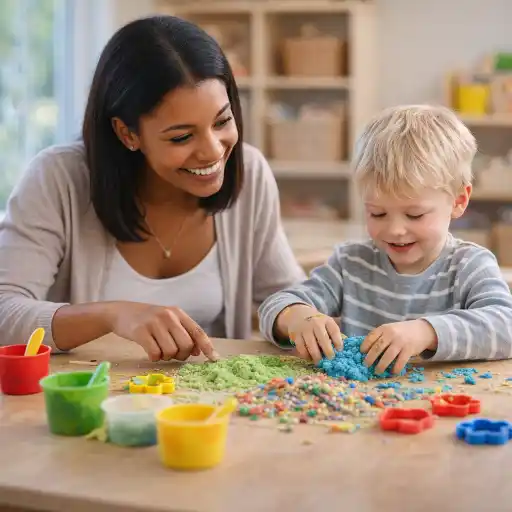
For a ready-to-share family resource, consider the Messy Play Family Information Pack. It can help standardize staff language while giving families practical ideas they can adapt at home.
How can the Messy Play Family Information Pack strengthen partnerships?
A family information pack should do more than list benefits. It should answer the questions families are most likely to have: What is messy play? Why does it matter? What will my child learn? How is it kept safe? How can we try it at home? A concise, welcoming resource can reduce repeated explanations and make communication more consistent across classrooms.
Consider including:
- 🧼 A reassuring explanation that mess is planned, contained, and followed by cleanup.
- Examples linking activities to motor, language, cognitive, social-emotional, and creative development.
- Photographs or brief vignettes showing process rather than perfect products.
- Simple home ideas using cups, cardboard, water, playdough, leaves, or paper.
- Adaptations for children who avoid sticky, wet, strongly scented, or visually busy materials.
- Safety reminders about supervision, allergies, choking hazards, sanitation, and water.
- A space for families to share observations, cultural practices, or children’s preferences.
Make the pack accessible. Use short sections, clear headings, translated versions when appropriate, and examples that do not assume families have specialty supplies. The resource should invite participation rather than imply that families must reproduce the classroom exactly. For families seeking another tactile idea, a taste-safe mud activity can offer a concrete way to extend messy play at home.
Directors can support implementation by reviewing the pack with staff, identifying consistent phrases, and inviting family feedback. State requirements vary - check your state licensing agency when adapting safety guidance, materials, supervision procedures, or documentation practices.
How can providers plan messy play that families can trust?
Trust grows when intentionality is visible. Before offering an experience, identify the children’s developmental range, a manageable learning focus, the materials, the boundaries of the space, and the supervision plan. Head Start recommends an organized, defined environment: tarps, trays, smocks, nearby cleanup supplies, and clear cues help children understand where messy play occurs and when it ends.
Safety decisions must be individualized. Inspect materials, remove broken or contaminated items, consider allergies, and avoid small objects for children who mouth materials. Water play requires active supervision even when the container is shallow. Food-based materials may create allergy or sanitation concerns, so programs should follow written policies and family communication procedures.
Inclusion is equally important. Some children may prefer tools, gloves, sealed bags, dry materials, or observation before touching. Respecting these preferences does not reduce learning. It demonstrates responsive practice and allows children to participate on their own terms.
Document learning with brief, objective notes:
- What did the child do?
- What language, strategy, movement, or interaction did you observe?
- What might be offered next?
- What could families try if they wish to extend the experience?
For example: “Amir used a funnel to transfer water, noticed that the cup overflowed, and said, ‘Too much.’ Next, we will offer containers of different sizes and model words such as full, empty, and more.” This documentation gives families evidence of learning without turning play into a worksheet.
What common mistakes should programs avoid?
Messy play can lose its developmental value when adults focus primarily on appearance, speed, or control. The goal is not to eliminate every boundary; it is to create enough structure for safety while preserving children’s agency.
- Calling every activity “messy play” without a purpose: Identify the experience’s possibilities and observe how children use them.
- Over-directing the outcome: Demonstrate safe use, then step back. Process matters more than identical products.
- Using too many materials at once: Begin with one base material and a few tools so children can focus.
- Pressuring children to touch: Offer alternatives and allow gradual participation.
- Promising therapeutic outcomes: Describe observable support for engagement or regulation, but avoid claiming that messy play “fixes” sensory or behavioral differences.
- Sharing photos without thoughtful permission: Follow program policy and applicable privacy requirements.
- Sending home jargon-heavy explanations: Replace terms such as “executive function” with examples, or define the term briefly.
When a family is concerned, respond with curiosity: “What part feels uncomfortable?” The answer may reveal a practical solution, such as a smaller setup, outdoor location, protective clothing, a different material, or a clearer cleanup routine. Professional communication does not require winning an argument; it requires building shared understanding.
Conclusion: How can families see the learning hidden inside messy play?
Families are more likely to value messy play when providers connect visible actions to meaningful development. Explain what children are doing, name the skills involved, show authentic documentation, and invite families to try manageable experiences at home. The Messy Play Family Information Pack can extend that conversation with practical examples, safety guidance, and inclusive options.
Messy play is not disorder without purpose. It is a context in which children explore materials, communicate ideas, solve problems, strengthen bodies, negotiate relationships, and express creativity. When adults prepare thoughtfully and communicate respectfully, the mess becomes evidence of active learning rather than a reason for concern.
For continued professional growth, explore ChildCareEd courses such as Role of Play in Learning Buy Now $16.00, The Best Promotion is Play Buy Now $24.00, Playful Spaces for Infants & Toddlers Buy Now $24.00, Bienvenido! Welcoming All Families Buy Now $16.00, and DAP for Preschool Buy Now $24.00. Together, these learning opportunities can strengthen classroom practice, family communication, and intentional play planning.
- 45 Hour Child Growth and Development
- 45 Hour Preschool Methods and Materials
- CDA Family Child Care Credential
- 45 Hour Infant and Toddler Methods and Materials
- 45 Hour School Age Methods and Materials
- Creating Environments that Nurture Growth and Community
- Texas Director Credential
- Supporting Families and Caregivers in Language and Literacy
- CDA Certification en Español: Recursos y Consejos para Educadores Bilingües
- 🍑 ¿Qué capacitación requiere DECAL cada año para el personal de cuidado infantil en Georgia?
- ¿Cómo empiezo mi certificación CDA en Florida en línea?
- 10 Ejemplos de Cómo la Cultura Influye en el Desarrollo Infantil
- Cómo Empezar una Guardería en Casa: Requisitos y Pasos
- Regulaciones de Licenciamiento de Cuidado Infantil en California para Centros y Hogares de Cuidado Infantil Familiar
- Proporciones de Cuidado Infantil y Tamaños de Grupo por Edad en Maryland (Guía Rápida para Centros y Hogares)
- Proporciones de Cuidado Infantil y Tamaños de Grupo por Edad en Nueva Jersey (Guía Rápida para Centros y Hogares)
- Proporciones de Cuidado Infantil y Tamaños de Grupo por Edad en Virginia (Guía Rápida para Centros y Hogares)
- Lista para Abrir una Guardería en Casa en Georgia: Cómo Empezar
- Cómo Trabajar en el Cuidado Infantil en Carolina del Norte: Requisitos y Pasos
- Cómo Trabajar en el Cuidado Infantil en Wisconsin: Requisitos y Pasos
- Capacitación Previa al Servicio para Proveedores de Cuidado Infantil en Georgia
- Capacitación CDA gratuita en Illinois
- Celebrando la amistad en el cuidado infantil durante el Día de los Mejores Amigos
- Canciones, juegos y preguntas de círculo para niños
- Cómo simplificar la capacitación para sus empleados de daycare
- Playground Safety Checklist for Daycares: 10 Hidden Hazards Staff Often Miss
- Dump It, Stack It, Build It! Open-Ended Activities for Curious Toddlers
- How Can Child Care Providers Help Families See the Learning Hidden Inside Messy Play?
