When a preschooler writes “MOM” and proudly notices it looks the same backward, a playful discovery opens the door to print, patterns, and early literacy. Explore how to respond to reversible letter patterns with activities that build curiosity without confusing palindromes with typical letter reversals—and deepen your practice with Understanding Print Knowledge in Preschool  Buy Now $16.00 or Science of Reading Foundations in the Pre-K Classroom Buy Now $16.00, two focused courses offering practical ways to strengthen early literacy instruction.
What makes “MOM” look the same backward?
“MOM” is a palindrome: a sequence of letters that reads the same from left to right and from right to left. In this uppercase example, the first and last letters are both M, and the middle letter is O. The arrangement therefore remains the same when the order is reversed. Other familiar word palindromes include “dad” and “wow,” although visual appearance depends on the font and whether letters are uppercase or lowercase.
A palindrome is not the same thing as a mirror image. If a child holds the word MOM in front of a mirror, the reflected image may appear reversed, but the written sequence itself is still read from either end in the same order. The central idea is sequence symmetry, not simply that the letters look unusual or are drawn backward. Palindromes can also be found in phrases and numbers; in longer phrases, spaces and punctuation are often ignored when checking the pattern.
Providers can make this distinction accessible by showing the word, pointing to its first and last letters, and asking children what they notice. Invite children to read or say the sequence both ways. Keep the exchange playful: the goal is to explore a pattern, not to test children’s reading ability.
- Ask: “What do you notice about the first and last letters?”
- Move a finger under the word in both directions and compare.
- Connect the word to a child’s name or a familiar classroom word when appropriate.
Why do reversible patterns matter in early literacy?
Noticing that a sequence stays the same in either direction invites children to attend closely to letters, order, and print. Those moments support conversation about how written symbols work and how words are organized. They can also connect naturally to mathematical ideas such as symmetry, patterns, and sequence. A short observation—“M is on both ends”—can become a rich exchange when an educator gives children time to describe and compare.
Children are learning that print is meaningful and follows conventions, including directionality. A palindrome offers an engaging exception to the usual left-to-right reading path in English: the word remains recognizable when approached from the opposite end. This makes it a useful conversation starter, but not a reason to expect young children to master reading direction or letter naming at a particular age.
For child care professionals, the key is to build on the child’s curiosity while keeping learning developmentally responsive. Print awareness grows through many experiences: shared books, children’s names, environmental print, talk, drawing, and emergent writing. As discussed in ChildCareEd’s importance of print knowledge resource, letter names, sounds, and concepts of print all contribute to early literacy foundations.
- 🔎 Treat the child’s discovery as a chance to observe and extend thinking.
- Use simple language: “The same letters are at the ends, so it reads the same both ways.”
- Let children respond by speaking, pointing, drawing, or arranging letter cards.
How can educators explore palindromes through play?
Offer a small, inviting word investigation rather than a worksheet-heavy lesson. Write MOM, WOW, or another familiar palindrome in large, clear print. Invite children to point to the first letter, then the last, and compare what they see. Use letter tiles or cards so children can physically arrange the sequence, turn their approach around, and check whether the pattern still works.
Play-based exploration makes abstract ideas concrete. Children might build a palindrome with magnetic letters, create a “word mirror” using two identical letter-card arrangements, or hunt for repeated patterns in names and classroom labels. A safe, unbreakable mirror can prompt discussion about reflection, but be explicit that the palindrome pattern is about letter order—not the mirror’s reversed image.
- Letter-card builder: Provide a few uppercase letters and invite children to make a word with matching ends.
- Sound and sequence talk: Say a familiar palindrome together and notice where the sequence begins and ends.
- Pattern studio: Let children design a symmetrical arrangement with blocks, loose parts, or drawings, then compare it with a word palindrome.
- Story connection: Find a palindrome in a book or create a playful phrase together, accepting approximations as exploration.
Keep choices limited and materials accessible. Children may enjoy the challenge even if they do not yet recognize the letters by name. The educator’s role is to model noticing, ask open-ended questions, and preserve the joy of discovery.
How are palindromes different from writing letters backward?
A palindrome is a correct sequence that reads the same from either end. Mirror writing, by contrast, describes letters or a whole word written in reversed orientation or direction. A child who writes a letter backward is not necessarily making a palindrome; the two phenomena involve different features of print. This distinction is particularly helpful when adults see unusual writing and feel concerned.
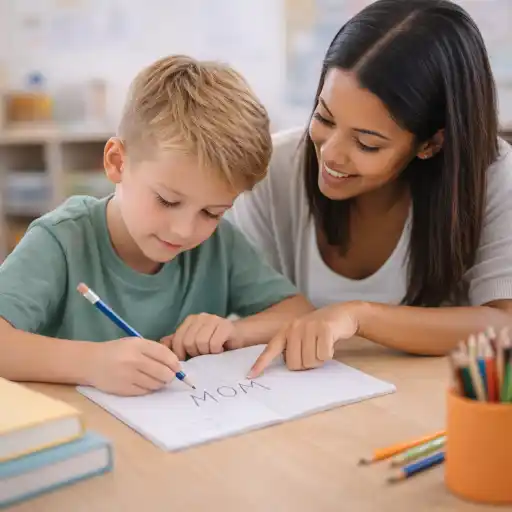
Young children may sometimes reverse individual letters or write a word from right to left as they are learning to write. Research with preschool children reports that mirror writing occurs during early writing development and is associated with age and writing experience; it was not explained simply by handedness or left-right discrimination in that study. A longitudinal study also describes how children’s understanding of letter orientation and writing conventions develops with experience. These findings support a calm, observant response rather than an immediate assumption that a reversal signals a disorder.
In practice, notice the pattern over time and across activities. Is the child exploring a palindrome on purpose, reversing a single letter occasionally, or consistently struggling to form letters and communicate in writing? Offer accurate models, clear starting points, and opportunities to trace, build, copy, and write without shame. If concerns persist or affect participation, follow your program’s process for discussing observations with families and seeking appropriate guidance.
- Describe what you observe rather than labeling the child: “The M was facing the other way in today’s drawing.”
- Demonstrate the conventional form and invite another try, without repeatedly correcting every mark.
- Remember that reversals alone do not establish dyslexia or another diagnosis.
How can providers encourage literacy without turning the discovery into a test?
Responsive teaching begins with the child’s own idea. If a child points out that MOM looks the same backward, acknowledge the observation and invite them to explain it. You might ask, “What would happen if we changed the last letter?” or “Can you find another word that has a pattern?” Questions should extend thinking without requiring a correct answer or a formal definition.
Connect the exploration to meaningful literacy experiences across the day. During read-alouds, notice the direction of print and how words are separated. At arrival, compare the first letters in children’s names. In the writing center, provide paper, markers, magnetic letters, and opportunities to dictate a message. The ChildCareEd article on supporting children’s early language and literacy development offers additional examples of everyday ways to nurture pre-reading and pre-writing.
Observe without turning a single moment into a judgment. Record a brief, objective note about what the child noticed, what they tried, and what support was useful. Consider the child’s language background, familiarity with the word, visual access, and interest. Invite families to share words or names that are meaningful at home, including languages and writing systems that may differ from English.
For continued professional learning, Classroom Tools for Emergent Literacy Buy Now $25.00 offers strategies and materials for building literacy into classroom experiences, while Assessment of Language and Literacy Skills Buy Now $24.00 focuses on observation and documentation that can inform responsive goals. State requirements vary - check your state licensing agency.
Conclusion: What should providers remember about “MOM” backward?
“MOM” looks the same backward because its sequence is a palindrome: the same letters appear in reverse order, with M at both ends and O in the middle. Exploring this pattern can spark meaningful conversations about letters, order, print, and symmetry. It is different from a child reversing a letter or writing a word in mirror direction, so providers should avoid confusing playful pattern discovery with writing development.
Follow children’s curiosity with clear models, hands-on materials, open-ended questions, and warm encouragement. Keep expectations flexible, observe development across time and contexts, and discuss persistent concerns thoughtfully with families. When adults respond with curiosity rather than pressure, a child’s simple “Look—it’s the same!” can become a joyful entry point into early literacy.
References
- Palindromes: Lesson for Kids | Study.com
- Palindrome: Definition & Examples | Study.com
- Mirror writing in pre-school children: a pilot study
- Mirror writing in typically developing children: A first longitudinal study
- A Test of Three Models of Character Reversal in Typically Developing Children’s Writing
- The development of letter representations in preschool children
- A Synoptic and Theoretical Account of Character Reversal in Writings by Typically Developing Children
- Mirror Me Letter Symmetry | This Reading Mama
- Symmetry Activities for Kids | Early Impact Learning
- Mirror Activities for Kids | Early Impact Learning
- Ways to Use Mirrors in Play | Montessori Nature
- Letter Formation Tips
- Letter Reversals and How to Fix Them
- Letter Reversal Activities & Games
- Importance of Print Knowledge | ChildCareEd
- Supporting Children’s Early Language and Literacy Development | ChildCareEd
- How Can Child Care Providers Help Children Recognize Letters Through Play? | ChildCareEd
- How Can Visual-Motor Practice Strengthen Alphabet Order? | ChildCareEd
- How Can You Observe Alphabet Knowledge During a Brief Preschool Activity? | ChildCareEd
- Language and Literacy Preschool Curriculum | ChildCareEd
- Early Mathematics Through Play
- Lesson Planning for Preschoolers
- Building Early Science Foundations
- Birth to Five CDA Credential with Portfolio Review
- Recognize, Respond, Respect: Supporting Diverse Learners
- CDA Bridge Bundle: Family Child Care without Portfolio Review
- CDA Bridge Bundle: Infant/Toddler without Portfolio Review
- CDA Bridge Bundle: Preschool without Portfolio Review
- Letter & Number Planning in Child Care
- Every Moment Matters: Schedules and Transitions
- CDA Certification en Español: Recursos y Consejos para Educadores Bilingües
- 🌙 ¿Cómo afecta el tiempo frente a las pantallas el sueño y el comportamiento infantil? 😴
- 🤯 ¿Por qué este niño está teniendo un comportamiento difícil de repente?
- How to Celebrate April Fools’ Day in Child Care (Without Chaos!)
- Cómo Abrir Una Quardería En Casa Sin Dinero?
- ¿Cómo puedo usar escenarios de juego de roles de primeros auxilios en mi aula?
- ¿Qué preguntas aparecen en el examen CDA para preescolar?
- Normas de Licenciamiento de Cuidado Infantil en Virginia para Centros Diurnos Infantiles y Hogares Diurnos Familiares
- Lista para Abrir una Guardería en Casa en Virginia: Cómo Empezar
- Lista para Guardería en Casa en Illinois: Cómo Iniciar una Guardería en el Hogar
- Cómo Ser Maestra de Preescolar en Illinois
- Cómo simplificar la capacitación para sus empleados de daycare
- What Kindergarten Readiness Skills Should My Program Build?
- How Can Early Math Activities Build Young Children’s Mathematical Thinking?
- How Can Hands-On Dot-Marker Activities Build Alphabet Knowledge?
- How Can You Use a Hundreds Chart Beyond Rote Counting?
- How Can Patterned Practice Help Young Children Master Subtraction Facts?
- Does an Empty Classroom Space Need to Stay Empty?
- Why Can a Child Skip Count by Twos but Not by Sixes?
- Why Does MOM Look the Same Backward? Exploring Reversible Letter Patterns
