A backward stamp is not a mistake—it is an invitation to investigate how images move from one surface to another. Help children turn surprise into playful science and creative problem-solving with the Open Heart, Open Art  Buy Now $16.00 course, which explores how open-ended art supports children’s social-emotional development; it can strengthen your classroom practice while contributing to professional learning.
For a wider grounding in creative experiences across development, explore CDA Subject Area 2 Buy Now $80.00, a 10-hour course that includes the arts alongside other areas of children’s physical and intellectual development.
What does it mean when a stamp prints backward?
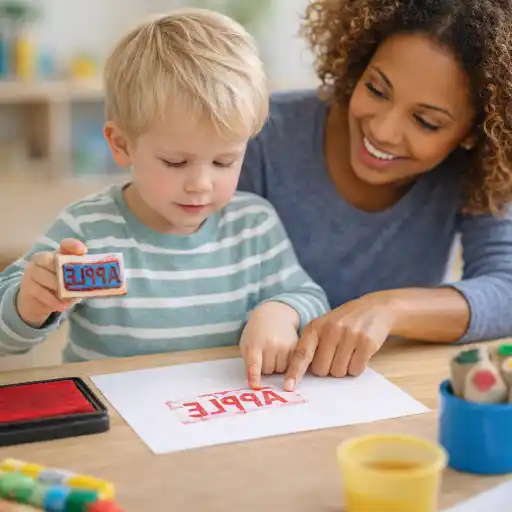
Children often expect a stamp to reproduce its design exactly as they see it. But a stamp transfers a design through contact: the raised or painted surface touches paper, and the result can appear reversed—especially when the image contains letters, numbers, or an obvious direction. That reversal is a natural feature of printing, not evidence that the child used the tool incorrectly.
Use a simple demonstration. Draw a large arrow or a simple letter on a sponge or block, then press it onto paper. Invite children to compare the stamp with the print. Depending on how the design was placed on the stamp and how it was pressed, the image may be reflected or oriented differently. With a solid shape, such as a circle, reversal is harder to notice; with an asymmetrical shape, it becomes visible.
This small discovery links art to observation and early scientific reasoning. Children make a prediction, perform an action, and inspect the outcome. Educators can describe the process without rushing to explain it: “You pressed the stamp down. What do you notice about the arrow?” That keeps curiosity at the center and supports #inquiry, #creativity, #observation, #language, and #problem-solving.
Why is reversal a valuable learning opportunity?
Printmaking gives children immediate, visible feedback. The connection between action and result is concrete: dip, press, lift, and look. When a print surprises a child, they have a reason to pause, compare, and test another approach. That moment can build persistence and flexible thinking—valuable habits in art and in everyday learning.
Reversal can also introduce early concepts such as orientation, symmetry, patterns, and cause and effect. Children might notice that a heart looks similar when turned, while an arrow points in a different direction. They can compare prints made from the same tool and discuss why some appear alike while others seem flipped or incomplete.
Just as importantly, open-ended printmaking lets children make choices. They can select tools, colors, pressure, and placement rather than aiming for identical results. The NAEYC creative arts resources include process-art perspectives that value children’s exploration and expression. In practice, an unexpected print is useful information: it invites another try, not correction or judgment.
How can providers set up a child-led stamp investigation?
A thoughtfully prepared station makes the exploration manageable without making every print predictable. Choose a few sturdy tools with distinct surfaces: large blocks, cardboard tubes, clean sponges, or broad leaves. Offer washable paint in shallow trays, large paper, and a small number of colors. Start with a limited selection, then add materials as children show interest.
- Show how to coat a stamp lightly, press it onto paper, and lift it straight up.
- Let children decide where to stamp and whether to repeat, rotate, or combine designs.
- Provide scrap paper for testing before children choose a larger sheet.
- Use open prompts: “What do you predict?” “What changed when you turned it?” “How could you make that mark again?”
- 🖍️ Keep a dry stamp or a clean block nearby so children can inspect its surface alongside the print.
Keep the experience process-focused. Avoid displaying a model that children are expected to copy; a brief demonstration of how to use materials is enough. For related classroom invitations, the Power of Art: Building Self-Esteem & Positive Behavior for All Abilities ONLINE Buy Now $24.00 course explores ways to use art experiences to support self-esteem and positive classroom practices.
How can you extend the discovery with questions and variations?
Follow children’s observations instead of turning the activity into a quiz. If a child says, “It’s backwards,” respond with interest: “You noticed the arrow points the other way. What could we try?” This acknowledges their idea and encourages them to test a possibility. Children may rotate a stamp, change pressure, use less paint, or choose a different tool.
Offer variations that deepen comparison while keeping the activity open-ended:
- Use two tools with different textures and compare the marks they leave.
- Print the same stamp in several orientations and look for what stays the same or changes.
- Try a simple letter or arrow with adult-prepared materials and ask children to compare the design to its print.
- Invite children to make repeating patterns, such as block–sponge–block, and describe the sequence.
- Explore symmetry with a shape that looks similar when flipped and one that does not.
Printmaking can also connect to literacy and mathematics through children’s own words, patterning, sorting, and comparing. Keep language descriptive and specific—“The lines are faint here,” or “This print has more paint”—rather than evaluating the artwork as good or bad. For fruit-and-vegetable printing, Scholastic’s stamping activity offers ideas for noticing natural patterns and symmetry; adults should handle cutting with sharp knives.
How can educators keep printmaking safe and inclusive?
Choose age-appropriate, washable materials and supervise children closely, especially when using small objects, natural materials, or anything that could be mouthed. Adults should cut produce or prepare materials that require sharp tools. Check that found objects are clean, intact, and large enough for the children using them; avoid items with sharp edges or loose parts that pose a choking risk.
Make participation accessible by offering tools in different sizes and shapes, securing paper to the table, or placing materials within easy reach. A child who does not want paint on their hands can use a handle or brush; a child who benefits from more time can observe first and join when ready. Provide options for pointing, describing, or showing what they notice.
Some common pitfalls are easy to avoid:
- Expecting a stamp and its print to look identical: explain that transfer can change orientation.
- Correcting a child’s “backward” print: treat it as evidence to explore, not an error.
- Offering too many materials at once: begin with a few purposeful choices.
- Focusing only on a finished product: document children’s predictions, attempts, and discoveries.
Plan for handwashing, paint cleanup, and safe storage. State requirements vary - check your state licensing agency.
Conclusion: How can a backward print become a meaningful discovery?
A backward stamp print offers children a hands-on way to explore how images transfer, how orientation changes, and how actions produce results. Providers can make the learning rich and manageable by setting out a few safe materials, inviting predictions, listening to children’s observations, and giving them time to try again. The goal is not to eliminate surprises; it is to help children use them as starting points for creative thinking.
Remember the central idea: a print may look reversed because an image transfers through contact, and noticing that difference is part of the learning. Celebrate children’s questions, document their strategies, and let the marks be their own. For professional learning that deepens your approach to open-ended art, consider Open Heart, Open Art Buy Now $16.00 and the CDA Subject Area 2 Buy Now $80.00 course.
References
- 12 Easy Printmaking Activities for Preschoolers
- Studio in a School: Stamping
- A Guide to Process Art for Preschool Classrooms
- Scholastic: How to Use Fruits & Veggies to Make Stamps
- NAEYC: Creative Arts
Recommended ChildCareEd Courses
- Open Heart, Open Art Buy Now $16.00
- CDA Subject Area 2 Buy Now $80.00
- Power of Art: Building Self-Esteem & Positive Behavior for All Abilities ONLINE Buy Now $24.00
- Art from the Heart for Preschoolers: Open Ended Art Projects that Build Self-Esteem Buy Now $35.00
- Montessori Cultural Activities: Exploring the World Through Play and Learning Buy Now $24.00
- Moving About the Classroom: Effective Transitions for Everyday
- You're Not My Friend Anymore: Learning Conflict Resolution
- CDA Home Visitor Subject Area 2 Part 3 Birth to 5
- Open Heart, Open Art
- Birth to Five CDA Credential with Portfolio Review
- CDA Bridge Bundle: Family Child Care without Portfolio Review
- Art from the Heart for Preschoolers: Open Ended Art Projects that Build Self-Esteem
- CDA Bridge Bundle: Infant/Toddler without Portfolio Review
- Texas Director Credential
- 10 Fine Motor Activities to Keep Tiny Hands Warm this Winter
- CDA Certification en Español: Recursos y Consejos para Educadores Bilingües
- 🌙 ¿Cómo afecta el tiempo frente a las pantallas el sueño y el comportamiento infantil? 😴
- 🌎 ¿Cómo apoyo a las familias diversas mientras honro su cultura y valores? 💜
- 👶 ¿Cuáles son las proporciones y grupos requeridos en Dakota del Norte? 🏫
- How to Celebrate April Fools’ Day in Child Care (Without Chaos!)
- Cómo Abrir Una Quardería En Casa Sin Dinero?
- Celebra El Cumpleaños de Dr. Seuss En Tu Guardería Con Actividades Fáciles y Divertidas!
- ¿Cómo puedo usar escenarios de juego de roles de primeros auxilios en mi aula?
- ¿Cómo puedo enseñar habilidades de primeros auxilios con escenarios de juego de roles?
- Actividades de Otoño Fáciles para Preescolares esta Temporada
- Consejos de Supervisión Activa para Salones de Preescolar y el Juego al Aire Libre
- Celebrando la amistad en el cuidado infantil durante el Día de los Mejores Amigos
- Cómo simplificar la capacitación para sus empleados de daycare
- How Can Short, Focused Practice Build Subtraction Fluency Within 10?
- How Can You Adapt Number Activities for Children with Cerebral Palsy?
- How Can a Pretend Toy Library Turn Play Into Meaningful Reading and Writing Practice?
- Why Does MOM Look the Same Backward? Exploring Reversible Letter Patterns
- Why Did My Stamp Print Backward? Discover Reversal Through Printmaking
- How Can November Classroom Observations Guide Developmentally Appropriate Activities?
