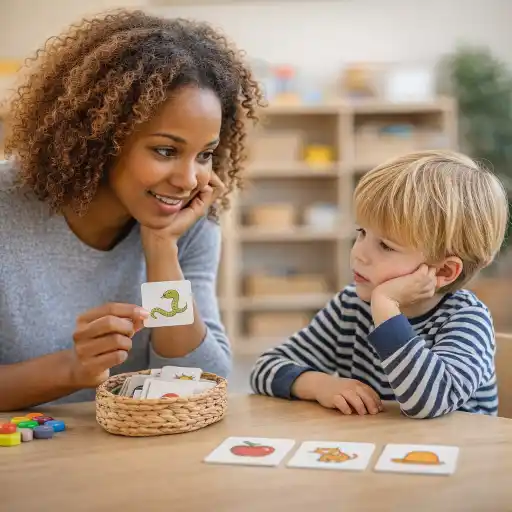
When a child says “moon” begins with /b/, their answer gives you a reason to look more closely at how they understood the task. With the Task Cards – Beginning Sounds Buy Now $2.49, start by asking the child to name the picture, then listen together for the first sound in the word they used. This can help you consider picture recognition, vocabulary, and the prompt itself before drawing conclusions from one response. For guidance on phonological awareness and responsive early literacy instruction, explore Science of Reading Foundations in the Pre-K Classroom Buy Now $16.00. Read on for ways to turn an unexpected answer into useful information for your next teaching step.
Why is an incorrect answer worth a closer look?
A wrong beginning-sound answer is one observation—not a verdict on a child’s ability or future reading. It can reveal which part of a task is challenging: naming the picture, hearing the whole word, focusing on its first sound, recalling a sound label, or explaining a response. When teachers look at the process rather than only the score, they can choose a more useful next step.
Beginning-sound awareness is one part of phonological awareness, the ability to notice and work with sound patterns in spoken language. It is related to, but distinct from, phonics, which explicitly connects speech sounds with letters. Head Start identifies awareness of smaller sound segments and letter-sound knowledge as related early literacy goals, while recognizing that children’s language experiences vary.
A single response can be affected by unfamiliar vocabulary, an unclear picture, fatigue, distraction, confidence, pronunciation, or the language in which the child is most comfortable. Treat the answer as information to investigate with warmth and curiosity. A calm, nonjudgmental exchange protects trust and gives the child room to show what they know.
What might the answer be telling you?
First, check whether the child knows the word. If a picture intended to show a “moon” is unfamiliar or interpreted as something else, the response may reflect naming rather than sound awareness. Ask, “What do you see?” before asking, “What sound starts that word?” Use a real object, a familiar photograph, or a shared label when the image is ambiguous.
Next, consider what the prompt actually asks. A child may be thinking about the letter name, the letter’s visual shape, or a sound elsewhere in the word. Keep the task oral at first: say the word naturally, invite the child to repeat it if helpful, and ask what they hear at the beginning. Do not assume that identifying a printed letter and identifying a spoken sound are the same skill.
Also consider language background and speech differences. Sounds and sound patterns vary across languages and dialects; a child learning English may not yet organize English sounds in the same way as a fluent English speaker. This is not, by itself, evidence of a problem. Respect the child’s home language, model the classroom word without shaming pronunciation, and ask families or bilingual colleagues about familiar vocabulary and language use.
- Notice whether the child understood and named the target word.
- Check whether the prompt, picture, and choices were clear.
- Consider attention, wait time, communication preferences, and language experience.
- Observe whether the child can match two words that begin alike, even if naming the sound is difficult.
How can you respond in the moment without turning it into a test?
Stay conversational. Rather than saying “No, that’s wrong,” repeat the word and model listening: “This is a moon. Listen to moon—mmmmoon. I hear /m/ at the beginning.” Then offer a comparison with a familiar word such as “milk.” Invite the child to listen again, point, gesture, or try another example. The goal is to make the sound noticeable, not to demand an immediate correct answer.
Use the smallest helpful cue. You might repeat the word, slow it slightly without distorting it, offer two familiar choices, or invite the child to feel the movement of the lips for a sound such as /m/. If the child still seems unsure, model and move on. A brief, positive experience is usually more useful than repeated quizzing.
Keep response options flexible. A child may point to a matching picture, sort objects, use a sign or communication device, or answer in a home language. These responses can provide meaningful evidence of listening even when spoken English is still developing. The ECE Resource Hub’s preschool phonological-awareness activities offer examples of sound questions and playful practice through stories and songs.
- 🗣️ Model the sound warmly, then give the child another chance without pressure.
- Use familiar names, classroom objects, songs, or pictures as examples.
- Allow extra wait time and accept pointing, sorting, gestures, or other communication.
- Keep the turn brief and return to play, reading, or conversation.
How can you learn more from observation over time?
Look for patterns across several low-pressure experiences rather than drawing a conclusion from one answer. Try different familiar words, settings, and response formats. A child who misses an isolated-sound question in a noisy group may demonstrate the skill during a quiet picture sort or in a conversation about a favorite book.
Record what happened descriptively. For example: “During a small-group game, the child named ‘sun’ independently and matched it with ‘sock’ after hearing both words repeated.” This note is more useful than “does not know /s/.” It identifies what the child did and what support helped, giving you a practical starting point for planning.
Separate related abilities in your notes where possible. Did the child recognize the picture? Repeat the word? Notice that two words began alike? Identify the first sound without choices? Connect the sound to a letter? These distinctions help avoid treating a multi-step task as a single skill. The Assessment of Language and Literacy Skills  Buy Now $24.00 course offers professional learning about objective observation and using assessment information to plan individualized instruction.
Use observations to adjust teaching, not to label a child. If results are inconsistent, simplify the task and gather more information. When concerns persist despite thoughtful instruction and opportunities to practice, follow program procedures and collaborate with the family and appropriate specialists. State requirements vary - check your state licensing agency.
What common misinterpretations should teachers avoid?
One incorrect answer should not be treated as proof of a learning disorder, lack of effort, or inability to learn. Preschool responses are shaped by many factors, and beginning-sound activities can require a child to manage vocabulary, listening, memory, and verbal expression at once.
Avoid confusing sound awareness with letter knowledge. If the goal is to hear the beginning sound, hide or set aside printed letters until the child has listened. Conversely, if the goal includes connecting a sound to a grapheme, state that clearly and observe the sound and letter responses separately. Avoid relying on unfamiliar illustrations, rapid-fire prompts, or public correction, all of which can obscure a child’s actual understanding.
- Do not infer a diagnosis or make a broad judgment from one response.
- Do not treat dialect, accent, or home-language influence as carelessness.
- Do not assume a child knows the word represented in a picture.
- Do not repeat the same quiz-like prompt when a model or a different support would help more.
- Do not record only “right” or “wrong”; note context, strategy, and support.
Instead, maintain a strengths-based stance: identify what the child can do, offer another opportunity, and plan a manageable next step. This approach combines professional attention with the reassurance children need to take risks in learning.
How can you plan the next learning opportunity?
Choose a small set of words the child knows well and make the listening goal clear. You might sort “sun,” “sock,” and “ball,” or compare two children’s names that start alike. Keep the group small enough for each child to hear the words, respond in an accessible way, and receive a gentle model. Revisit the same sounds through different, enjoyable routines rather than repeating an identical drill.
Build sound play into the day: notice alliteration during a read-aloud, sing a familiar rhyme, play “I Spy” with classroom objects, or invite children to find words that begin like their names. NAEYC highlights that planned activities and spontaneous word play can both support phonological awareness. For practical strategies across oral language, phonological awareness, print knowledge, and other emergent-literacy areas, consider Language and Literacy Foundations in Pre-K Buy Now $16.00.
Ready children can compare additional words or connect the sound with a letter; others may benefit from continuing with familiar words, gestures, and modeling. Do not require mastery of one broad sound-play skill before introducing another. Let observations guide the level of challenge, and make children’s languages, interests, and family knowledge part of the activity.
Conclusion: What can a wrong beginning-sound answer tell you? It can show where a child may need a clearer word, a more accessible prompt, more listening practice, or simply another opportunity. Check vocabulary and context, model the target sound without pressure, observe over time, and use what you learn to plan inclusive play. The response is a useful clue—not a final judgment—and your supportive teaching can help turn that clue into the next step in learning.
- Understanding Print Knowledge in Preschool
- Lesson Planning for Preschoolers
- Birth to Five CDA Credential with Portfolio Review
- CDA Bridge Bundle: Preschool
- CDA Bridge Bundle: Family Child Care without Portfolio Review
- CDA Bridge Bundle: Infant/Toddler without Portfolio Review
- CDA Bridge Bundle: Preschool without Portfolio Review
- Texas Director Credential
- Every Moment Matters: Schedules and Transitions
- 🚨 Reporte Obligatorio en Nevada
- Requisitos Para Ser Maestra Principal En Un Daycare: Lo Que Necesitas Para Empezar
- Color Without Vision: Fun Ways to Talk About Colors With Your Child
- Proporciones de Cuidado Infantil y Tamaños de Grupo por Edad en Maryland (Guía Rápida para Centros y Hogares)
- Cómo Trabajar en el Cuidado Infantil en Carolina del Norte: Requisitos y Pasos
- Cómo Ser Maestra de Preescolar en Illinois
- Cómo Ser Maestra de Preescolar en Wisconsin
- Cómo Ser Maestra de Preescolar en California
- Cómo Ser Maestra de Preescolar en Maryland
- Cómo Ser Maestra de Preescolar en Carolina del Norte
- Celebrando la amistad en el cuidado infantil durante el Día de los Mejores Amigos
- Get to Know You Activities for Preschool: 12 Easy First-Week Ideas
- STEM for Preschoolers: What to Do When the Experiment Doesn’t Work
- Why Are Self-Checking Clip Cards Great for Independent Practice?
- How Can Child Care Providers Move Children from Letter Recognition to Beginning-Sound Awareness?
- How Can Familiar Household Words Help Children Complete CVC Words?
- How Can Picture Task Cards Help You Assess Beginning Sounds?
- How Can Child Care Providers Preserve a Child’s Exact Words During Story Dictation?
- How Can Classroom Photo Sequences Help Children Tell What Happened?
- What Can a Wrong Beginning-Sound Answer Tell a Preschool Teacher?
