Ever handed a child a flashy, battery-powered toy only to watch them become more interested in the box? That moment highlights an important truth: simple, open-ended materials often support richer learning than single-purpose electronic toys. To help your program encourage deeper #play and improve classroom outcomes, explore The Best Promotion is Play Buy Now $35.00 and Play, Learn, Grow Buy Now $25.00. Both courses provide practical strategies educators can use to meet professional training needs and strengthen everyday classroom practice.
What exactly is an open-ended toy — and how is it different from battery-powered ones?
Open-ended toys are materials without a single prescribed outcome: blocks, fabric, loose parts, natural items and simple manipulatives invite multiple uses and endless variations. Battery-powered toys usually signal a single function—press a button, and the toy reacts. That immediate response can be entertaining, but it narrows exploration and externalizes the cause–effect work children would otherwise do themselves.
Choosing open-ended items encourages children to lead discovery: they test ideas, assign symbolic meaning, and invent social rules. This is the core of #openended learning: the child drives the activity, not the object. As part of Why Open-Ended Play Is Essential for Healthy Child Development, ChildCareEd explains how offering many-purpose materials supports decision-making and independence. In practice, that means swapping some single-use gadgets for loose parts, blocks, art materials, and props that support language, problem-solving, and social interaction.
How does open-ended play support cognitive, social, and motor development?
Open-ended play activates multiple developmental systems at once. Cognitively, children must plan, anticipate outcomes, and revise strategies when structures collapse — early engineering and reasoning in action. Socially, dramatic and cooperative play requires negotiation, role-taking, and empathy. Motorically, building, threading, pouring and arranging strengthen fine and gross motor skills.
Research on pretend play and loose parts shows links to theory of mind, language growth, and problem-solving (see Bergen’s synthesis on pretend play and cognition). ChildCareEd resources such as Beyond ABCs: Why 'Loose Parts' Play... describe practical outcomes: more extended talk, richer narratives, and repeated experimentation that underpins learning. Guided play — brief adult prompts that keep the child in control — also improves learning outcomes; Cambridge and other syntheses find guided play can be as effective as direct instruction for certain early skills. In short, open-ended materials give children cognitive practice that battery toys often short-circuit.
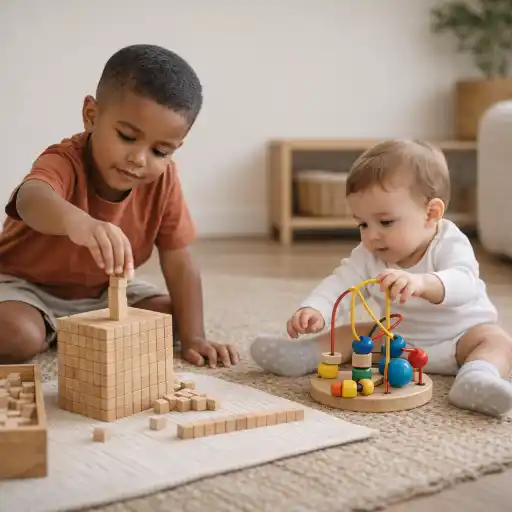
What materials and room setups favor open-ended play over electronic toys?
Designing the environment is as important as choosing materials. Low shelves, labeled bins, and clearly defined centers let children find and return materials independently. Keep choices limited per bin (rotate weekly) to avoid overwhelm: the magic of open-ended play is depth, not clutter.
- Essential zones: blocks/constructing, art/process art, sensory table, dramatic play, and loose-parts table.
- Good materials to keep on hand:
- Wooden blocks, magnetic tiles, cardboard tubes
- Fabric scraps, scarves, playsilks, baskets
- Natural loose parts: stones, shells, sticks (inspect for safety)
- Art basics: paper, tempera, collage bits, play dough
- Small-world figures and containers for sorting
- 😃 Rotate and provoke: add a single new loose part or a real-world prop (clean jar, plant, empty food container) to renew interest.
For infants and toddlers, remove choking hazards and use larger loose parts; for preschoolers, smaller bits support fine-motor growth. ChildCareEd’s loose-parts and materials guides (see How can I use Loose Parts Play... and What classroom materials best foster learning...) include age-based lists and safety checks. Remember: state requirements vary - check your state licensing agency for storage and material rules.
How can teachers guide learning without taking over a child’s invention?
The adult role shifts from director to scaffold: observe, listen, and add provocations. Use short, targeted moves that extend thinking without imposing a script. Techniques include: narrating what you notice, asking open invitations, and introducing a single challenge or new vocabulary when the child is ready.
- Observation script: "I notice you stacked the blue blocks high — what helps them stand up?"
- Open invitations: "You have these scarves and boxes — what could they be?"
- Mini-provocation: add a ramp, toy car, or basket and step back to see what changes.
Guided play — a brief adult prompt that preserves child control — has strong evidence as an effective bridge between free play and intentional teaching. For staff training and strategies to scaffold without directing, see ChildCareEd’s Role of Play and Play-based courses (for example, Role of Play in Learning  Buy Now $16.00 and Play with Purpose: Supporting Children with Autism Buy Now
 $55.00$40.00), which provide frameworks for building goals into playful interactions.
Do battery-powered toys actually interfere with learning — and how do I explain this to families and administrators?
Battery toys are not universally bad; some apps and devices can support learning when used intentionally and sparingly. The problem is when electronic toys become substitutes for child-driven exploration. Screens and single-function gadgets often remove the need to problem-solve, reduce conversational turns, and can shorten attention to open-ended tasks. OECD and other reviews raise caution about excessive digital engagement: it can displace physical, social, and imaginative activities that support wellbeing and learning.
Practical ways to make the case to families and directors:
- Share concrete examples: contrast a child building a bridge with blocks (predicting collapse, testing balance, learning spatial vocabulary) with a toy car that simply rolls when a button is pressed.
- Use observation data: photograph sequences of play, record child quotes, and link moments to learning goals (language, problem solving, cooperation).
- Offer alternatives: give families small home invitations (cardboard forts, sorting cups, homemade collage kits) so they can see open-ended play at work.
State research and practical commentary (see Nemours KidsHealth on age-appropriate toys and the New York Times piece on the developmental value of play) support sharing balanced messaging: electronics have a place, but much of early learning depends on active, multisensory, child-led exploration. The Yahoo News and academic work on loose parts remind us that low-cost, everyday items often produce the richest play and equitable learning opportunities.
Summary: What should I do tomorrow to favor open-ended toys and richer learning?
Three small, high-impact next steps:
- Remove or rotate out 1–2 single-function electronic toys and replace each with one open-ended bin (blocks, loose parts, or art provocation).
- Train staff in one scaffold move: observe, describe, then ask one open question. Consider ChildCareEd’s Play, Learn, Grow course (https://www.childcareed.com/courses-play-learn-grow.html Buy Now $25.00) or The Best Promotion is Play (https://www.childcareed.com/courses-the-best-promotion-is-play.html Buy Now $35.00) for practical coaching and documentation templates.
- Document and share one play story with families weekly — a photo, a child quote, and a short learning note. This builds understanding and buy-in.
Common mistakes to avoid: overfilling shelves (rotate materials instead), over-directing play (ask a question, don’t give steps), and assuming all digital toys are educational (context matters). If you want deeper practice designing invitations and documenting learning, ChildCareEd courses such as Open Heart, Open Art Buy Now $16.00 and Art from the Heart for Preschoolers Buy Now $35.00 offer concrete lesson plans and assessment ideas.
Why it matters: As a provider or director, you shape children’s everyday opportunities. Choosing open-ended materials over battery-driven, single-use toys supports deeper language, #creativity, collaboration, and problem solving — the foundations of long-term school readiness. Swap one toy for one bin, coach one staff move, and you’ll see how quickly children’s play turns into purposeful learning. For more structured training that also satisfies continuing-education needs, explore the linked ChildCareEd courses above. State requirements vary - check your state licensing agency.
- Birth to Five CDA Credential with Portfolio Review
- Using Toys to Support Learning
- 45 Hour School Age Methods and Materials
- CDA Bridge Bundle: Family Child Care without Portfolio Review
- Art from the Heart for Preschoolers: Open Ended Art Projects that Build Self-Esteem
- CDA Bridge Bundle: Infant/Toddler without Portfolio Review
- CDA Bridge Bundle: Preschool without Portfolio Review
- Creating Engaging and Meaningful Learning Experiences
- Every Moment Matters: Schedules and Transitions
- Ways to Serve: Leadership
- 🌙 ¿Cómo afecta el tiempo frente a las pantallas el sueño y el comportamiento infantil? 😴
- ¿Cómo puedo usar escenarios de juego de roles de primeros auxilios en mi aula?
- Capacitación en Salud y Seguridad Preventiva en Línea para Proveedores de Cuidado Infantil
- Cómo Solicitar una Licencia de Guardería en Texas
- Cómo Empezar una Guardería en Casa: Requisitos y Pasos
- ¿Cómo solicito la licencia para una guardería en California?
- Regulaciones de Cuidado Infantil en Maryland para Centros y Hogares de Cuidado Infantil Familiar
- Lista para Abrir una Guardería en Casa en Dakota del Norte: Cómo Empezar
- Lista para Guardería en Casa en California: Cómo Iniciar una Guardería en el Hogar
- Lista para Guardería en Casa en Texas: Cómo Iniciar una Guardería en el Hogar
- Capacitación Previa al Servicio para Proveedores de Cuidado Infantil en Dakota del Norte
- How can early childhood programs be ready for emergencies?
- Did Nevada’s 'Powered by Play' Conference Show Why Play-Based Learning Still Matters?
- Cómo simplificar la capacitación para sus empleados de daycare
- Why Do Open-Ended Toys Beat Battery-Powered Ones?
- How can I introduce the Festival of Lights to young children in respectful, developmentally appropriate ways?
- How Do You Test Whether a Toy Is Too Small? A Choking Hazard Size Guide by Age
- What Should You Check During a Daily Child Care Toy Inspection?
- How Can Child Care Programs Add Device-Charging Hazards to a Safety Walkthrough?
- What Should You Do When a Rechargeable Classroom Toy Is Damaged?
